Institute for Lung Health, Department of Infection, Immunity and Inflammation, University of Leicester, Leicester, UK.
PLoS One. 2013 Apr 19;8(4):e61579. doi: 10.1371/journal.pone.0061579. Print 2013.
Mast cells (MCs) play a central role in the development of many diseases including asthma and pulmonary fibrosis. Interactions of human lung mast cells (HLMCs) with human airway smooth muscle cells (HASMCs) are partially dependent on adhesion mediated by cell adhesion molecule-1 (CADM1), but the adhesion mechanism through which HLMCs interact with human lung fibroblasts (HLFs) is not known. CADM1 is expressed as several isoforms (SP4, SP1, SP6) in HLMCs, with SP4 dominant. These isoforms differentially regulate HLMC homotypic adhesion and survival.
In this study we have investigated the role of CADM1 isoforms in the adhesion of HLMCs and HMC-1 cells to primary HASMCs and HLFs.
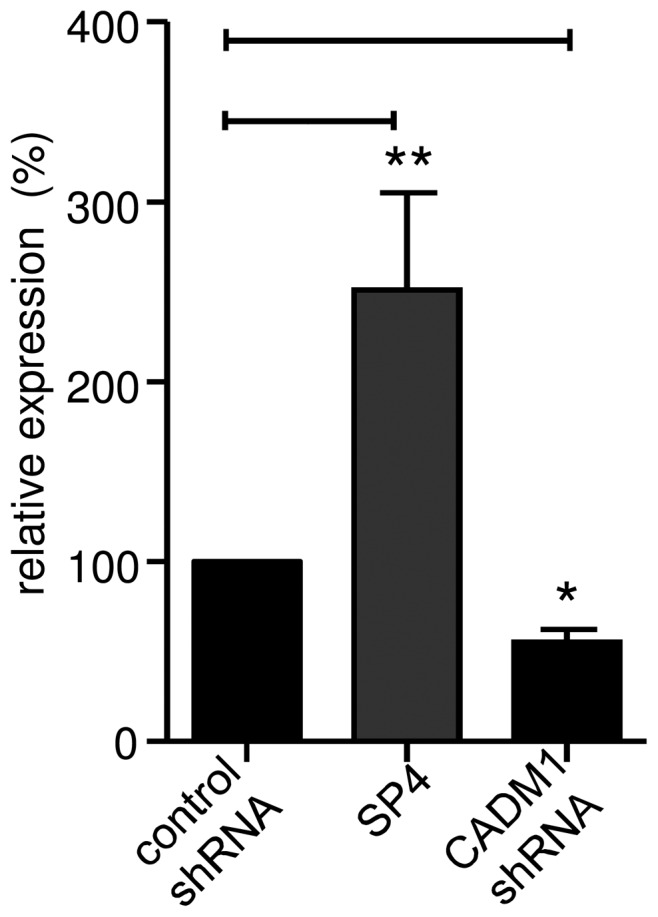
CADM1 overexpression or downregulation was achieved using adenoviral delivery of CADM1 short hairpin RNAs or isoform-specific cDNAs respectively.
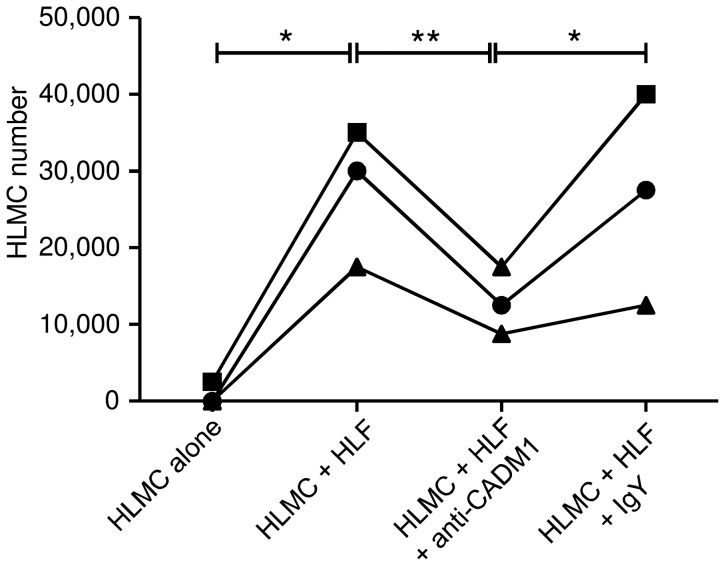
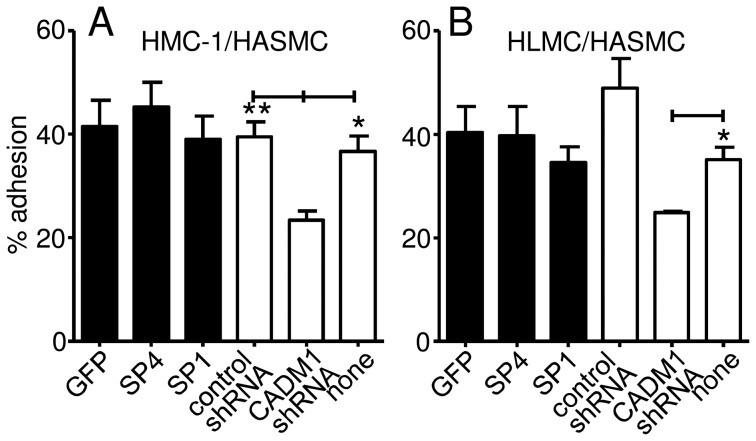
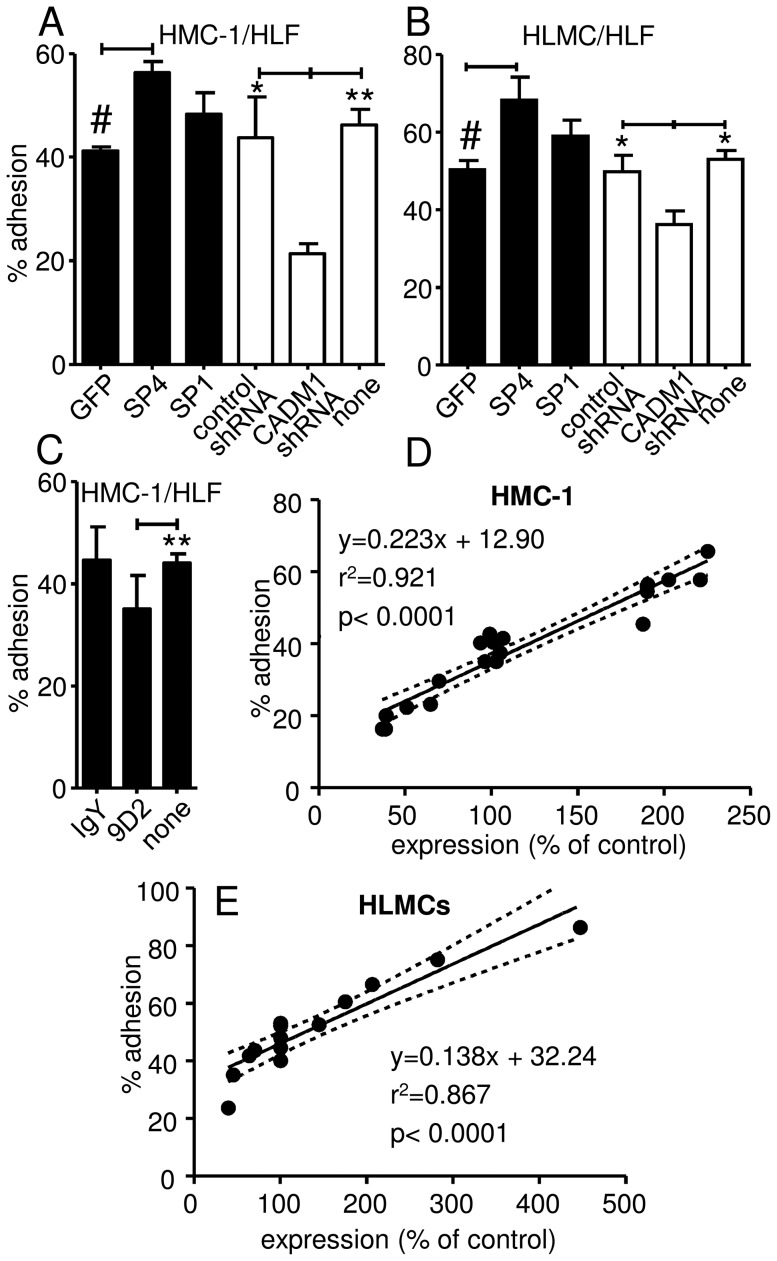
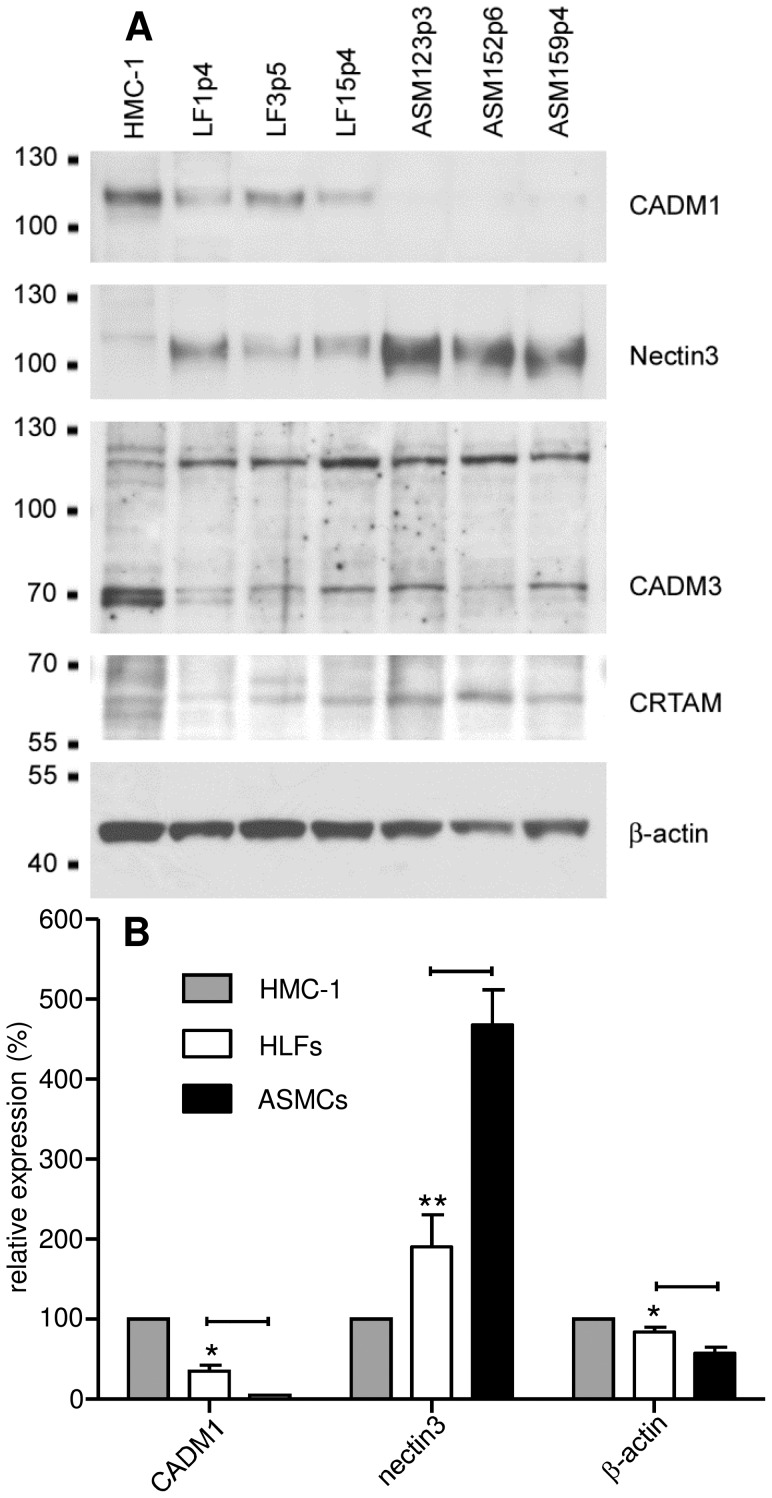
Downregulation of CADM1 attenuated both HLMC and HMC-1 adhesion to both primary HASMCs and HLFs. Overexpression of either SP1 or SP4 isoforms did not alter MC adhesion to HASMCs, whereas overexpression of SP4, but not SP1, significantly increased both HMC-1 cell and HLMC adhesion to HLFs. The expression level of CADM1 SP4 strongly predicted the extent of MC adhesion; linear regression indicated that CADM1 accounts for up to 67% and 32% of adhesion to HLFs for HMC-1 cells and HLMCs, respectively. HLFs supported HLMC proliferation and survival through a CADM1-dependent mechanism. With respect to CADM1 counter-receptor expression, HLFs expressed both CADM1 and nectin-3, whereas HASMCs expressed only nectin-3.
Collectively these data indicate that the CADM1 SP4 isoform is a key receptor mediating human MC adhesion to HASMCs and HLFs. The differential expression of CADM1 counter-receptors on HLFs compared to HASMCs may allow the specific targeting of either HLMC-HLF or HLMC-HASMC interactions in the lung parenchyma and airways.
肥大细胞(MCs)在许多疾病的发展中起着核心作用,包括哮喘和肺纤维化。人肺肥大细胞(HLMCs)与人气道平滑肌细胞(HASMCs)的相互作用部分依赖于细胞黏附分子-1(CADM1)介导的黏附,但 HLMCs 与人肺成纤维细胞(HLFs)相互作用的黏附机制尚不清楚。CADM1 在 HLMCs 中表达为几种异构体(SP4、SP1、SP6),其中 SP4 占优势。这些异构体差异调节 HLMC 同源黏附与存活。
在这项研究中,我们研究了 CADM1 异构体在 HLMCs 和 HMC-1 细胞与原代 HASMCs 和 HLFs 黏附中的作用。
通过腺病毒递送 CADM1 短发夹 RNA 或异构体特异性 cDNA 分别实现 CADM1 的过表达或下调。
CADM1 的下调减弱了 HLMC 和 HMC-1 对原代 HASMCs 和 HLFs 的黏附。SP1 或 SP4 异构体的过表达均未改变 MC 对 HASMCs 的黏附,而 SP4 的过表达而非 SP1 的过表达显著增加了 HMC-1 细胞和 HLMC 对 HLFs 的黏附。CADM1 SP4 的表达水平强烈预测 MC 黏附的程度;线性回归表明 CADM1 分别解释了 HMC-1 细胞和 HLMC 对 HLFs 黏附的 67%和 32%。HLFs 通过 CADM1 依赖的机制支持 HLMC 的增殖和存活。就 CADM1 拮抗受体的表达而言,HLFs 表达 CADM1 和 nectin-3,而 HASMCs 仅表达 nectin-3。
总的来说,这些数据表明 CADM1 SP4 异构体是介导人 MC 黏附到 HASMCs 和 HLFs 的关键受体。HLFs 上 CADM1 拮抗受体的表达与 HASMCs 相比存在差异,这可能允许在肺实质和气道中针对 HLMC-HLF 或 HLMC-HASMC 相互作用进行特异性靶向。