Department of Microbiology and Immunology, Albert Einstein College of Medicine Bronx, New York, NY 10461, USA.
Retrovirology. 2013 Apr 26;10:46. doi: 10.1186/1742-4690-10-46.
Expression of the cellular karyopherin TNPO3/transportin-SR2/Tnp3 is necessary for HIV-1 infection. Depletion of TNPO3 expression in mammalian cells inhibits HIV-1 infection after reverse transcription but prior to integration.
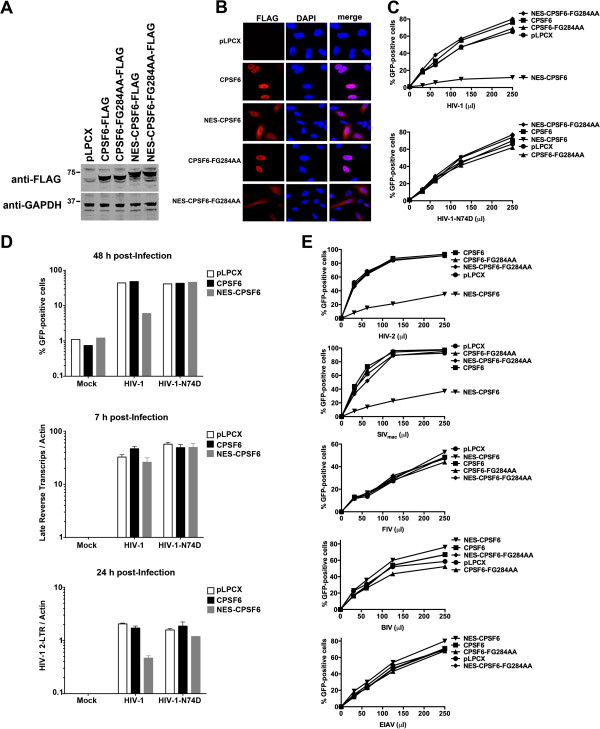
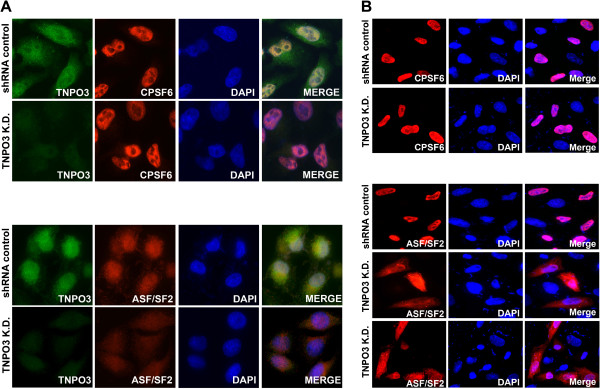
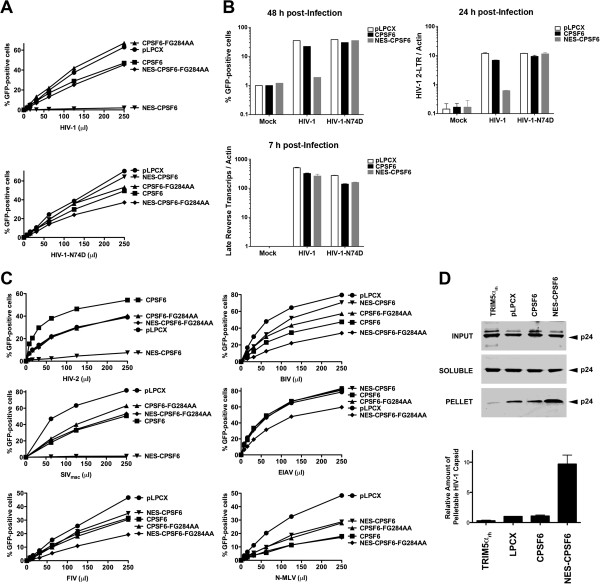
This work explores the role of cleavage and polyadenylation specificity factor subunit 6 (CPSF6) in the ability of TNPO3-depleted cells to inhibit HIV-1 infection. Our findings showed that depletion of TNPO3 expression inhibits HIV-1 infection, while the simultaneous depletion of TNPO3 and CPSF6 expression rescues HIV-1 infection. Several experiments to understand the rescue of infectivity by CPSF6 were performed. Our experiments revealed that the HIV-1 capsid binding ability of the endogenously expressed CPSF6 from TNPO3-depleted cells does not change when compared to CPSF6 from wild type cells. In agreement with our previous results, depletion of TNPO3 did not change the nuclear localization of CPSF6. Studies on the formation of 2-LRT circles during HIV-1 infection revealed that TNPO3-depleted cells are impaired in the integration process or exhibit a defect in the formation of 2-LTR circles. To understand whether the cytosolic fraction of CPSF6 is responsible for the inhibition of HIV-1 in TNPO3-depleted cells, we tested the ability of a cytosolic full-length CPSF6 to block HIV-1 infection. These results demonstrated that overexpression of a cytosolic full-length CPSF6 blocks HIV-1 infection at the nuclear import step. Fate of the capsid assays revealed that cytosolic expression of CPSF6 enhances stability of the HIV-1 core during infection.
These results suggested that inhibition of HIV-1 by TNPO3-depleted cells requires CPSF6.
细胞胞质核输入蛋白 TNPO3/transportin-SR2/Tnp3 的表达对于 HIV-1 感染是必需的。在哺乳动物细胞中 TNPO3 表达的耗竭会抑制逆转录后但整合前的 HIV-1 感染。
本工作探讨了切割和多聚腺苷酸化特异性因子亚基 6(CPSF6)在 TNPO3 耗竭细胞抑制 HIV-1 感染能力中的作用。我们的发现表明,TNPO3 表达的耗竭抑制 HIV-1 感染,而同时耗竭 TNPO3 和 CPSF6 的表达则挽救 HIV-1 感染。进行了几项了解 CPSF6 拯救感染性的实验。我们的实验表明,与野生型细胞中的 CPSF6 相比,从 TNPO3 耗竭细胞中内源性表达的 HIV-1 衣壳结合能力没有改变。与我们之前的结果一致,TNPO3 的耗竭并没有改变 CPSF6 的核定位。在 HIV-1 感染过程中形成 2-LRT 环的研究表明,TNPO3 耗竭细胞在整合过程中受损或在形成 2-LTR 环方面存在缺陷。为了了解 CPSF6 的细胞质部分是否负责 TNPO3 耗竭细胞中 HIV-1 的抑制作用,我们测试了细胞质全长 CPSF6 阻断 HIV-1 感染的能力。这些结果表明,细胞质全长 CPSF6 的过表达会在核输入步骤阻断 HIV-1 感染。衣壳命运测定表明,CPSF6 的细胞质表达在感染过程中增强了 HIV-1 核心的稳定性。
这些结果表明,TNPO3 耗竭细胞对 HIV-1 的抑制作用需要 CPSF6。