Department of Oncology, Georgetown University, Lombardi Comprehensive Cancer Center, Washington, DC, USA.
Cancer. 2013 Jul 15;119(14):2541-8. doi: 10.1002/cncr.28087. Epub 2013 Apr 26.
US breast cancer mortality is declining, but thousands of women still die each year.
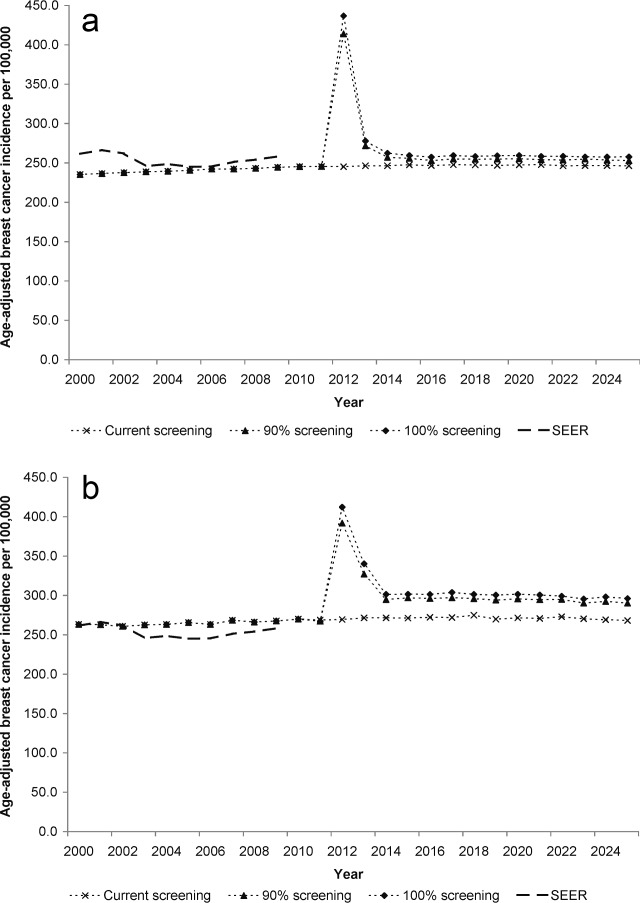
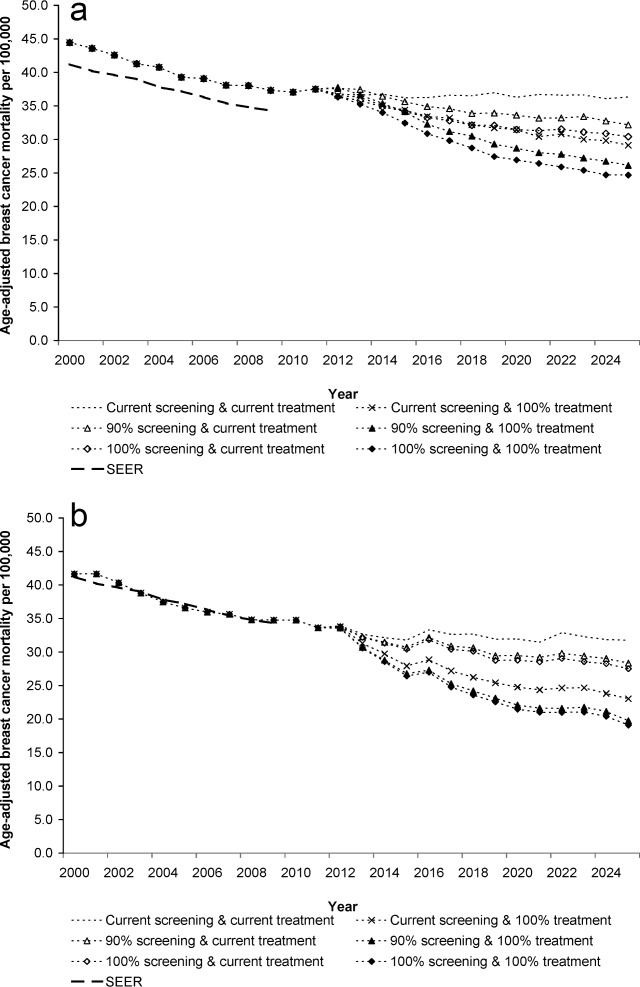
Two established simulation models examine 6 strategies that include increased screening and/or treatment or elimination of obesity versus continuation of current patterns. The models use common national data on incidence and obesity prevalence, competing causes of death, mammography characteristics, treatment effects, and survival/cure. Parameters are modified based on obesity (defined as BMI ≥ 30 kg/m(2) ). Outcomes are presented for the year 2025 among women aged 25+ and include numbers of cases, deaths, mammograms and false-positives; age-adjusted incidence and mortality; breast cancer mortality reduction and deaths averted; and probability of dying of breast cancer.
If current patterns continue, the models project that there would be about 50,100-57,400 (range across models) annual breast cancer deaths in 2025. If 90% of women were screened annually from ages 40 to 54 and biennially from ages 55 to 99 (or death), then 5100-6100 fewer deaths would occur versus current patterns, but incidence, mammograms, and false-positives would increase. If all women received the indicated systemic treatment (with no screening change), then 11,400-14,500 more deaths would be averted versus current patterns, but increased toxicity could occur. If 100% received screening plus indicated therapy, there would be 18,100-20,400 fewer deaths. Eliminating obesity yields 3300-5700 fewer breast cancer deaths versus continuation of current obesity levels.
Maximal reductions in breast cancer deaths could be achieved through optimizing treatment use, followed by increasing screening use and obesity prevention.
美国的乳腺癌死亡率正在下降,但每年仍有数千名女性死亡。
两个成熟的模拟模型研究了 6 种策略,包括增加筛查和/或治疗,或消除肥胖,与继续当前模式相比。这些模型使用了关于发病率和肥胖流行率、其他死因、乳房 X 线摄影特征、治疗效果和生存/治愈率的常见国家数据。根据肥胖情况(定义为 BMI≥30kg/m2)修改参数。研究结果针对 25 岁以上的女性,在 2025 年呈现病例数、死亡人数、乳房 X 光检查和假阳性数量;年龄调整后的发病率和死亡率;乳腺癌死亡率降低和死亡人数减少;以及死于乳腺癌的概率。
如果继续当前模式,模型预测 2025 年每年将有约 50100-57400 例(模型之间的范围)乳腺癌死亡。如果 90%的女性从 40 岁到 54 岁每年接受一次筛查,从 55 岁到 99 岁(或死亡)每两年接受一次筛查,那么与当前模式相比,将减少 5100-6100 人死亡,但发病率、乳房 X 光检查和假阳性率将会增加。如果所有女性都接受了指定的系统治疗(不改变筛查),与当前模式相比,将避免 11400-14500 人死亡,但可能会出现毒性增加的情况。如果 100%的人接受筛查加指定的治疗,将减少 18100-20400 人死亡。与继续当前肥胖水平相比,消除肥胖可使乳腺癌死亡人数减少 3300-5700 人。
通过优化治疗的使用,其次是增加筛查的使用和预防肥胖,可以实现乳腺癌死亡人数的最大减少。