Centre for Bone and Arthritis Research, Sahlgrenska Academy, University of Gothenburg, Vita Stråket 11, SE-413 45 Gothenburg, Sweden.
J Clin Endocrinol Metab. 2013 Jun;98(6):E1097-102. doi: 10.1210/jc.2012-3861. Epub 2013 Apr 30.
Immunoassay-based techniques, routinely used to measure serum estradiol (E2), are known to have reduced specificity, especially at lower concentrations, when compared with the gold standard technique of mass spectrometry (MS). Different measurement techniques may be responsible for the conflicting results of associations between serum E2 and clinical phenotypes in men.
Our objective was to compare immunoassay and MS measurements of E2 levels in men and evaluate associations with clinical phenotypes.
Middle-aged and older male subjects participating in the population-based Osteoporotic Fractures in Men (MrOS) Sweden study (n = 2599), MrOS US (n = 688), and the European Male Aging Study (n = 2908) were included.
Immunoassay and MS measurements of serum E2 were compared and related to bone mineral density (BMD; measured by dual energy x-ray absorptiometry) and ankle-brachial index.
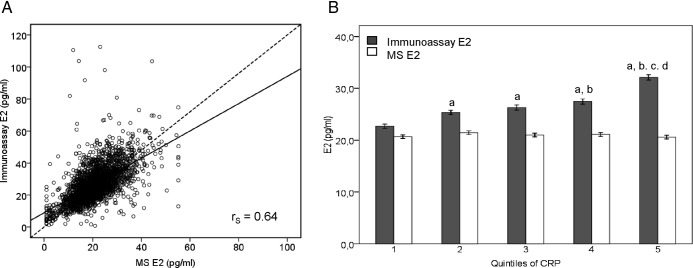
Within each cohort, serum E2 levels obtained by immunoassay and MS correlated moderately (Spearman rank correlation coefficient rS 0.53-0.76). Serum C-reactive protein (CRP) levels associated significantly (albeit to a low extent, rS = 0.29) with immunoassay E2 but not with MS E2 levels. Similar associations of immunoassay E2 and MS E2 were seen with lumbar spine and total hip BMD, independent of serum CRP. However, immunoassay E2, but not MS E2, associated inversely with ankle-brachial index, and this correlation was lost after adjustment for CRP.
Our findings suggest interference in the immunoassay E2 analyses, possibly by CRP or a CRP-associated factor. Although associations with BMD remain unaffected, this might imply for a reevaluation of previous association studies between immunoassay E2 levels and inflammation-related outcomes.
与质谱(MS)的金标准技术相比,基于免疫测定的技术常用于测量血清雌二醇(E2),但众所周知,其特异性较低,尤其是在浓度较低时。不同的测量技术可能是导致男性血清 E2 与临床表型之间关联的结果相互矛盾的原因。
我们的目的是比较男性中 E2 水平的免疫测定和 MS 测量,并评估与临床表型的关联。
参与基于人群的男性骨质疏松症(MrOS)瑞典研究(n = 2599)、MrOS 美国(n = 688)和欧洲男性衰老研究(n = 2908)的中年和老年男性受试者被纳入研究。
比较血清 E2 的免疫测定和 MS 测量,并与骨密度(通过双能 X 射线吸收法测量)和踝臂指数相关。
在每个队列中,免疫测定和 MS 获得的血清 E2 水平中度相关(Spearman 秩相关系数 rS 0.53-0.76)。血清 C 反应蛋白(CRP)水平与免疫测定 E2 显著相关(尽管相关性较低,rS = 0.29),但与 MS E2 水平无关。免疫测定 E2 和 MS E2 与腰椎和全髋骨密度的相似关联独立于血清 CRP。然而,免疫测定 E2 与踝臂指数呈负相关,但 MS E2 与踝臂指数无关,且在调整 CRP 后,这种相关性消失。
我们的发现表明免疫测定 E2 分析可能受到 CRP 或 CRP 相关因素的干扰。尽管与 BMD 的关联不受影响,但这可能意味着需要重新评估之前免疫测定 E2 水平与炎症相关结局之间的关联研究。