Vandenput Liesbeth, Mellström Dan, Laughlin Gail A, Cawthon Peggy M, Cauley Jane A, Hoffman Andrew R, Karlsson Magnus K, Rosengren Björn E, Ljunggren Östen, Nethander Maria, Eriksson Anna L, Lorentzon Mattias, Leung Jason, Kwok Timothy, Orwoll Eric S, Ohlsson Claes
Centre for Bone and Arthritis Research, Department of Internal Medicine and Clinical Nutrition, Institute of Medicine, Sahlgrenska Academy, University of Gothenburg, Gothenburg, Sweden.
Geriatric Medicine, Institute of Medicine, Sahlgrenska Academy, University of Gothenburg, Gothenburg, Sweden.
J Bone Miner Res. 2017 Jun;32(6):1174-1181. doi: 10.1002/jbmr.3088. Epub 2017 Feb 27.
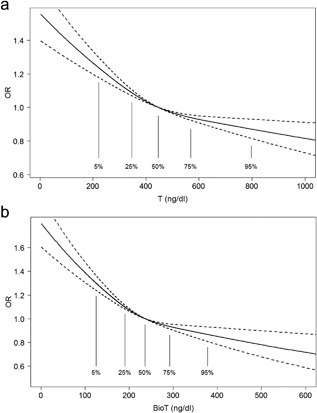
Fracture risk is determined by bone strength and the risk of falls. The relationship between serum sex steroids and bone strength parameters in men is well known, whereas the predictive value of sex steroids for falls is less studied. The aim of this study was to assess the associations between serum testosterone (T) and estradiol (E2) and the likelihood of falls. Older men (aged ≥65 years) from the United States (n = 1919), Sweden (n = 2495), and Hong Kong (n = 1469) participating in the Osteoporotic Fractures in Men Study had baseline T and E2 analyzed by mass spectrometry. Bioavailable (Bio) levels were calculated using mass action equations. Incident falls were ascertained every 4 months during a mean follow-up of 5.7 years. Associations between sex steroids and falls were estimated by generalized estimating equations. Fall rate was highest in the US and lowest in Hong Kong (US 0.50, Sweden 0.31, Hong Kong 0.12 fall reports/person/year). In the combined cohort of 5883 men, total T (odds ratio [OR] per SD increase = 0.88, 95% confidence interval [CI] 0.86-0.91) and BioT (OR = 0.86, 95% CI 0.83-0.88) were associated with incident falls in models adjusted for age and prevalent falls. These associations were only slightly attenuated after simultaneous adjustment for physical performance variables (total T: OR = 0.94, 95% CI 0.91-0.96; BioT: OR = 0.91, 95% CI 0.89-0.94). E2, BioE2, and sex hormone-binding globulin (SHBG) were not significantly associated with falls. Analyses in the individual cohorts showed that both total T and BioT were associated with falls in MrOS US and Sweden. No association was found in MrOS Hong Kong, and this may be attributable to environmental factors rather than ethnic differences because total T and BioT predicted falls in MrOS US Asians. In conclusion, low total T and BioT levels, but not E2 or SHBG, are associated with increased falls in older men. © 2017 American Society for Bone and Mineral Research.
骨折风险由骨强度和跌倒风险决定。血清性激素与男性骨强度参数之间的关系已为人熟知,而性激素对跌倒的预测价值则较少被研究。本研究的目的是评估血清睾酮(T)和雌二醇(E2)与跌倒可能性之间的关联。参与男性骨质疏松性骨折研究的来自美国(n = 1919)、瑞典(n = 2495)和中国香港(n = 1469)的老年男性(年龄≥65岁),其基线T和E2通过质谱法进行分析。使用质量作用方程计算生物可利用(Bio)水平。在平均5.7年的随访期间,每4个月确定一次跌倒事件。通过广义估计方程评估性激素与跌倒之间的关联。跌倒发生率在美国最高,在中国香港最低(美国为0.50,瑞典为0.31,中国香港为0.12次跌倒报告/人/年)。在5883名男性的合并队列中,在调整年龄和既往跌倒情况的模型中,总T(每标准差增加的比值比[OR]=0.88,95%置信区间[CI] 0.86 - 0.91)和BioT(OR = 0.86,95% CI 0.83 - 0.88)与跌倒事件相关。在同时调整身体性能变量后,这些关联仅略有减弱(总T:OR = 0.94,95% CI 0.91 - 0.96;BioT:OR = 0.91,95% CI 0.89 - 0.94)。E2、BioE2和性激素结合球蛋白(SHBG)与跌倒无显著关联。在各个队列中的分析表明,总T和BioT在美国男性骨质疏松性骨折研究(MrOS)美国和瑞典队列中均与跌倒相关。在中国香港MrOS队列中未发现关联,这可能归因于环境因素而非种族差异,因为总T和BioT可预测美国亚洲人MrOS队列中的跌倒情况。总之,低总T和BioT水平而非E2或SHBG水平与老年男性跌倒增加相关。© 2017美国骨与矿物质研究学会。