Neuroprotection Research Laboratory, Departments of Neurology and Radiology, Massachusetts General Hospital, Charlestown, MA 02129, USA.
Oxid Med Cell Longev. 2013;2013:756989. doi: 10.1155/2013/756989. Epub 2013 Mar 24.
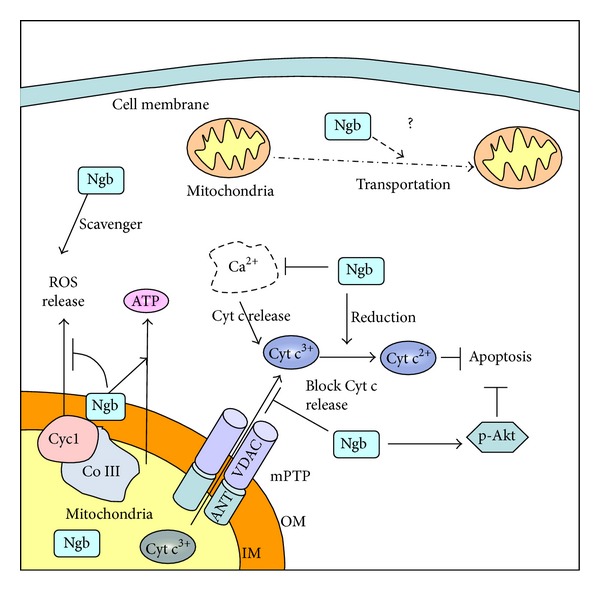
Neuroglobin (Ngb) is an oxygen-binding globin protein that has been demonstrated to be neuroprotective against stroke and related neurological disorders. However, the underlying mechanisms of Ngb's neuroprotection remain largely undefined. Mitochondria play critical roles in multiple physiological pathways including cell respiration, energy production, free radical generation, and cellular homeostasis and apoptosis. Mitochondrial dysfunction is widely involved in the pathogenesis of stroke and neurodegenerative diseases including Alzheimer's, Parkinson's, and Huntington's diseases. Accumulating evidence showed that elevated Ngb level is associated with preserved mitochondrial function, suggesting that Ngb may play neuroprotective roles through mitochondria-mediated pathways. In this paper we briefly discuss the mitochondria-related mechanisms in Ngb's neuroprotection, especially those involved in ATP production, ROS generation and scavenging, and mitochondria-mediated cell death signaling pathways.
神经球蛋白(Ngb)是一种氧结合球蛋白,已被证明对中风和相关神经紊乱具有神经保护作用。然而,Ngb 的神经保护作用的潜在机制在很大程度上仍未得到明确。线粒体在包括细胞呼吸、能量产生、自由基生成以及细胞内稳态和细胞凋亡在内的多种生理途径中发挥关键作用。线粒体功能障碍广泛参与中风和神经退行性疾病(包括阿尔茨海默病、帕金森病和亨廷顿病)的发病机制。越来越多的证据表明,升高的 Ngb 水平与线粒体功能的保存有关,这表明 Ngb 可能通过线粒体介导的途径发挥神经保护作用。本文简要讨论了 Ngb 神经保护中的线粒体相关机制,特别是涉及 ATP 产生、ROS 生成和清除以及线粒体介导的细胞死亡信号通路的机制。