Instituto Superior de Investigaciones Biológicas (Concejo Nacional de Investigación Científica y Técnica-Universidad Nacional de Tucumán) and Instituto de Química Biológica Dr, Bernabe Bloj, Chacabuco 461, San Miguel de Tucumán 4000 Tucumán, Argentina.
BMC Microbiol. 2013 May 1;13:95. doi: 10.1186/1471-2180-13-95.
Microcin J25 (MccJ25) is a plasmid-encoded antibiotic peptide produced by Escherichia coli (E. coli). MccJ25 enters into the sensitive E. coli strains by the outer membrane receptor FhuA and the inner membrane proteins TonB, ExbB, ExbD and SbmA. The resistance of Salmonella enterica serovar Typhimurium (S. Typhimurium) to MccJ25 is attributed to the inability of its FhuA protein to incorporate the antibiotic into the cell.
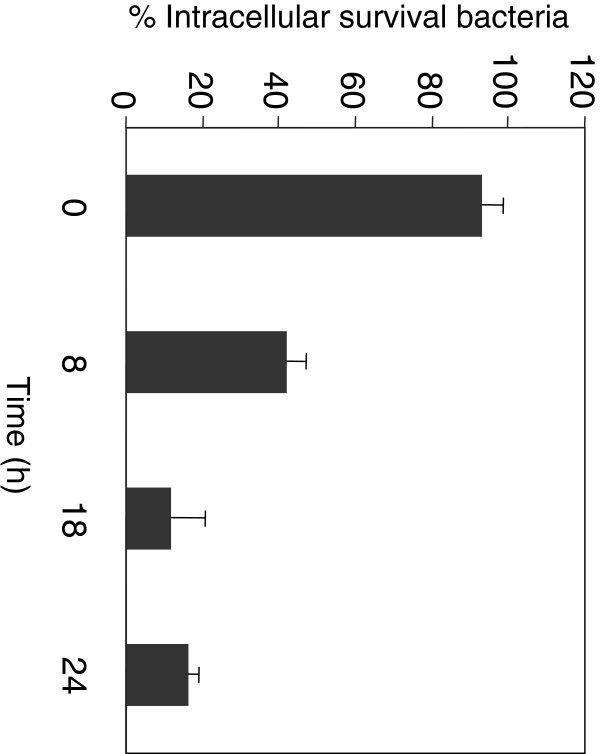
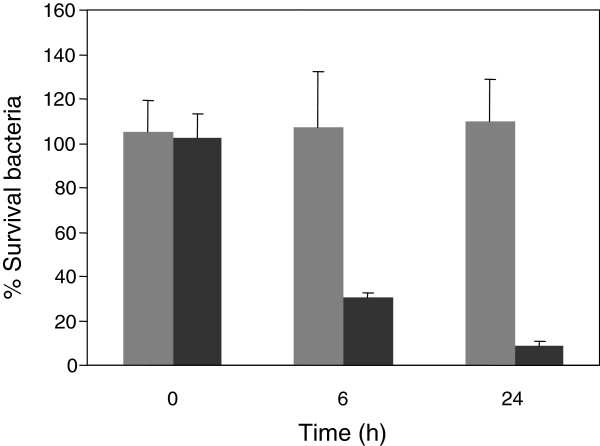
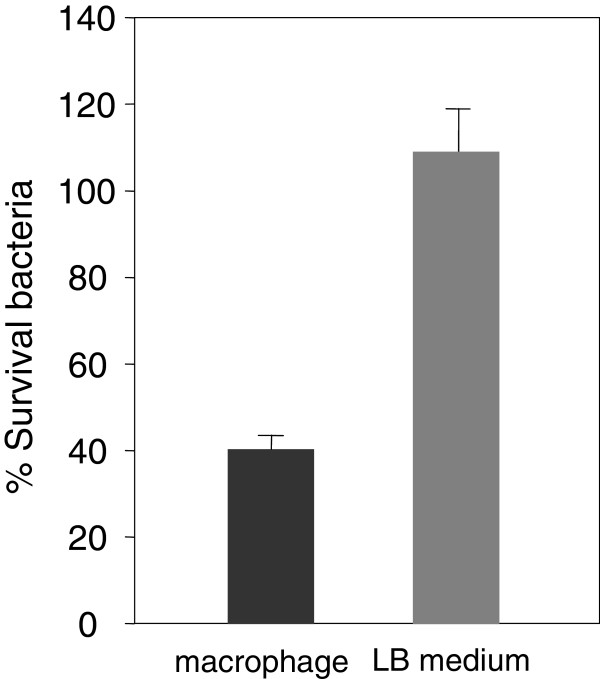
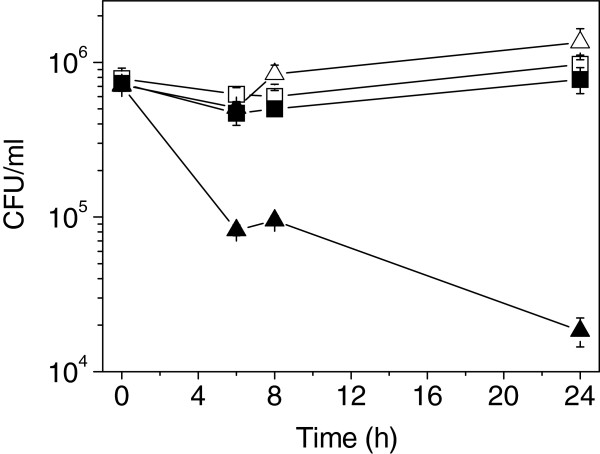
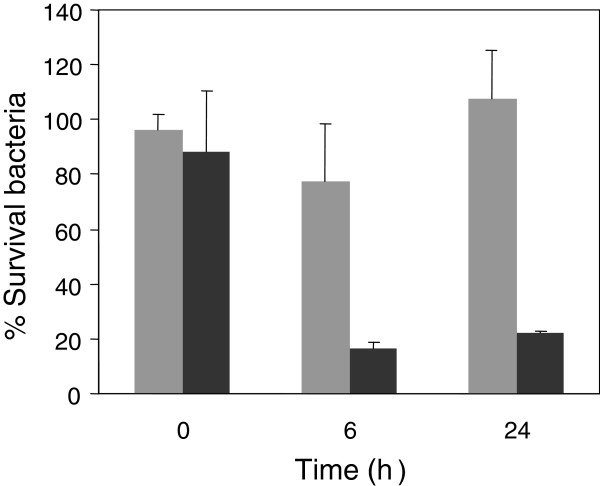
In this work we demonstrate that S. Typhimurium becomes notably susceptible to MccJ25 when replicating within macrophages. In order to determine the possible cause of this phenomenon, we studied the sensitivity of S. Typhimurium to MccJ25 at conditions resembling those of the internal macrophage environment, such as low pH, low magnesium and iron deprivation. We observed that the strain was only sensitive to the antibiotic at low pH, leading us to attribute the bacterial sensitization to this condition. A MccJ25-resistant E. coli strain in which fhuA is deleted was also inhibited by the antibiotic at low pH. Then, we could assume that the MccJ25 sensitivity change observed in both E. coli fhuA and S. Typhimurium is mediated by a MccJ25 uptake independent of the FhuA receptor. Moreover, low pH incubation also sensitized S. Typhimurium to the hydrophobic antibiotic novobiocin, which does not affect enteric bacteria viability because it is unable to penetrate the bacterial outer membrane. This observation supports our hypothesis about low pH producing a modification in the bacterial membrane permeability that allows an unspecific MccJ25 uptake. On the other hand, MccJ25 inhibited S. Typhimurium when cells were preincubated in acidic pH medium and then treated at neutral pH with the antibiotic.
Our results suggest that acidic condition does not alter MccJ25 hydrophobicity but irreversibly modifies bacterial membrane permeability. This would allow an unspecific antibiotic uptake into the cell.From our data it is possible to infer that intracellular pathogenic strains, which are in vitro resistant to MccJ25, could become susceptible ones in vivo. Therefore, the MccJ25 action spectrum would be broader than what in vitro experiments indicate.
微菌素 J25(MccJ25)是一种由大肠杆菌(E. coli)产生的质粒编码抗生素肽。MccJ25 通过外膜受体 FhuA 和内膜蛋白 TonB、ExbB、ExbD 和 SbmA 进入敏感的大肠杆菌菌株。鼠伤寒沙门氏菌(S. Typhimurium)对 MccJ25 的耐药性归因于其 FhuA 蛋白无法将抗生素纳入细胞。
在这项工作中,我们证明了当沙门氏菌在巨噬细胞内复制时,它对 MccJ25 明显敏感。为了确定这种现象的可能原因,我们研究了 S. Typhimurium 在类似于巨噬细胞内环境的条件下对 MccJ25 的敏感性,例如低 pH 值、低镁和缺铁。我们观察到该菌株仅在低 pH 值下对该抗生素敏感,这导致我们将细菌的敏感性归因于这种情况。在低 pH 值下,缺失 fhuA 的 MccJ25 抗性大肠杆菌菌株也被该抗生素抑制。然后,我们可以假设在大肠杆菌 fhuA 和 S. Typhimurium 中观察到的 MccJ25 敏感性变化是由一种不依赖 FhuA 受体的 MccJ25 摄取介导的。此外,低 pH 值孵育也使鼠伤寒沙门氏菌对疏水性抗生素新生霉素敏感,新生霉素由于无法穿透细菌外膜,因此不会影响肠道细菌的活力。这一观察结果支持了我们关于低 pH 值产生细菌膜通透性变化的假设,这种变化允许非特异性的 MccJ25 摄取。另一方面,当细胞在酸性 pH 介质中预孵育然后在中性 pH 值下用抗生素处理时,MccJ25 抑制了鼠伤寒沙门氏菌。
我们的结果表明,酸性条件不会改变 MccJ25 的疏水性,但会不可逆地改变细菌膜的通透性。这将允许抗生素非特异性地进入细胞。根据我们的数据,可以推断出在体外对 MccJ25 耐药的细胞内致病性菌株在体内可能变得敏感。因此,MccJ25 的作用光谱将比体外实验所表明的更广泛。