Department of Pharmacy, University of Washington, Seattle, Washington (JJC, RT, JR, JG, DLV)
SWOG and University of Michigan Medical School, Ann Arbor, Michigan (NLH, LB)
Med Decis Making. 2013 May;33(4):463-71. doi: 10.1177/0272989X13484388.
The objective of this study was to evaluate the feasibility and outcomes of incorporating value-of-information (VOI) analysis into a stakeholder-driven research prioritization process in a US-based setting.
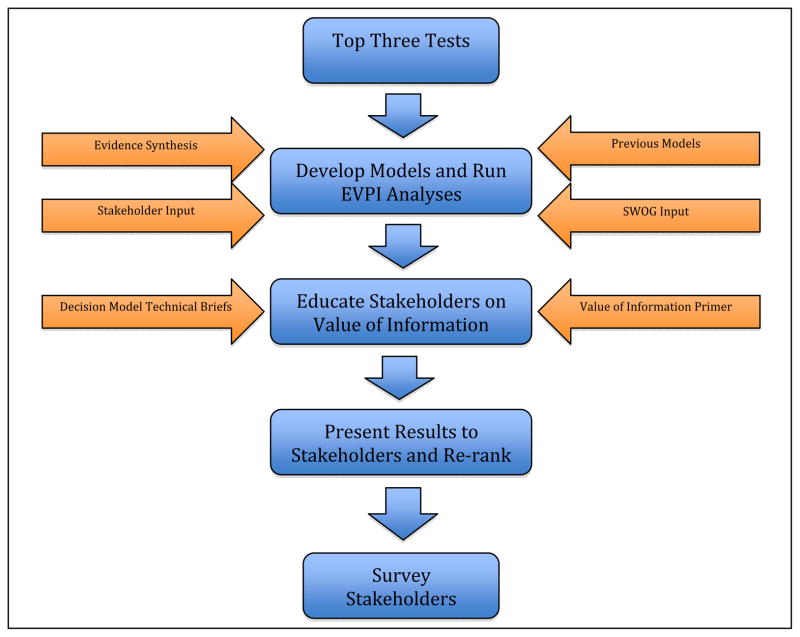
. Within a program to prioritize comparative effectiveness research areas in cancer genomics, over a period of 7 months, we developed decision-analytic models and calculated upper-bound VOI estimates for 3 previously selected genomic tests. Thirteen stakeholders representing patient advocates, payers, test developers, regulators, policy makers, and community-based oncologists ranked the tests before and after receiving VOI results. The stakeholders were surveyed about the usefulness and impact of the VOI findings.
The estimated upper-bound VOI ranged from $33 million to $2.8 billion for the 3 research areas. Seven stakeholders indicated the results modified their rankings, 9 stated VOI data were useful, and all indicated they would support its use in future prioritization processes. Some stakeholders indicated expected value of sampled information might be the preferred choice when evaluating specific
Limitations. Our study was limited by the size and the potential for selection bias in the composition of the external stakeholder group, lack of a randomized design to assess effect of VOI data on rankings, and the use of expected value of perfect information v. expected value of sample information methods.
Value of information analyses may have a meaningful role in research topic prioritization for comparative effectiveness research in the United States, particularly when large differences in VOI across topic areas are identified. Additional research is needed to facilitate the use of more complex value of information analyses in this setting.
本研究旨在评估在美国基于利益相关者的研究优先级制定过程中纳入信息价值(VOI)分析的可行性和结果。
在癌症基因组学中优先考虑比较有效性研究领域的计划中,在 7 个月的时间内,我们开发了决策分析模型,并计算了之前选择的 3 项基因组测试的上限 VOI 估计值。代表患者权益倡导者、支付方、测试开发者、监管机构、政策制定者和社区肿瘤学家的 13 名利益相关者在收到 VOI 结果之前和之后对这些测试进行了排名。利益相关者被调查了 VOI 结果的有用性和影响。
这 3 个研究领域的估计上限 VOI 从 3300 万美元到 28 亿美元不等。7 名利益相关者表示结果改变了他们的排名,9 名表示 VOI 数据有用,所有人都表示他们将支持在未来的优先级制定过程中使用它。一些利益相关者表示,在评估特定研究时,可能会选择采样信息的预期价值作为首选。
局限性。我们的研究受到外部利益相关者群体组成的规模和潜在选择偏差的限制,缺乏随机设计来评估 VOI 数据对排名的影响,以及使用完美信息的预期价值与采样信息方法的预期价值的限制。
信息价值分析可能在美国的比较有效性研究主题优先级制定中具有重要作用,特别是当在不同主题领域中发现 VOI 存在较大差异时。需要进一步研究以促进在这种情况下使用更复杂的信息价值分析。