Center for Health and Community, University of California, San Francisco, San Francisco, California, USA.
Diabetes Care. 2013 Sep;36(9):2697-705. doi: 10.2337/dc12-2190. Epub 2013 May 1.
It is unknown whether any association between neighborhood food environment and obesity varies according to individual income and/or race/ethnicity. The objectives of this study were to test whether there was an association between food environments and obesity among adults with diabetes and whether this relationship differed according to individual income or race/ethnicity.
Subjects (n = 16,057) were participants in the Diabetes Study of Northern California survey. Kernel density estimation was used to create a food environment score for each individual's residence address that reflected the mix of healthful and unhealthful food vendors nearby. Logistic regression models estimated the association between the modeled food environment and obesity, controlling for confounders, and testing for interactions between food environment and race/ethnicity and income.
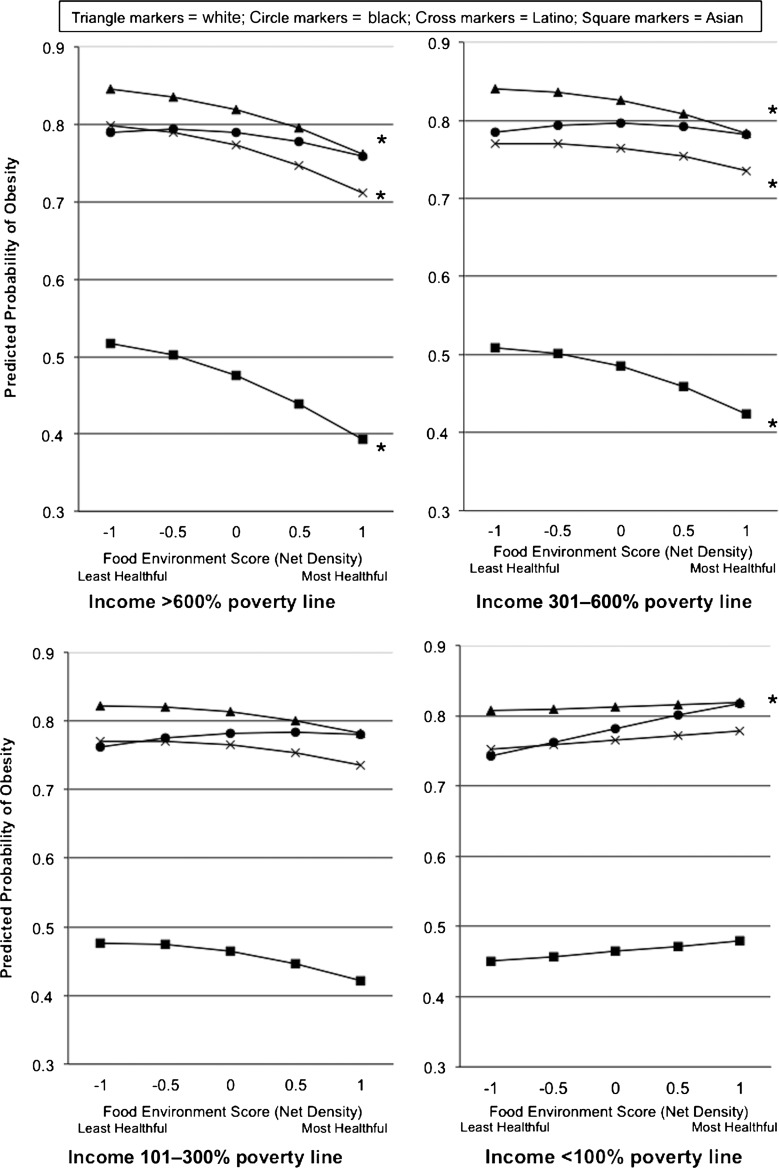
The authors found that more healthful food environments were associated with lower obesity in the highest income groups (incomes 301-600% and >600% of U.S. poverty line) among whites, Latinos, and Asians. The association was negative, but smaller and not statistically significant, among high-income blacks. On the contrary, a more healthful food environment was associated with higher obesity among participants in the lowest-income group (<100% poverty threshold), which was statistically significant for black participants in this income category.
These findings suggest that the availability of healthful food environments may have different health implications when financial resources are severely constrained.
目前尚不清楚邻里食物环境与肥胖之间的任何关联是否因个人收入和/或种族/民族而异。本研究的目的是检验糖尿病患者的食物环境与肥胖之间是否存在关联,以及这种关系是否因个人收入或种族/民族而异。
研究对象(n=16057)为北加州糖尿病研究调查的参与者。核密度估计用于为每个个体的居住地址创建一个食物环境分数,反映附近健康和不健康食物供应商的混合情况。使用逻辑回归模型估计模型化的食物环境与肥胖之间的关联,控制混杂因素,并检验食物环境与种族/民族和收入之间的交互作用。
作者发现,在白人、拉丁裔和亚裔中,收入较高(收入为美国贫困线的 301%-600%和>600%)的人群中,更健康的食物环境与较低的肥胖率相关。这种关联在高收入黑人中是负的,但较小且不具有统计学意义。相反,在收入最低的人群(<100%贫困线)中,更健康的食物环境与更高的肥胖率相关,这在这一收入类别的黑人参与者中具有统计学意义。
这些发现表明,在财政资源严重受限的情况下,健康食物环境的可获得性可能对健康有不同的影响。