Department of Speech, Hearing and Phonetic Sciences, Division of Psychology and Language Sciences, University College London, London, United Kingdom.
PLoS One. 2013 Apr 24;8(4):e62397. doi: 10.1371/journal.pone.0062397. Print 2013.
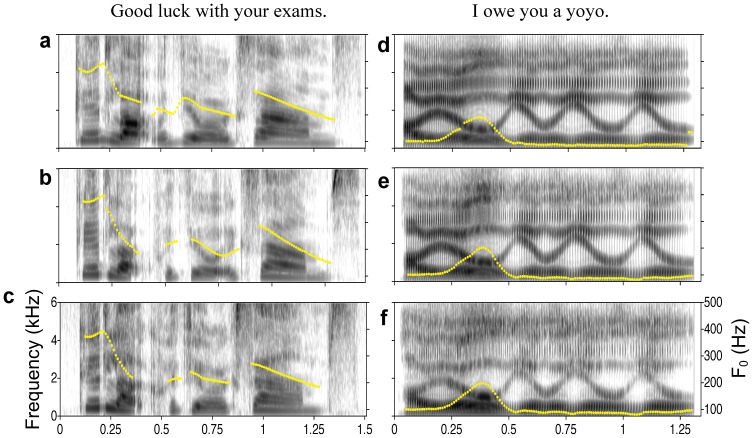
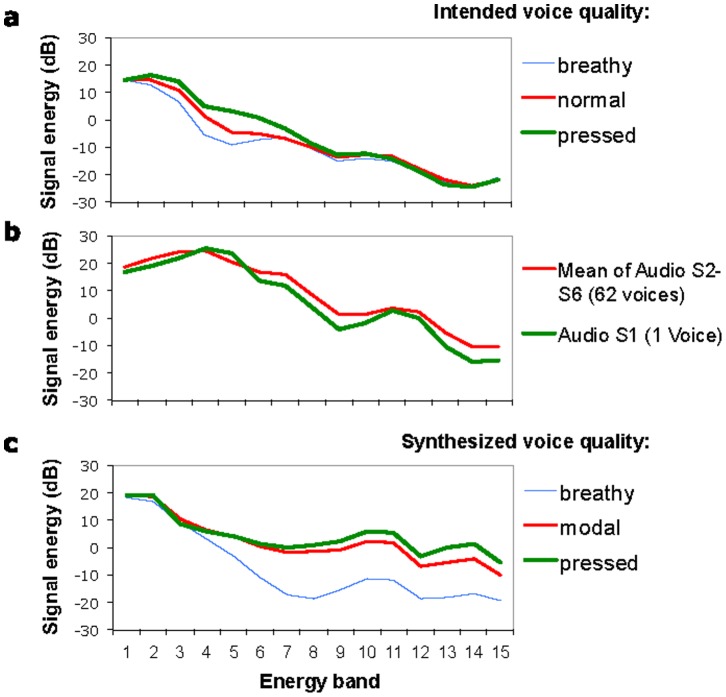
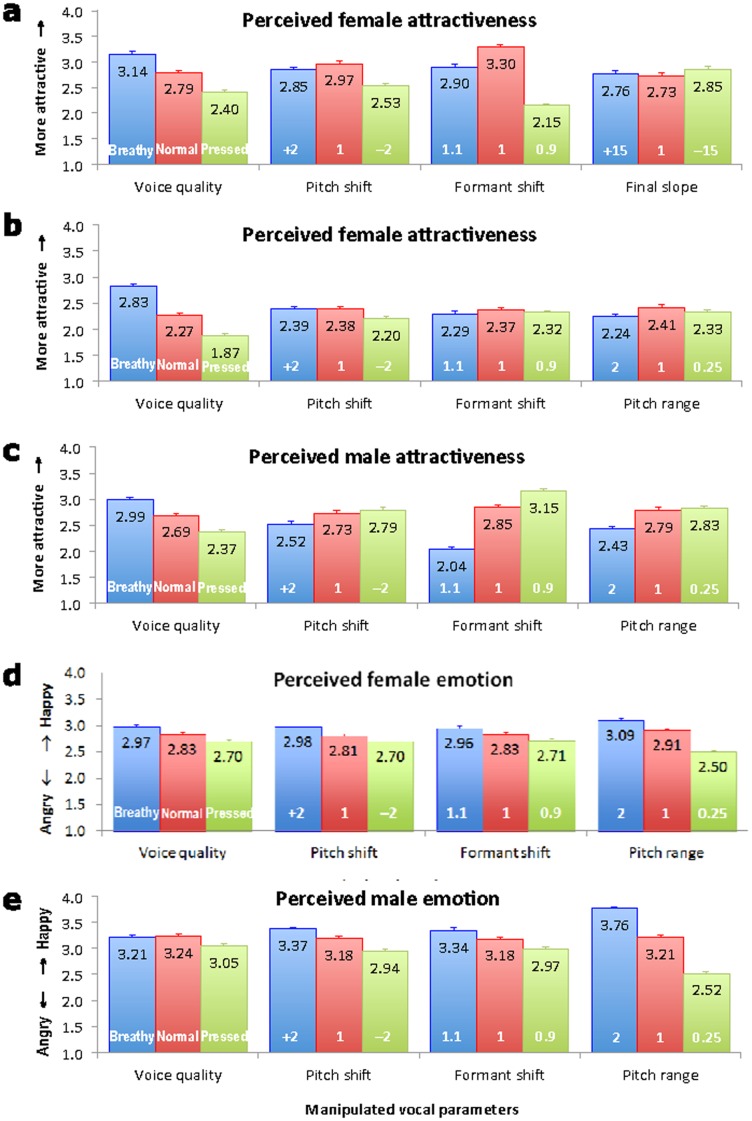
Voice, as a secondary sexual characteristic, is known to affect the perceived attractiveness of human individuals. But the underlying mechanism of vocal attractiveness has remained unclear. Here, we presented human listeners with acoustically altered natural sentences and fully synthetic sentences with systematically manipulated pitch, formants and voice quality based on a principle of body size projection reported for animal calls and emotional human vocal expressions. The results show that male listeners preferred a female voice that signals a small body size, with relatively high pitch, wide formant dispersion and breathy voice, while female listeners preferred a male voice that signals a large body size with low pitch and narrow formant dispersion. Interestingly, however, male vocal attractiveness was also enhanced by breathiness, which presumably softened the aggressiveness associated with a large body size. These results, together with the additional finding that the same vocal dimensions also affect emotion judgment, indicate that humans still employ a vocal interaction strategy used in animal calls despite the development of complex language.
声音作为一种次要的性特征,已知会影响人类个体的吸引力。但是,声音吸引力的潜在机制仍不清楚。在这里,我们向人类听众展示了经过声学改变的自然句子和完全合成的句子,这些句子的音高、共振峰和语音质量是根据动物叫声和情感人类声音表达中报告的身体大小投射原理来系统地操纵的。结果表明,男性听众更喜欢表示小体型的女性声音,其具有相对较高的音高、较宽的共振峰分散度和呼吸声,而女性听众则更喜欢表示大体型的男性声音,其具有较低的音高和较窄的共振峰分散度。有趣的是,然而,男性声音的吸引力也会因呼吸声而增强,这大概会降低与大体型相关的攻击性。这些结果,再加上附加的发现,即相同的声音维度也会影响情绪判断,表明尽管人类已经发展出了复杂的语言,但仍然采用了在动物叫声中使用的声音互动策略。