Department of Internal Medicine, School of Medicine of Ribeirao Preto, University of Sao Paulo, Sao Paulo, Brazil.
PLoS One. 2013 Apr 26;8(4):e62424. doi: 10.1371/journal.pone.0062424. Print 2013.
Canonical and non-canonical Wnt pathways are involved in the genesis of multiple tumors; however, their role in pituitary tumorigenesis is mostly unknown.
This study evaluated gene and protein expression of Wnt pathways in pituitary tumors and whether these expression correlate to clinical outcome.
Genes of the WNT canonical pathway: activating ligands (WNT11, WNT4, WNT5A), binding inhibitors (DKK3, sFRP1), β-catenin (CTNNB1), β-catenin degradation complex (APC, AXIN1, GSK3β), inhibitor of β-catenin degradation complex (AKT1), sequester of β-catenin (CDH1), pathway effectors (TCF7, MAPK8, NFAT5), pathway mediators (DVL-1, DVL-2, DVL-3, PRICKLE, VANGL1), target genes (MYB, MYC, WISP2, SPRY1, TP53, CCND1); calcium dependent pathway (PLCB1, CAMK2A, PRKCA, CHP); and planar cell polarity pathway (PTK7, DAAM1, RHOA) were evaluated by QPCR, in 19 GH-, 18 ACTH-secreting, 21 non-secreting (NS) pituitary tumors, and 5 normal pituitaries. Also, the main effectors of canonical (β-catenin), planar cell polarity (JNK), and calcium dependent (NFAT5) Wnt pathways were evaluated by immunohistochemistry.
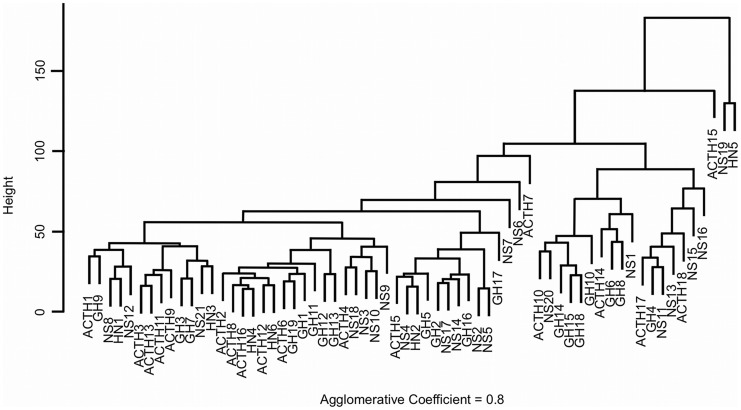
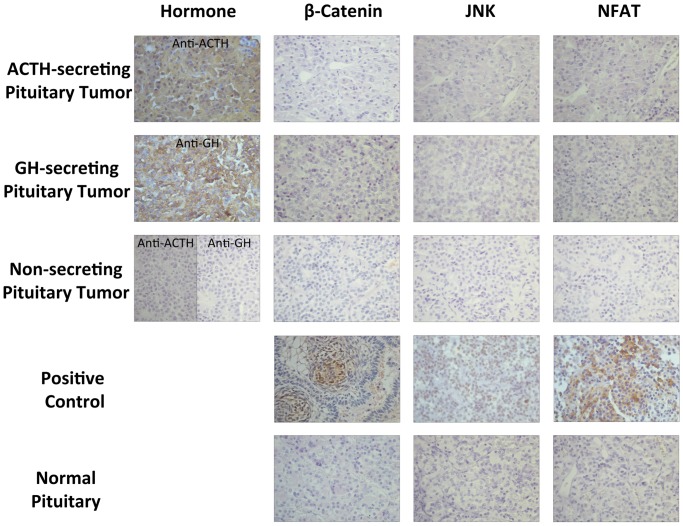
There are no differences in gene expression of canonical and non-canonical Wnt pathways between all studied subtypes of pituitary tumors and normal pituitaries, except for WISP2, which was over-expressed in ACTH-secreting tumors compared to normal pituitaries (4.8x; p = 0.02), NS pituitary tumors (7.7x; p = 0.004) and GH-secreting tumors (5.0x; p = 0.05). β-catenin, NFAT5 and JNK proteins showed no expression in normal pituitaries and in any of the pituitary tumor subtypes. Furthermore, no association of the studied gene or protein expression was observed with tumor size, recurrence, and progressive disease. The hierarchical clustering showed a regular pattern of genes of the canonical and non-canonical Wnt pathways randomly distributed throughout the dendrogram.
Our data reinforce previous reports suggesting no activation of canonical Wnt pathway in pituitary tumorigenesis. Moreover, we describe, for the first time, evidence that non-canonical Wnt pathways are also not mis-expressed in the pituitary tumors.
经典和非经典 Wnt 通路参与了多种肿瘤的发生;然而,它们在垂体肿瘤发生中的作用大多尚不清楚。
本研究评估了 Wnt 通路的基因和蛋白在垂体肿瘤中的表达情况,以及这些表达是否与临床结果相关。
经典 WNT 通路的基因:激活配体(WNT11、WNT4、WNT5A)、结合抑制剂(DKK3、sFRP1)、β-连环蛋白(CTNNB1)、β-连环蛋白降解复合物(APC、AXIN1、GSK3β)、β-连环蛋白降解复合物抑制剂(AKT1)、β-连环蛋白隔离物(CDH1)、通路效应物(TCF7、MAPK8、NFAT5)、通路介质(DVL-1、DVL-2、DVL-3、PRICKLE、VANGL1)、靶基因(MYB、MYC、WISP2、SPRY1、TP53、CCND1);钙依赖性通路(PLCB1、CAMK2A、PRKCA、CHP)和平面细胞极性通路(PTK7、DAAM1、RHOA)通过 QPCR 在 19 例 GH 分泌瘤、18 例 ACTH 分泌瘤、21 例非分泌瘤(NS)垂体肿瘤和 5 例正常垂体中进行了评估。此外,通过免疫组织化学评估了经典(β-连环蛋白)、平面细胞极性(JNK)和钙依赖性(NFAT5)Wnt 通路的主要效应物。
除 WISP2 外,所有研究的垂体肿瘤亚型和正常垂体之间的经典和非经典 Wnt 通路基因表达没有差异,WISP2 在 ACTH 分泌瘤中的表达高于正常垂体(4.8 倍;p=0.02)、NS 垂体肿瘤(7.7 倍;p=0.004)和 GH 分泌瘤(5.0 倍;p=0.05)。β-连环蛋白、NFAT5 和 JNK 蛋白在正常垂体和任何垂体肿瘤亚型中均无表达。此外,研究的基因或蛋白表达与肿瘤大小、复发和进行性疾病之间没有关联。层次聚类显示,经典和非经典 Wnt 通路的基因图谱呈随机分布。
我们的数据进一步证实了先前的报告,提示经典 Wnt 通路在垂体肿瘤发生中没有被激活。此外,我们首次描述了非经典 Wnt 通路在垂体肿瘤中也没有异常表达的证据。