Laboratoire de Biologie Moléculaire et Cellulaire des Eucaryotes, FRE3354 Centre National de la Recherche Scientifique, Université Pierre et Marie Curie, Institut de Biologie Physico-Chimique Paris, France.
Front Oncol. 2013 Apr 26;3:101. doi: 10.3389/fonc.2013.00101. eCollection 2013.
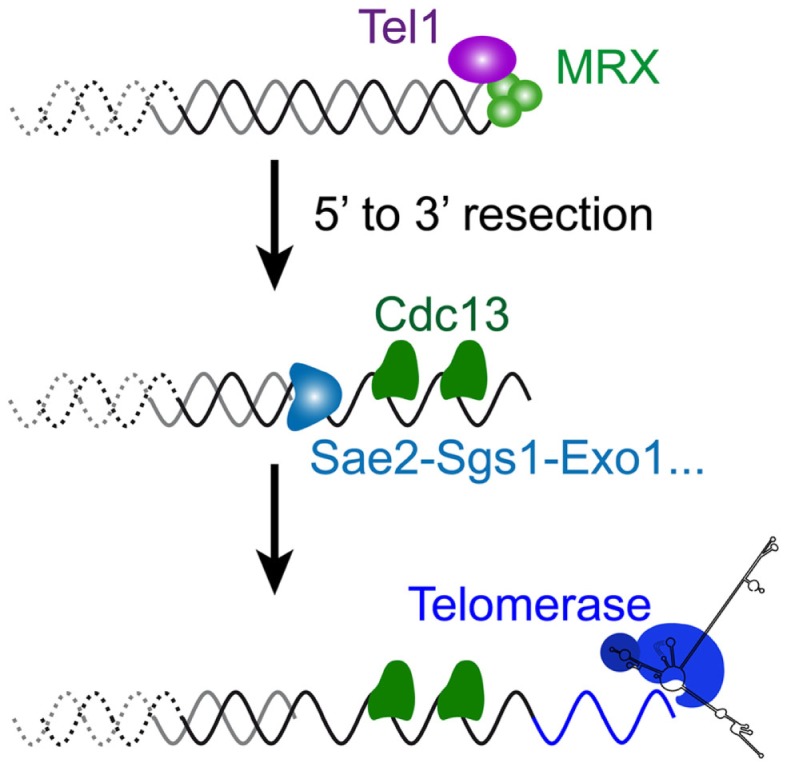
In many somatic human tissues, telomeres shorten progressively because of the DNA-end replication problem. Consequently, cells cease to proliferate and are maintained in a metabolically viable state called replicative senescence. These cells are characterized by an activation of DNA damage checkpoints stemming from eroded telomeres, which are bypassed in many cancer cells. Hence, replicative senescence has been considered one of the most potent tumor suppressor pathways. However, the mechanism through which short telomeres trigger this cellular response is far from being understood. When telomerase is removed experimentally in Saccharomyces cerevisiae, telomere shortening also results in a gradual arrest of population growth, suggesting that replicative senescence also occurs in this unicellular eukaryote. In this review, we present the key steps that have contributed to the understanding of the mechanisms underlying the establishment of replicative senescence in budding yeast. As in mammals, signals stemming from short telomeres activate the DNA damage checkpoints, suggesting that the early cellular response to the shortest telomere(s) is conserved in evolution. Yet closer analysis reveals a complex picture in which the apparent single checkpoint response may result from a variety of telomeric alterations expressed in the absence of telomerase. Accordingly, the DNA replication of eroding telomeres appears as a critical challenge for senescing budding yeast cells and the easy manipulation of S. cerevisiae is providing insights into the way short telomeres are integrated into their chromatin and nuclear environments. Finally, the loss of telomerase in budding yeast triggers a more general metabolic alteration that remains largely unexplored. Thus, telomerase-deficient S. cerevisiae cells may have more common points than anticipated with somatic cells, in which telomerase depletion is naturally programed, thus potentially inspiring investigations in mammalian cells.
在许多人体组织中,端粒会因 DNA 末端复制问题而逐渐缩短。因此,细胞停止增殖,并保持在一种代谢上可行的状态,称为复制性衰老。这些细胞的特征是由于侵蚀的端粒而激活的 DNA 损伤检查点,而许多癌细胞会绕过这些检查点。因此,复制性衰老被认为是最有效的肿瘤抑制途径之一。然而,端粒缩短触发这种细胞反应的机制还远未被理解。当实验中从酿酒酵母中去除端粒酶时,端粒缩短也会导致种群生长逐渐停滞,这表明复制性衰老也会发生在这种单细胞真核生物中。在这篇综述中,我们介绍了有助于理解酿酒酵母中建立复制性衰老机制的关键步骤。与哺乳动物一样,源自短端粒的信号激活了 DNA 损伤检查点,这表明,在进化过程中,对最短端粒的早期细胞反应是保守的。然而,更仔细的分析揭示了一个复杂的情况,即明显的单一检查点反应可能是由多种在没有端粒酶的情况下表达的端粒改变引起的。因此,侵蚀端粒的 DNA 复制似乎是衰老的酿酒酵母细胞面临的一个关键挑战,而酿酒酵母的易操作正在为理解短端粒如何整合到其染色质和核环境中提供新的视角。最后,酿酒酵母中端粒酶的缺失会引发更普遍的代谢改变,而这一点在很大程度上仍未得到探索。因此,缺乏端粒酶的酿酒酵母细胞可能与自然编程端粒酶缺失的体细胞有更多共同之处,这可能会激发对哺乳动物细胞的研究。