Marshfield Clinic Research Foundation, Marshfield, Wisconsin, USA.
Genet Med. 2013 Dec;15(12):933-40. doi: 10.1038/gim.2013.43. Epub 2013 May 2.
The aim of this study was to examine Lynch syndrome screening of patients with metastatic colorectal cancer in integrated health-care-delivery organizations.
We determined the availability of Lynch syndrome screening criteria and actual Lynch syndrome screening in the medical records of 1,188 patients diagnosed with metastatic colorectal cancer between 2004 and 2009 at seven institutions in the Cancer Research Network.
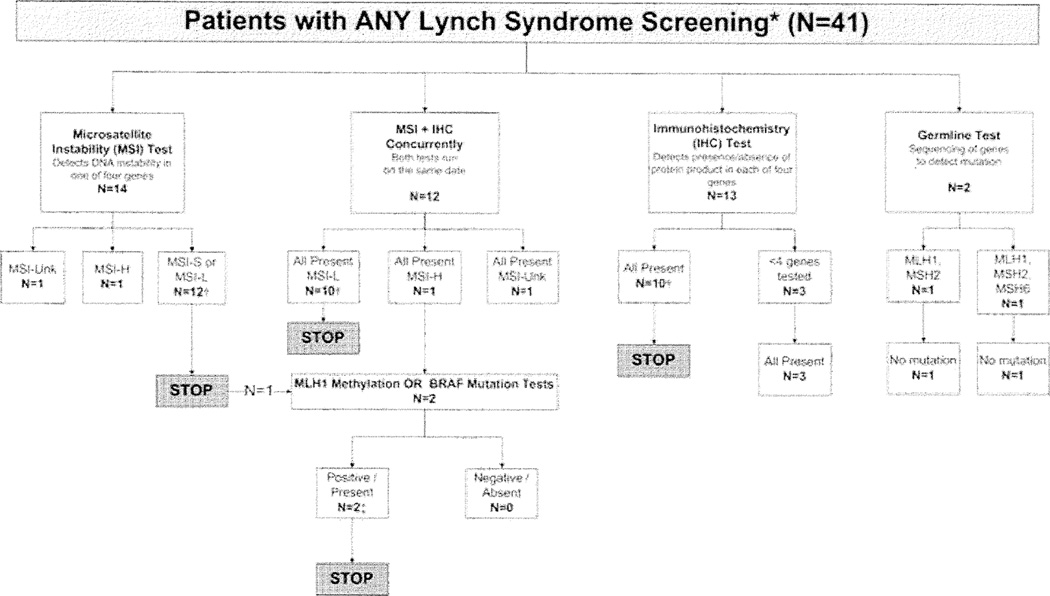
We found infrequent use of Lynch syndrome screening (41/1,188). Family history was available for 937 of the 1,188 patients (79%). There was sufficient information to assess Lynch syndrome risk using family history-based criteria in 719 of the 937 patients (77%) with family history documentation. In 391 individuals with a family history of a Lynch syndrome-associated cancer, 107 (27%) could not be evaluated due to missing information such as age of cancer onset. Eleven percent of patients who met the Bethesda criteria and 25% of individuals who met the Amsterdam II criteria were screened for Lynch syndrome. Recommended guidelines were adhered to during screening, but no testing method was preferred.
The information required for Lynch syndrome screening decisions is routinely collected but seldom used. There is a critical gap between collection of family history and its use to guide Lynch syndrome screening, which may support a case for implementation of universal screening guidelines.
本研究旨在检查在综合医疗服务提供组织中,转移性结直肠癌患者的林奇综合征筛查情况。
我们在癌症研究网络的七个机构中,确定了 2004 年至 2009 年间诊断为转移性结直肠癌的 1188 例患者的病历中林奇综合征筛查标准的可用性和实际林奇综合征筛查情况。
我们发现林奇综合征筛查的应用较少(41/1188)。在 1188 例患者中,有 937 例(79%)可获得家族史。在有家族史记录的 937 例患者中,有 719 例(77%)有足够的信息可根据家族史标准评估林奇综合征风险。在 391 名有林奇综合征相关癌症家族史的个体中,由于缺乏信息(如癌症发病年龄),有 107 人(27%)无法进行评估。符合贝塞斯达标准的患者中有 11%,符合阿姆斯特丹 II 标准的个体中有 25%接受了林奇综合征筛查。在筛查过程中遵循了推荐的指南,但没有首选任何一种检测方法。
进行林奇综合征筛查决策所需的信息通常是收集的,但很少使用。在收集家族史和将其用于指导林奇综合征筛查之间存在重大差距,这可能支持实施普遍筛查指南的理由。