Department of Zoology, University of Calcutta, Kolkata, India.
Indian J Med Res. 2013 Mar;137(3):549-59.
BACKGROUND & OBJECTIVES: Entomological surveillance of the dengue vectors using pupal productivity as indicators can be helpful in effective management. On this basis, an assessment was made on the relative importance of the larval habitats of Aedes mosquitoes in Kolkata, an endemic zone for dengue in West Bengal, India.
Monthly collection of larvae and pupae of Aedes from larval habitats categorized as earthen, plastic and porcelain containers and tyres, was carried out from selected sites. Pupal weight was recorded and degree of sexual dimorphism was calculated. The data on pupal weight, sexual dimorphism and immature density were used for regression analysis.
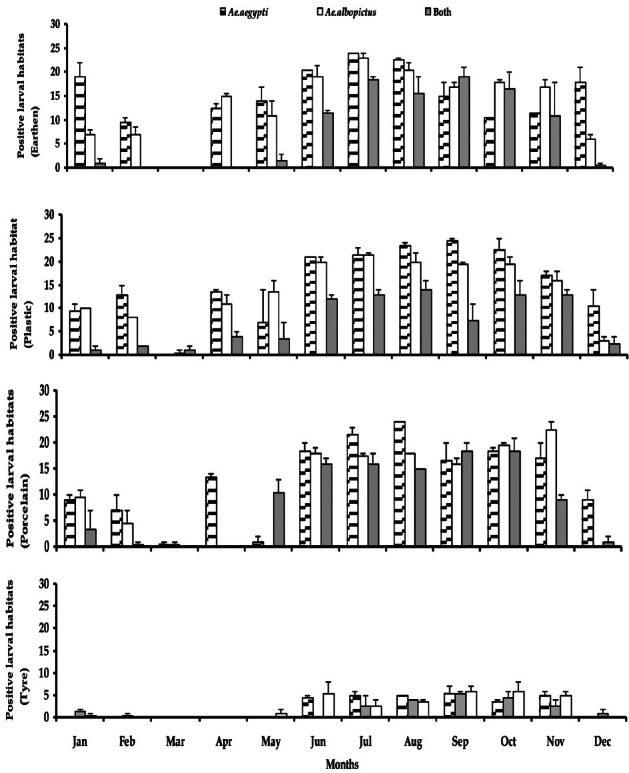
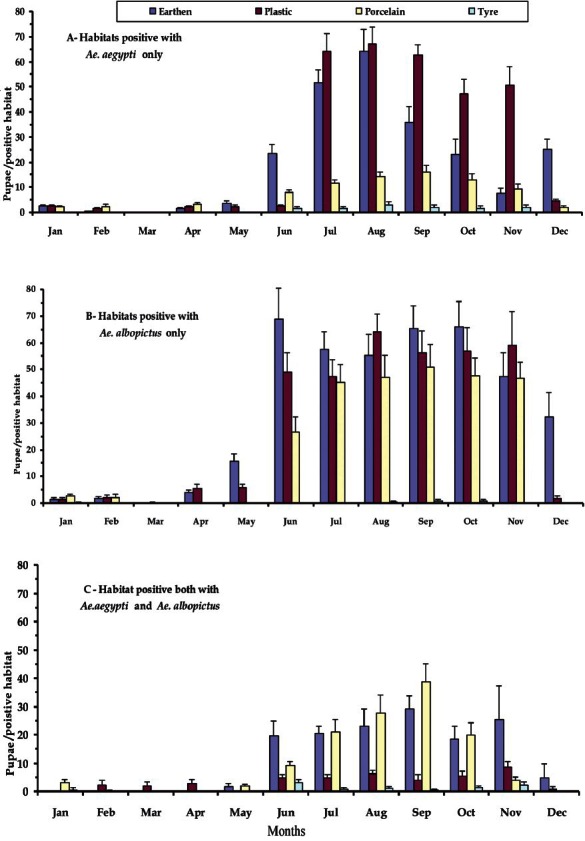
The number of positive sites for each type of larval habitats varied with months and mosquito species. Based on mean density per month, the plastic containers were the most productive habitats and the tyres were least productive for both Aedes species. The pupal weight of both Ae. aegypti and Ae. albopictus varied with the relative density and type of larval habitats. Significant differences in pupal productivity, positive sites and the proportion of pupae were observed in the habitats. Species-specific differences in the degree of dimorphism were noted with the females being larger in size than males, irrespective of the habitats.
INTERPRETATION & CONCLUSIONS: Pupal productivity of Aedes mosquitoes in Kolkata differed in terms of the type of the larval habitats with the immature density affecting the body size of the adults. This habitat-based study is a pioneer effort considering Kolkata and calls for a management plan for source reduction of these habitats to minimize Aedes mosquitoes and thus potential risk of dengue.
使用蛹生产力作为指标进行登革热媒介昆虫学监测有助于进行有效的管理。在此基础上,我们对印度西孟加拉邦登革热流行区加尔各答的埃及伊蚊幼虫栖息地的相对重要性进行了评估。
从选定的地点每月收集埃及伊蚊的幼虫和蛹,将幼虫栖息地分为土、塑料和瓷容器以及轮胎。记录蛹重并计算性二型性程度。将蛹重、性二型性和幼虫密度数据用于回归分析。
每种类型的幼虫栖息地的阳性地点数量随月份和蚊子种类而变化。基于每月的平均密度,塑料容器是最具生产力的栖息地,而轮胎对两种埃及伊蚊都是最不具生产力的栖息地。两种埃及伊蚊的蛹重均随相对密度和幼虫栖息地类型而变化。在栖息地中观察到蛹生产力、阳性地点和蛹比例存在显著差异。无论栖息地如何,都注意到了种间性二型性程度的差异,即雌性比雄性体型更大。
加尔各答埃及伊蚊的蛹生产力因幼虫栖息地类型而异,幼虫密度影响成虫的体型。这项基于栖息地的研究是加尔各答的开创性工作,需要制定减少这些栖息地的源头管理计划,以最大程度地减少埃及伊蚊的数量,从而降低登革热的潜在风险。