Khan Khurum H, Yap Timothy A, Yan Li, Cunningham David
The Royal Marsden NHS Foundation Trust, Sutton, Surrey, UK.
Chin J Cancer. 2013 May;32(5):253-65. doi: 10.5732/cjc.013.10057.
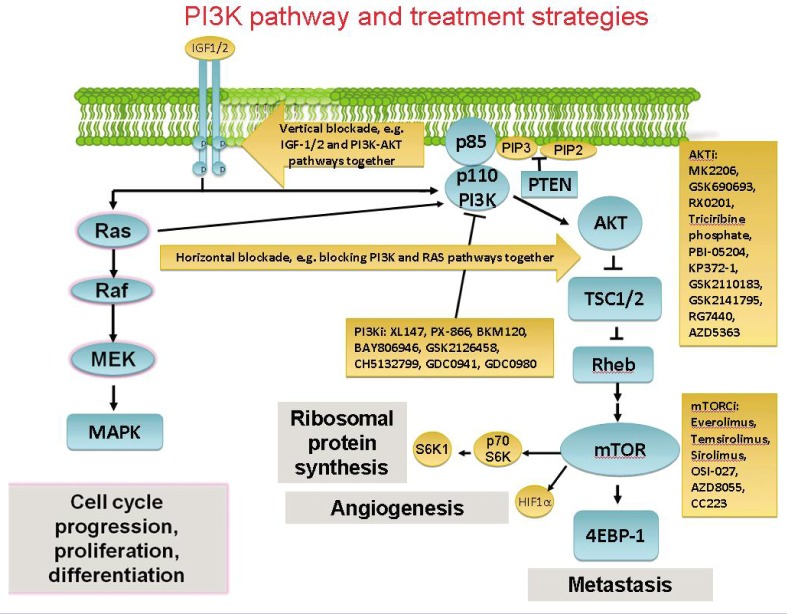
The phosphoinositide 3-kinase-AKT-mammalian target of rapamycin (PI3K-AKT-mTOR) pathway is a frequently hyperactivated pathway in cancer and is important for tumor cell growth and survival. The development of targeted therapies against mTOR, a vital substrate along this pathway, led to the approval of allosteric inhibitors, including everolimus and temsirolimus, for the treatment of breast, renal, and pancreatic cancers. However, the suboptimal duration of response in unselected patients remains an unresolved issue. Numerous novel therapies against critical nodes of this pathway are therefore being actively investigated in the clinic in multiple tumor types. In this review, we focus on the progress of these agents in clinical development along with their biological rationale, the need of predictive biomarkers and various combination strategies, which will be useful in counteracting the mechanisms of resistance to this class of drugs.
磷酸肌醇3激酶-蛋白激酶B-雷帕霉素哺乳动物靶蛋白(PI3K-AKT-mTOR)信号通路在癌症中经常过度激活,对肿瘤细胞的生长和存活至关重要。针对该信号通路中重要底物mTOR的靶向治疗药物的研发,使得包括依维莫司和替西罗莫司在内的变构抑制剂获批用于治疗乳腺癌、肾癌和胰腺癌。然而,未经过筛选的患者中疗效持续时间不理想仍是一个未解决的问题。因此,临床上正在多种肿瘤类型中积极研究针对该信号通路关键节点的众多新型疗法。在本综述中,我们重点关注这些药物在临床开发中的进展,以及它们的生物学原理、预测性生物标志物的需求和各种联合策略,这些将有助于对抗这类药物的耐药机制。