Department of Physics and Astronomy, University of Manitoba, Winnipeg, MB, Canada.
Toxins (Basel). 2013 May 3;5(5):926-38. doi: 10.3390/toxins5050926.
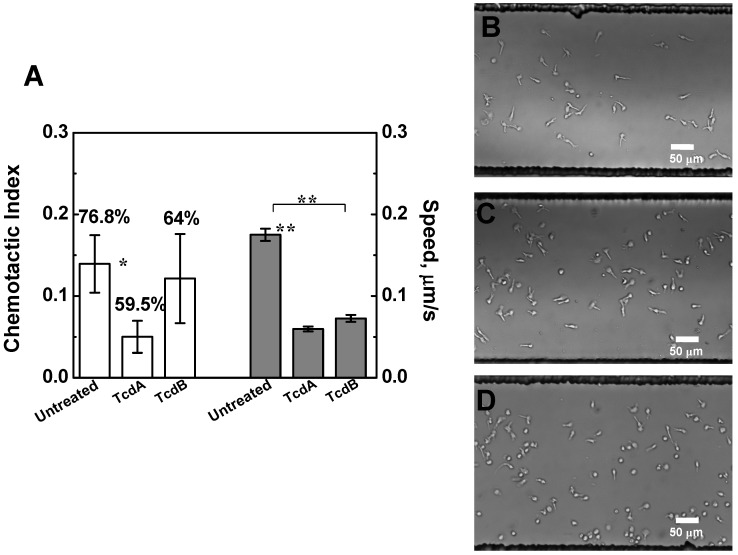
Bacterial products such as toxins can interfere with a variety of cellular processes, leading to severe human diseases. Clostridium difficile toxins, TcdA and TcdB are the primary contributing factors to the pathogenesis of C. difficile-associated diseases (CDAD). While the mechanisms for TcdA and TcdB mediated cellular responses are complex, it has been shown that these toxins can alter chemotactic responses of neutrophils and intestinal epithelial cells leading to innate immune responses and tissue damages. The effects of C. difficile toxins on the migration and trafficking of other leukocyte subsets, such as T lymphocytes, are not clear and may have potential implications for adaptive immunity. We investigated here the direct and indirect effects of TcdA and TcdB on the migration of human blood T cells using conventional cell migration assays and microfluidic devices. It has been found that, although both toxins decrease T cell motility, only TcdA but not TcdB decreases T cell chemotaxis. Similar effects are observed in T cell migration toward the TcdA- or TcdB-treated human epithelial cells. Our study demonstrated the primary role of TcdA (compared to TcdB) in altering T cell migration and chemotaxis, suggesting possible implications for C. difficile toxin mediated adaptive immune responses in CDAD.
细菌产物,如毒素,可以干扰多种细胞过程,导致严重的人类疾病。艰难梭菌毒素 TcdA 和 TcdB 是艰难梭菌相关疾病(CDAD)发病机制的主要因素。虽然 TcdA 和 TcdB 介导的细胞反应机制很复杂,但已经表明这些毒素可以改变中性粒细胞和肠上皮细胞的趋化反应,导致先天免疫反应和组织损伤。艰难梭菌毒素对其他白细胞亚群(如 T 淋巴细胞)的迁移和运输的影响尚不清楚,可能对适应性免疫有潜在影响。我们使用传统的细胞迁移检测和微流控设备研究了 TcdA 和 TcdB 对人血 T 细胞迁移的直接和间接影响。结果发现,尽管两种毒素都降低了 T 细胞的迁移能力,但只有 TcdA 而不是 TcdB 降低了 T 细胞的趋化性。在 T 细胞向 TcdA 或 TcdB 处理的人上皮细胞迁移的过程中也观察到了类似的效应。我们的研究表明 TcdA(与 TcdB 相比)在改变 T 细胞迁移和趋化性方面起主要作用,这表明艰难梭菌毒素介导的适应性免疫反应在 CDAD 中可能有一定的影响。