Institute of Biochemistry, Molecular Biology and Biotechnology, University of Colombo, Colombo, Sri Lanka.
BMC Infect Dis. 2013 May 6;13:206. doi: 10.1186/1471-2334-13-206.
The relationship between inducible nitric oxide synthatase activity and disease severity in leptospirosis is unclear. Nitric oxide is converted to nitrites and nitrates, thus nitrite and nitrate levels (NOx) in serum are considered surrogate markers for nitric oxide. NOx are excreted through the kidneys, and elimination is diminished in renal impairment. We assessed the correlation of NOx with disease severity in patients with leptospirosis, compared with healthy controls and non-leptospirosis fever patients.
All patients admitted over a two-month period to the National Hospital, Colombo, Sri Lanka with a clinical picture suggestive of leptospirosis were included. Leptospirosis was confirmed by the microscopic agglutination test (titre ≥ 400). Severe leptospirosis was defined by the presence of two or more of the following criteria: jaundice (bilirubin> 51.3 μmol/l), oliguria (urine output < 400 ml/day), serum creatinine> 133 μmol/l or blood urea > 25.5 mmol/l, or the presence of organ dysfunction. Non-leptospirosis fever patients and healthy volunteers were used as control groups. NOx levels were measured using a modified Griess reaction.
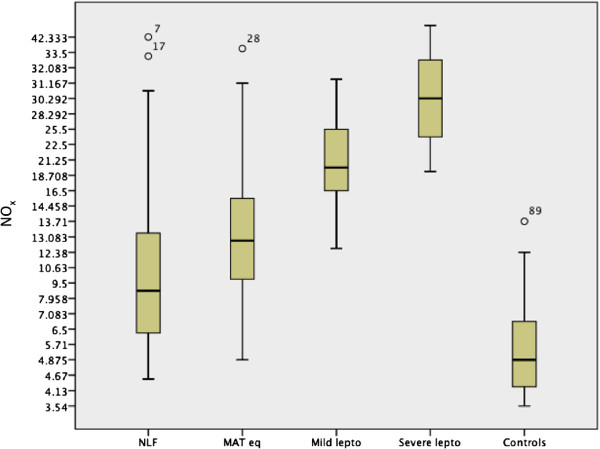
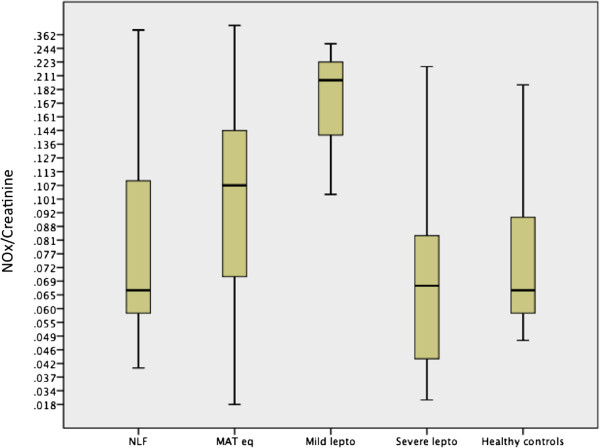
Forty patients were confirmed as having leptospirosis and 26 of them had severe disease. NOx levels were significantly higher in confirmed leptospirosis patients compared to healthy controls, MAT equivocal patients and non-leptospirosis fever patients (p<0.001). NOx concentrations were also significantly higher in patients with severe compared to mild leptospirosis (p<0.001). Once NOx levels were corrected for renal function, by using the ratio NOx/creatinine, NOx levels were actually significantly lower in patients with severe disease compared to other patients, and values were similar to those of healthy controls.
We postulate that high NOx levels may be protective against severe leptospirosis, and that finding low NOx levels (when corrected for renal function) in patients with leptospirosis may predict the development of severe disease and organ dysfunction.
诱导型一氧化氮合酶活性与钩端螺旋体病严重程度之间的关系尚不清楚。一氧化氮转化为亚硝酸盐和硝酸盐,因此血清中亚硝酸盐和硝酸盐水平(NOx)被认为是一氧化氮的替代标志物。NOx 通过肾脏排泄,肾功能受损时排泄减少。我们评估了 NOx 与钩端螺旋体病患者严重程度的相关性,并与健康对照组和非钩端螺旋体病发热患者进行了比较。
在斯里兰卡科伦坡国家医院住院的 2 个月内,所有具有钩端螺旋体病临床特征的患者均被纳入研究。通过显微镜凝集试验(滴度≥400)确认钩端螺旋体病。严重钩端螺旋体病的定义为存在以下两个或更多标准:黄疸(胆红素>51.3μmol/l)、少尿(尿量<400ml/天)、血清肌酐>133μmol/l 或血尿素>25.5mmol/l,或存在器官功能障碍。非钩端螺旋体病发热患者和健康志愿者作为对照组。使用改良的格里斯反应测量 NOx 水平。
40 例患者被确诊为钩端螺旋体病,其中 26 例病情严重。与健康对照组、MAT 不确定患者和非钩端螺旋体病发热患者相比,确诊的钩端螺旋体病患者的 NOx 水平显著升高(p<0.001)。与轻度钩端螺旋体病患者相比,严重钩端螺旋体病患者的 NOx 浓度也显著升高(p<0.001)。一旦通过使用 NOx/肌酐比值校正肾功能,严重疾病患者的 NOx 水平实际上明显低于其他患者,并且与健康对照组相似。
我们推测高 NOx 水平可能对严重钩端螺旋体病有保护作用,并且在钩端螺旋体病患者中发现低 NOx 水平(当校正肾功能时)可能预测严重疾病和器官功能障碍的发展。