Istitute Pasteur-Fondazione Cenci Bolognetti, Department of Clinical and Molecular Medicine, Sapienza University of Roma, and S. Andrea Hospital, Rome, Italy.
Mol Cancer. 2013 May 7;12:38. doi: 10.1186/1476-4598-12-38.
Infection with high-risk human papillomavirus (HR-HPV) genotypes, mainly HPV16 and HPV18, is a major risk factor for cervical cancer and responsible for its progression. While the transforming role of the HPV E6 and E7 proteins is more characterized, the molecular mechanisms of the oncogenic activity of the E5 product are still only partially understood, but appear to involve deregulation of growth factor receptor expression. Since the signaling of the transforming growth factor beta (TGFbeta) is known to play crucial roles in the epithelial carcinogenesis, aim of this study was to investigate if HPV16 E5 would modulate the TGF-BRII expression and TGFbeta/Smad signaling.
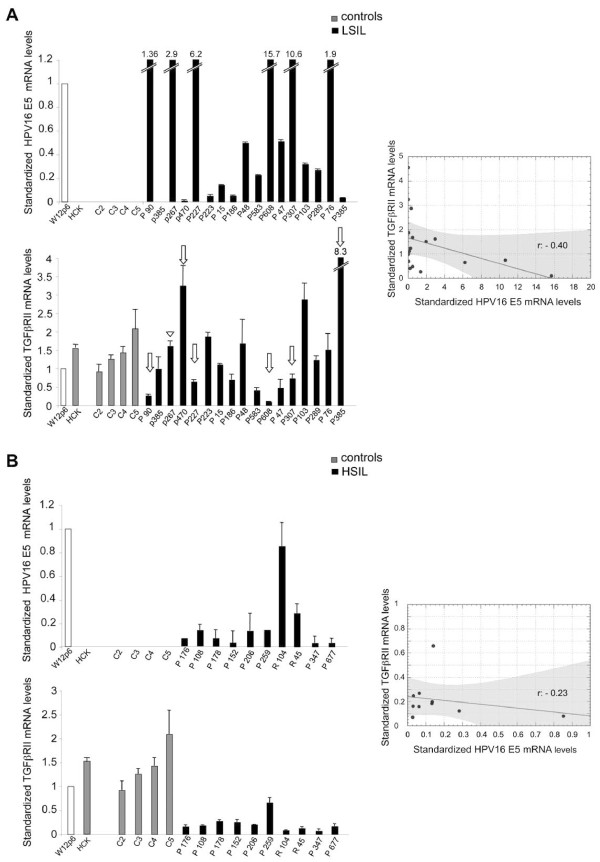
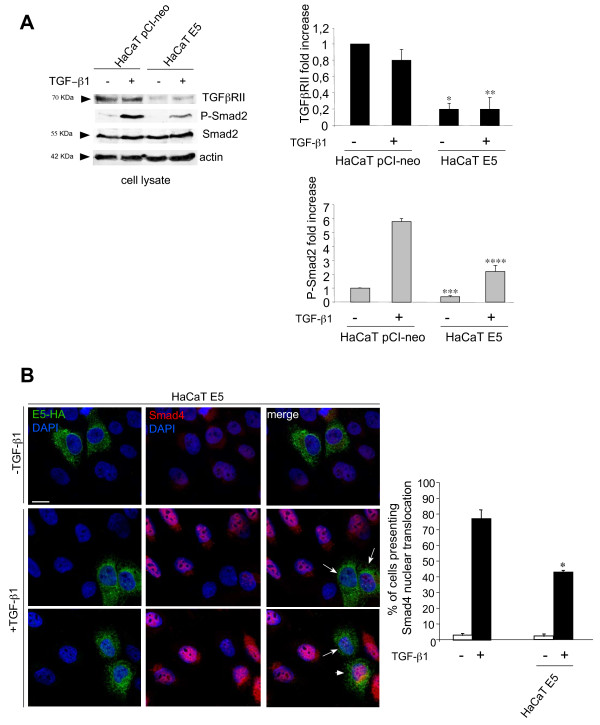
The HPV16 E5 mRNA expression pattern was variable in low-grade squamous intraepithelial lesions (LSIL), while homogeneously reduced in high-grade lesions (HSIL). Parallel analysis of TGFBRII mRNA showed that the receptor transcript levels were also variable in LSILs and inversely related to those of the viral protein. In vitro quantitation of the TGFBRII mRNA and protein in human keratinocytes expressing 16E5 in a dose-dependent and time-dependent manner showed a progressive down-modulation of the receptor. Phosphorylation of Smad2 and nuclear translocation of Smad4 were also decreased in E5-expressing cells stimulated with TGFbeta1.
Taken together our results indicate that HPV16 E5 expression is able to attenuate the TGFbeta1/Smad signaling and propose that this loss of signal transduction, leading to destabilization of the epithelial homeostasis at very early stages of viral infection, may represent a crucial mechanism of promotion of the HPV-mediated cervical carcinogenesis.
高危型人乳头瘤病毒(HR-HPV)基因型(主要是 HPV16 和 HPV18)的感染是宫颈癌的主要危险因素,并导致其进展。虽然 HPV E6 和 E7 蛋白的转化作用得到了更深入的研究,但 HPV E5 产物致癌活性的分子机制仍仅部分了解,但似乎涉及生长因子受体表达的失调。由于转化生长因子 β(TGFβ)的信号传导在上皮性肿瘤发生中起着至关重要的作用,因此本研究旨在探讨 HPV16 E5 是否会调节 TGF-BRII 的表达和 TGFβ/Smad 信号转导。
HPV16 E5 mRNA 表达模式在低级别鳞状上皮内病变(LSIL)中变化不定,而在高级别病变(HSIL)中则均匀降低。对 TGFBRII mRNA 的平行分析表明,受体转录本水平在 LSIL 中也变化不定,并且与病毒蛋白的转录本水平呈负相关。在表达 HPV16 E5 的人角质形成细胞中,体外定量分析发现 TGFBRII mRNA 和蛋白呈剂量依赖性和时间依赖性下调。用 TGFβ1 刺激 E5 表达细胞后,Smad2 的磷酸化和 Smad4 的核转位也减少。
综上所述,我们的结果表明 HPV16 E5 的表达能够减弱 TGFβ1/Smad 信号转导,并提出这种信号转导的丧失,导致在病毒感染的早期阶段上皮内稳态的不稳定,可能是 HPV 介导的宫颈癌发生的一个关键促进机制。