The Wallace H. Coulter Department of Biomedical Engineering, Georgia Tech and Emory University Atlanta, GA, USA.
Front Comput Neurosci. 2013 May 2;7:48. doi: 10.3389/fncom.2013.00048. eCollection 2013.
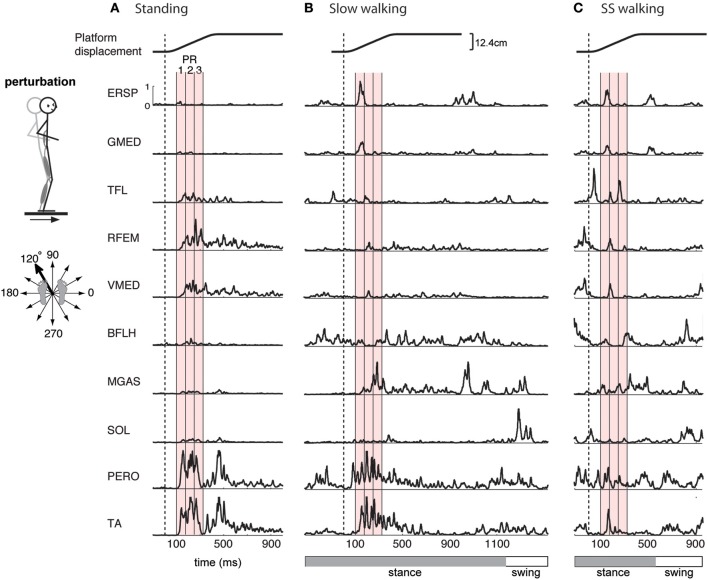
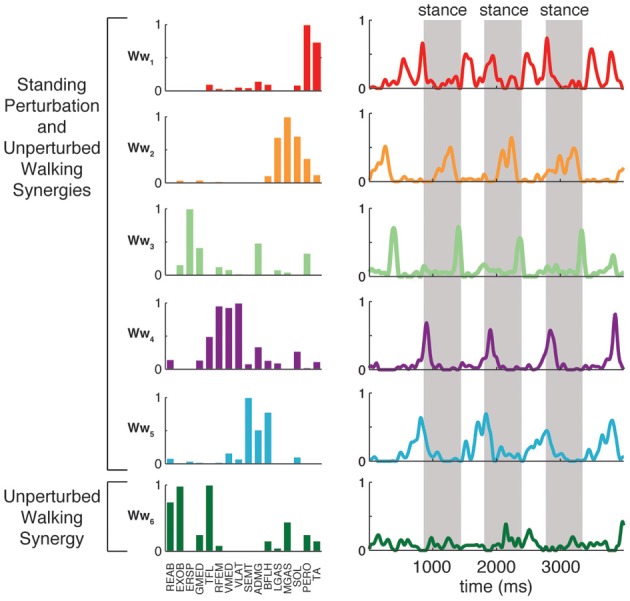
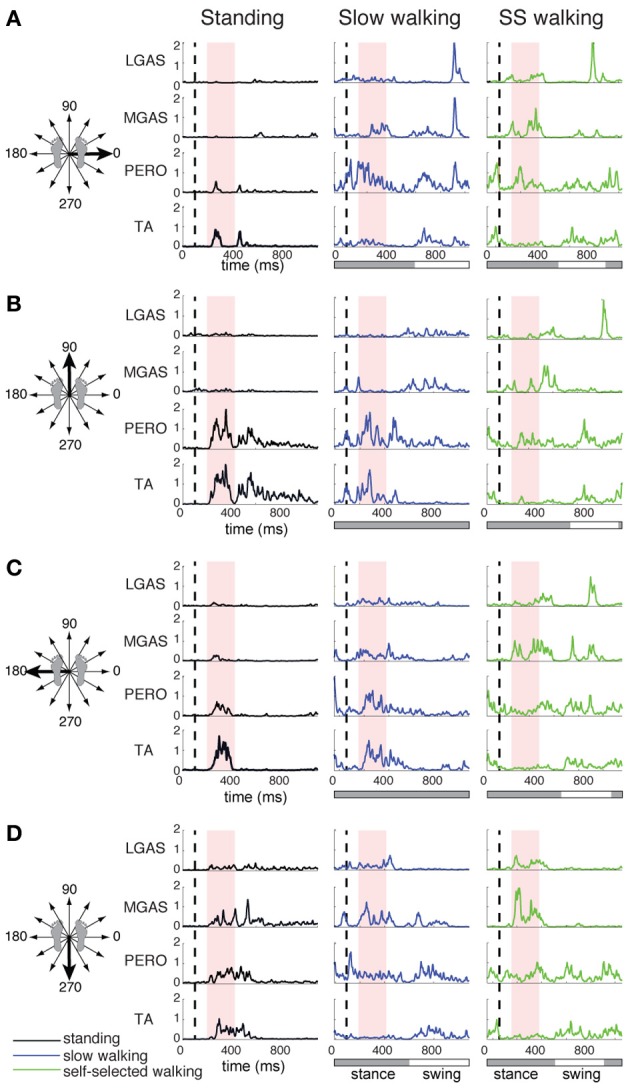
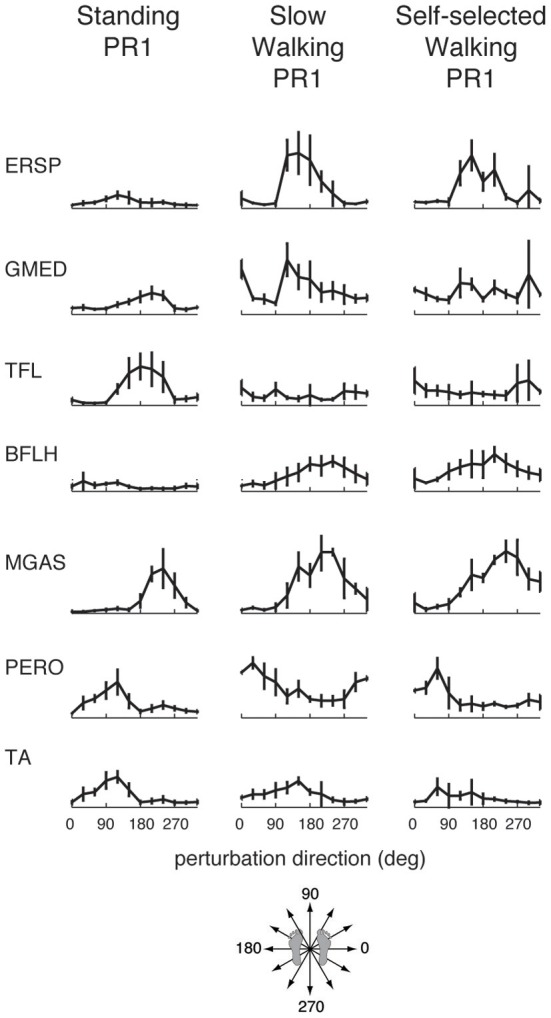
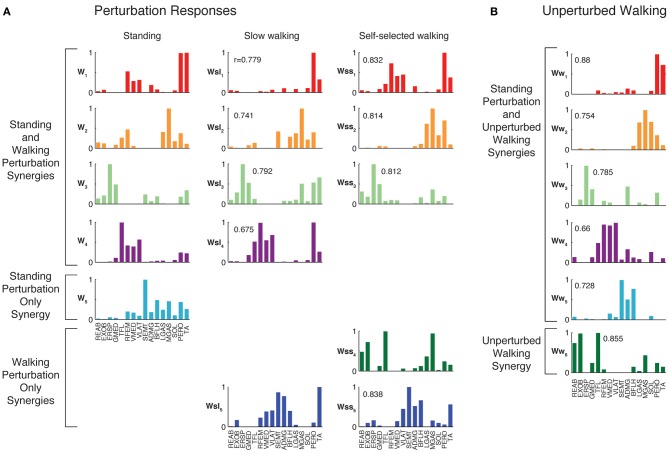
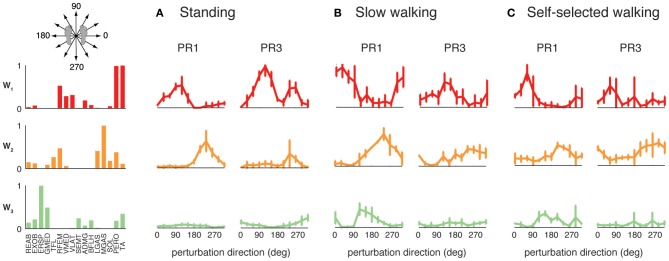
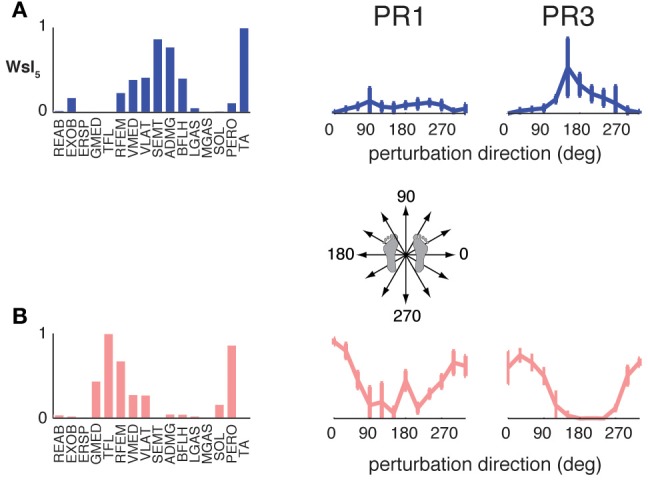
Little is known about the integration of neural mechanisms for balance and locomotion. Muscle synergies have been studied independently in standing balance and walking, but not compared. Here, we hypothesized that reactive balance and walking are mediated by a common set of lower-limb muscle synergies. In humans, we examined muscle activity during multidirectional support-surface perturbations during standing and walking, as well as unperturbed walking at two speeds. We show that most muscle synergies used in perturbations responses during standing were also used in perturbation responses during walking, suggesting common neural mechanisms for reactive balance across different contexts. We also show that most muscle synergies using in reactive balance were also used during unperturbed walking, suggesting that neural circuits mediating locomotion and reactive balance recruit a common set of muscle synergies to achieve task-level goals. Differences in muscle synergies across conditions reflected differences in the biomechanical demands of the tasks. For example, muscle synergies specific to walking perturbations may reflect biomechanical challenges associated with single limb stance, and muscle synergies used during sagittal balance recovery in standing but not walking were consistent with maintaining the different desired center of mass motions in standing vs. walking. Thus, muscle synergies specifying spatial organization of muscle activation patterns may define a repertoire of biomechanical subtasks available to different neural circuits governing walking and reactive balance and may be recruited based on task-level goals. Muscle synergy analysis may aid in dissociating deficits in spatial vs. temporal organization of muscle activity in motor deficits. Muscle synergy analysis may also provide a more generalizable assessment of motor function by identifying whether common modular mechanisms are impaired across the performance of multiple motor tasks.
关于平衡和运动神经机制的整合,目前知之甚少。肌肉协同作用已在站立平衡和行走中进行了独立研究,但尚未进行比较。在这里,我们假设反应性平衡和行走由一组共同的下肢肌肉协同作用来介导。在人类中,我们研究了站立时多方向支撑面扰动以及两种速度下未受扰动行走过程中的肌肉活动。我们发现,站立时用于反应性平衡的大多数肌肉协同作用也用于行走时的扰动反应,这表明不同环境下的反应性平衡具有共同的神经机制。我们还发现,用于反应性平衡的大多数肌肉协同作用也用于未受干扰的行走,这表明调节运动和反应性平衡的神经回路利用一组共同的肌肉协同作用来实现任务水平的目标。不同条件下肌肉协同作用的差异反映了任务的生物力学需求的差异。例如,专门用于行走扰动的肌肉协同作用可能反映了与单腿支撑相关的生物力学挑战,而在站立但不在行走中用于矢状面平衡恢复的肌肉协同作用与在站立时保持不同的期望质心运动一致与行走。因此,指定肌肉激活模式空间组织的肌肉协同作用可能定义了不同神经回路控制行走和反应性平衡的可用生物力学子任务的组合,并可能根据任务水平的目标进行招募。肌肉协同作用分析可以帮助区分运动障碍中肌肉活动的空间和时间组织缺陷。肌肉协同作用分析还可以通过识别常见的模块化机制是否在多个运动任务的表现中受到损害,从而提供更具普遍性的运动功能评估。