Stress Physiology and Molecular Biology Laboratory; School of Life Sciences; Jawaharlal Nehru University; New Delhi, India.
Plant Signal Behav. 2013 Jul;8(7):e24738. doi: 10.4161/psb.24738. Epub 2013 May 13.
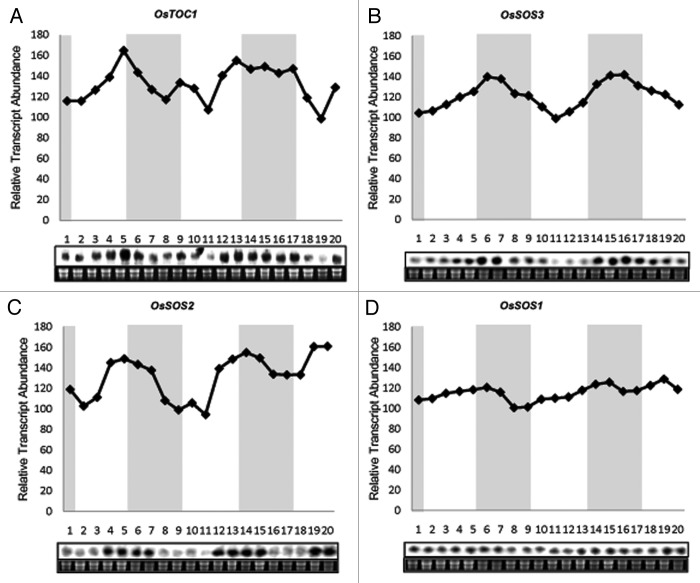
The diurnal rhythm controls many aspects of plant physiology such as flowering, photosynthesis and growth. Rice is one of the staple foods for world's population. Abiotic stresses such as salinity, drought, heat and cold severely affect rice production. Under salinity stress, maintenance of ion homeostasis is a major challenge, which also defines the tolerance level of a given genotype. Salt overly sensitive (SOS) pathway is well documented to play a key role in maintaining the Na(+) homeostasis in plant cell. However, it is not reported yet whether the transcriptional regulation of genes of this pathway are influenced by diurnal rhythm. In the present work, we have studied the diurnal pattern of transcript abundance of SOS pathway genes in rice at seedling stage.To rule out the effect of temperature fluctuations on the expression patterns of these genes, the seedlings were grown under constant temperature. We found that OsSOS3 and OsSOS2 exhibited a rhythmic and diurnal expression pattern, while OsSOS1did not have any specific pattern of expression. This analysis establishes a cross-link between diurnal rhythm and SOS pathway and suggests that SOS pathway is influenced by diurnal rhythm in rice.
昼夜节律控制着植物生理学的许多方面,如开花、光合作用和生长。水稻是世界人口的主要粮食作物之一。非生物胁迫,如盐度、干旱、热和冷,严重影响水稻生产。在盐胁迫下,维持离子稳态是一个主要挑战,这也决定了给定基因型的耐受水平。盐过度敏感(SOS)途径在维持植物细胞中的 Na+稳态方面起着关键作用,这一点已有充分的文献记载。然而,目前还没有报道该途径基因的转录调控是否受到昼夜节律的影响。在本工作中,我们研究了水稻幼苗期 SOS 途径基因的转录丰度的昼夜节律模式。为了排除温度波动对这些基因表达模式的影响,幼苗在恒温下生长。我们发现 OsSOS3 和 OsSOS2 表现出节律性和昼夜表达模式,而 OsSOS1 则没有特定的表达模式。这项分析建立了昼夜节律和 SOS 途径之间的联系,并表明 SOS 途径在水稻中受到昼夜节律的影响。