Inter-Departmental AIL Laboratory, Diagnostics Department, Spedali Civili of Brescia, Brescia, Italy.
J Transl Med. 2013 May 9;11:119. doi: 10.1186/1479-5876-11-119.
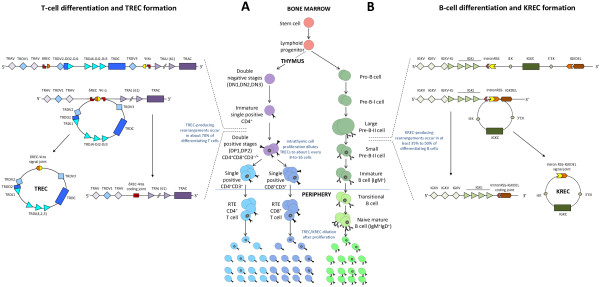
T-cell receptor excision circles (TRECs) and kappa-deleting recombination excision circles (KRECs) are circular DNA segments generated in T and B cells during their maturation in the thymus and bone marrow. These circularized DNA elements persist in the cells, are unable to replicate, and are diluted as a result of cell division, thus are considered markers of new lymphocyte output. The quantification of TRECs and KRECs, which can be reliably performed using singleplex or duplex real-time quantitative PCR, provides novel information in the management of T- and B-cell immunity-related diseases. In primary immunodeficiencies, when combined with flow cytometric analysis of T- and B-cell subpopulations, the measure of TRECs and KRECs has contributed to an improved characterization of the diseases, to the identification of patients' subgroups, and to the monitoring of stem cell transplantation and enzyme replacement therapy. For the same diseases, the TREC and KREC assays, introduced in the newborn screening program, allow early disease identification and may lead to discovery of new genetic defects. TREC and KREC levels can also been used as a surrogate marker of lymphocyte output in acquired immunodeficiencies. The low number of TRECs, which has in fact been extensively documented in untreated HIV-infected subjects, has been shown to increase following antiretroviral therapy. Differently, KREC number, which is in the normal range in these patients, has been shown to decrease following long-lasting therapy. Whether changes of KREC levels have relevance in the biology and in the clinical aspects of primary and acquired immunodeficiencies remains to be firmly established.
T 细胞受体切除环(TRECs)和κ 缺失重组切除环(KRECs)是 T 细胞和 B 细胞在胸腺和骨髓成熟过程中产生的环状 DNA 片段。这些环状 DNA 元件在细胞中持续存在,无法复制,并因细胞分裂而稀释,因此被认为是新淋巴细胞输出的标志物。TRECs 和 KRECs 的定量分析可以使用单重或双重实时定量 PCR 可靠地进行,为 T 细胞和 B 细胞免疫相关疾病的管理提供了新的信息。在原发性免疫缺陷中,当与 T 细胞和 B 细胞亚群的流式细胞术分析相结合时,TRECs 和 KRECs 的测量有助于对疾病进行更准确的描述,确定患者的亚组,并监测干细胞移植和酶替代治疗。对于相同的疾病,在新生儿筛查计划中引入的 TREC 和 KREC 检测可早期识别疾病,并且可能发现新的遗传缺陷。TREC 和 KREC 水平也可作为获得性免疫缺陷中淋巴细胞输出的替代标志物。实际上,在未经治疗的 HIV 感染患者中已经广泛记录了低数量的 TRECs,在接受抗逆转录病毒治疗后,TRECs 的数量会增加。相反,在这些患者中处于正常范围内的 KREC 数量在长期治疗后会减少。KREC 水平的变化是否与原发性和获得性免疫缺陷的生物学和临床方面相关,仍有待进一步确定。