Department of General Pediatrics, Division for Neuropediatrics and Metabolic Medicine, Center for Child and Adolescent Medicine and Dietmar Hopp Metabolic Center, University Hospital Heidelberg, Heidelberg, Germany.
Department of Pediatric Oncology, Hematology, Oncology and Immunology, University of Heidelberg, Heidelberg, Germany.
PLoS One. 2023 Mar 10;18(3):e0283024. doi: 10.1371/journal.pone.0283024. eCollection 2023.
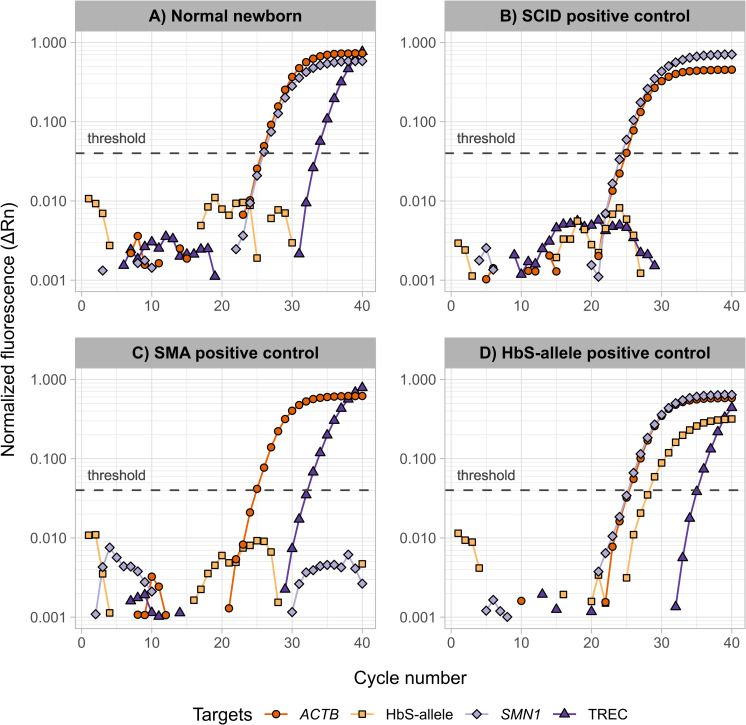
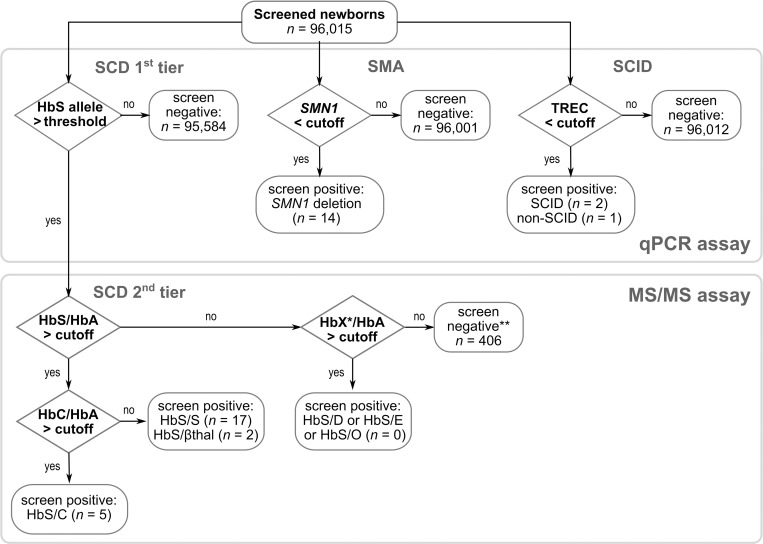
Early diagnosis of severe combined immunodeficiency (SCID), spinal muscular atrophy (SMA), and sickle cell disease (SCD) improves health outcomes by providing a specific treatment before the onset of symptoms. A high-throughput nucleic acid-based method in newborn screening (NBS) has been shown to be fast and cost-effective in the early detection of these diseases. Screening for SCD has been included in Germany's NBS Program since Fall 2021 and typically requires high-throughput NBS laboratories to adopt analytical platforms that are demanding in terms of instrumentation and personnel. Thus, we developed a combined approach applying a multiplexed quantitative real-time PCR (qPCR) assay for simultaneous SCID, SMA, and 1st-tier SCD screening, followed by a tandem mass spectrometry (MS/MS) assay for 2nd-tier SCD screening. DNA is extracted from a 3.2-mm dried blood spot from which we simultaneously quantify T-cell receptor excision circles for SCID screening, identify the homozygous SMN1 exon 7 deletion for SMA screening, and determine the integrity of the DNA extraction through the quantification of a housekeeping gene. In our two-tier SCD screening strategy, our multiplex qPCR identifies samples carrying the HBB: c.20A>T allele that is coding for sickle cell hemoglobin (HbS). Subsequently, the 2nd tier MS/MS assay is used to distinguish heterozygous HbS/A carriers from samples of patients with homozygous or compound heterozygous SCD. Between July 2021 and March 2022, 96,015 samples were screened by applying the newly implemented assay. The screening revealed two positive SCID cases, while 14 newborns with SMA were detected. Concurrently, the qPCR assay registered HbS in 431 samples which were submitted to 2nd-tier SCD screening, resulting in 17 HbS/S, five HbS/C, and two HbS/β thalassemia patients. The results of our quadruplex qPCR assay demonstrate a cost-effective and fast approach for a combined screening of three diseases that benefit from nucleic-acid based methods in high-throughput NBS laboratories.
早期诊断严重联合免疫缺陷症(SCID)、脊髓性肌萎缩症(SMA)和镰状细胞病(SCD)可以在症状出现前提供特定的治疗,从而改善健康结果。高通量基于核酸的新生儿筛查(NBS)方法已被证明在这些疾病的早期检测中快速且具有成本效益。自 2021 年秋季以来,德国的 NBS 计划已将 SCD 筛查纳入其中,通常需要高通量 NBS 实验室采用在仪器和人员方面要求苛刻的分析平台。因此,我们开发了一种联合方法,应用多重定量实时 PCR(qPCR)检测同时进行 SCID、SMA 和 1 级 SCD 筛查,然后进行串联质谱(MS/MS)检测进行 2 级 SCD 筛查。从 3.2 毫米的干血斑中提取 DNA,我们同时定量 SCID 筛查的 T 细胞受体切除环,识别 SMA 筛查的纯合 SMN1 外显子 7 缺失,并通过管家基因的定量来确定 DNA 提取的完整性。在我们的 2 级 SCD 筛查策略中,我们的多重 qPCR 鉴定携带编码镰状血红蛋白(HbS)的 HBB:c.20A>T 等位基因的样本。随后,使用第 2 层 MS/MS 检测来区分杂合 HbS/A 携带者和纯合或复合杂合 SCD 患者的样本。在 2021 年 7 月至 2022 年 3 月期间,应用新实施的检测共筛查了 96015 个样本。筛查发现了两个 SCID 阳性病例,同时检测到 14 名 SMA 新生儿。同时,qPCR 检测在 431 个样本中登记了 HbS,这些样本被提交进行 2 级 SCD 筛查,结果发现 17 名 HbS/S、5 名 HbS/C 和 2 名 HbS/β 地中海贫血患者。我们的四重 qPCR 检测结果表明,对于需要基于核酸的高通量 NBS 实验室方法的三种疾病的联合筛查,这是一种具有成本效益且快速的方法。