Department of Community and Global Health, Graduate School of Medicine, The University of Tokyo, 7-3-1, Hongo, Bunkyo-ku, Tokyo, 113-0033, Japan.
BMC Womens Health. 2013 May 9;13:22. doi: 10.1186/1472-6874-13-22.
Pelvic organ prolapse (POP) is a common gynecological condition that can affect quality of life (QOL) in women. In Nepal, the prevalence of POP is high, but many affected women are still deprived of treatment. Vaginal hysterectomy with pelvic floor repair is one of the common treatment options for advanced POP. However, QOL outcomes after surgery have not been reported in low-income countries. Thus, we aimed to examine changes in QOL among Nepalese women with POP after such surgery.
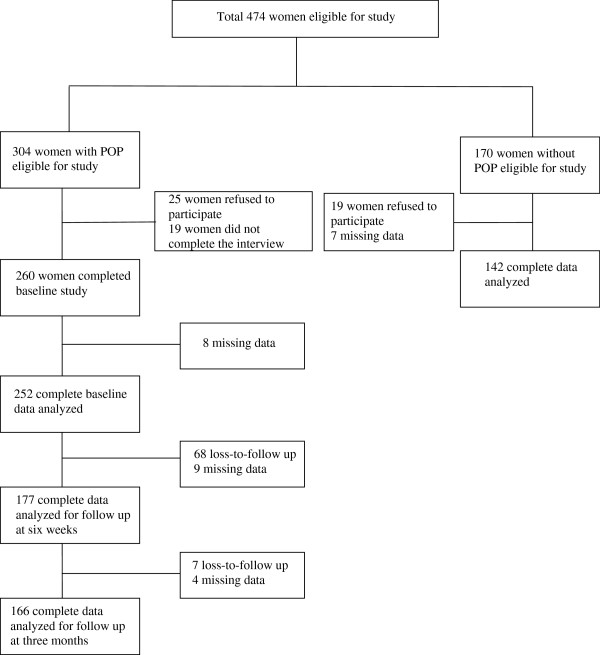
This longitudinal study was conducted in the selected central and peripheral hospitals in Nepal where vaginal hysterectomy was being performed free of cost for POP. A baseline study first measured the QOL domains (physical, psychological, social relationships and environment) among 252 women with advanced POP. Follow-up data was then collected at six weeks and three months after surgery. Among the 177 women that were available at six weeks post-surgery, 166 participated in the follow-up study at three months post-surgery. To evaluate QOL at baseline, 142 women with no history of POP were included as a comparison group.
The mean scores across QOL domains improved from baseline to 3 months after surgery. The baseline score for the physical domain increased from 11.2 to 12.8 at six weeks and 13.5 at three months post-surgery (p < 0.001); the psychological domain score increased from 11.6 to 13.1 at six weeks and 13.8 at three months post-surgery (p < 0.001); the social relationships domain score increased from 13.6 to 14.4 at six weeks and 15.0 at three months post-surgery (p < 0.001); and the environmental domain score increased from 12.9 to 13.9 at six weeks and 14.0 at three months post-surgery (p < 0.001).
QOL progressively improved among women undergoing surgery for POP. Such surgical services need to be scaled up for treatment of advanced POP in low-income countries.
盆腔器官脱垂(POP)是一种常见的妇科疾病,会影响女性的生活质量(QOL)。在尼泊尔,POP 的患病率很高,但许多受影响的女性仍然无法得到治疗。阴道子宫切除术加盆底修复是治疗晚期 POP 的常用方法之一。然而,在低收入国家,尚未报告手术后 QOL 的结果。因此,我们旨在研究尼泊尔患有 POP 的女性在接受此类手术后 QOL 的变化。
这项纵向研究在尼泊尔选定的中央和外围医院进行,那里正在免费为 POP 进行阴道子宫切除术。基线研究首先测量了 252 名患有晚期 POP 的女性的 QOL 领域(身体、心理、社会关系和环境)。然后在手术后六周和三个月收集随访数据。在术后六周可获得的 177 名女性中,有 166 名参加了术后三个月的随访研究。为了评估基线时的 QOL,还纳入了 142 名没有 POP 病史的女性作为对照组。
从基线到手术后三个月,所有 QOL 领域的平均得分均有所提高。身体领域的基线评分从术后六周的 11.2 增加到 12.8,术后三个月的评分增加到 13.5(p < 0.001);心理领域的评分从术后六周的 11.6 增加到 13.1,术后三个月的评分增加到 13.8(p < 0.001);社会关系领域的评分从术后六周的 13.6 增加到 14.4,术后三个月的评分增加到 15.0(p < 0.001);环境领域的评分从术后六周的 12.9 增加到 13.9,术后三个月的评分增加到 14.0(p < 0.001)。
接受 POP 手术的女性的 QOL 逐渐提高。在低收入国家,需要扩大此类手术服务以治疗晚期 POP。