UCLA School of Nursing, University of California, Olive View-UCLA Medical Center Los Angeles, 700 Tiverton Ave., 4-242 Factor Blvd., Los Angeles, CA 90095, USA.
J Gen Intern Med. 2011 Sep;26(9):979-86. doi: 10.1007/s11606-011-1668-y. Epub 2011 Mar 3.
We sought to examine the relationship between literacy and heart failure-related quality of life (HFQOL), and to explore whether literacy-related differences in knowledge, self-efficacy and/or self-care behavior explained the relationship.
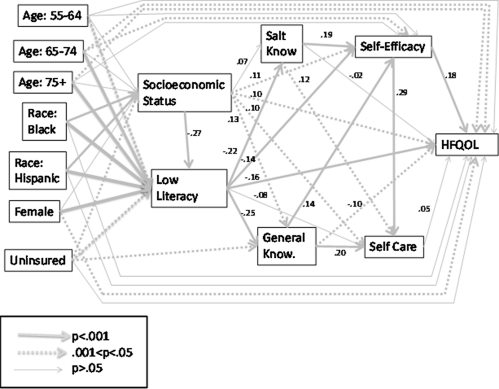
We recruited patients with symptomatic heart failure (HF) from four academic medical centers. Patients completed the short version of the Test of Functional Health Literacy in Adults (TOFHLA) and questions on HF-related knowledge, HF-related self-efficacy, and self-care behaviors. We assessed HFQOL with the Heart Failure Symptom Scale (HFSS) (range 0-100), with higher scores denoting better quality of life. We used bivariate (t-tests and chi-square) and multivariate linear regression analyses to estimate the associations between literacy and HF knowledge, self-efficacy, self-care behaviors, and HFQOL, controlling for demographic characteristics. Structural equation modeling was conducted to assess whether general HF knowledge, salt knowledge, self-care behaviors, and self-efficacy mediated the relationship between literacy and HFQOL.
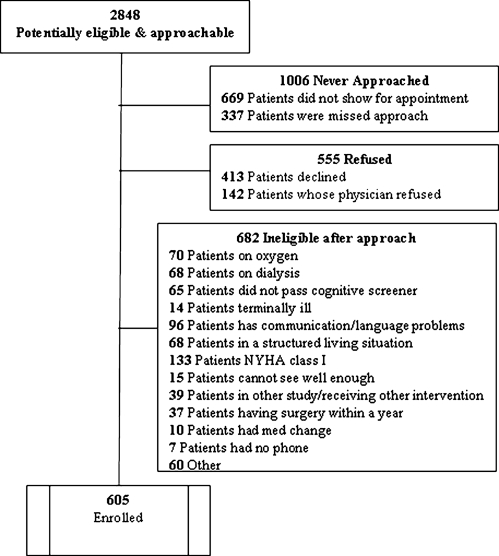
We enrolled 605 patients with mean age of 60.7 years; 52% were male; 38% were African-American and 16% Latino; 26% had less than a high school education; and 67% had annual incomes under $25,000. Overall, 37% had low literacy (marginal or inadequate on TOFHLA). Patients with adequate literacy had higher general HF knowledge than those with low literacy (mean 6.6 vs. 5.5, adjusted difference 0.63, p < 0.01), higher self-efficacy (5.0 vs. 4.1, adjusted difference 0.99, p < 0.01), and higher prevalence of key self-care behaviors (p < 0.001). Those with adequate literacy had better HFQOL scores compared to those with low literacy (63.9 vs. 55.4, adjusted difference 7.20, p < 0.01), but differences in knowledge, self-efficacy, and self-care did not mediate this difference in HFQOL.
Low literacy was associated with worse HFQOL and lower HF-related knowledge, self-efficacy, and self-care behaviors, but differences in knowledge, self-efficacy and self-care did not explain the relationship between low literacy and worse HFQOL.
我们旨在探讨文化程度与心力衰竭相关生活质量(HFQOL)之间的关系,并探讨文化程度相关的知识、自我效能感和/或自我护理行为差异是否可以解释这种关系。
我们从四个学术医疗中心招募了有症状心力衰竭(HF)的患者。患者完成了成人功能性健康文化程度测试(TOFHLA)的简短版本以及与 HF 相关的知识、HF 相关的自我效能感和自我护理行为的问题。我们使用心力衰竭症状量表(HFSS)(范围 0-100)评估 HFQOL,得分越高表示生活质量越好。我们使用双变量(t 检验和卡方检验)和多元线性回归分析来估计文化程度与 HF 知识、自我效能感、自我护理行为和 HFQOL 之间的关联,同时控制人口统计学特征。结构方程模型用于评估一般 HF 知识、盐知识、自我护理行为和自我效能感是否在文化程度与 HFQOL 之间起中介作用。
我们共纳入了 605 名平均年龄为 60.7 岁的患者;52%为男性;38%为非裔美国人,16%为拉丁裔;26%的受教育程度低于高中;67%的人年收入低于 25,000 美元。总体而言,37%的患者文化程度较低(TOFHLA 测试中为边缘或不充分)。具有足够文化程度的患者比文化程度较低的患者具有更高的一般 HF 知识(平均 6.6 对 5.5,调整差异 0.63,p<0.01)、更高的自我效能感(5.0 对 4.1,调整差异 0.99,p<0.01)和更高的关键自我护理行为的发生率(p<0.001)。与文化程度较低的患者相比,文化程度较高的患者 HFQOL 评分更好(63.9 对 55.4,调整差异 7.20,p<0.01),但知识、自我效能感和自我护理方面的差异并不能解释文化程度较低与 HFQOL 较差之间的关系。
文化程度较低与 HFQOL 较差以及 HF 相关知识、自我效能感和自我护理行为较差有关,但知识、自我效能感和自我护理方面的差异并不能解释文化程度较低与 HFQOL 较差之间的关系。