HAL Allergy BV, JH Oortweg 15, Leiden, The Netherlands.
Clin Transl Allergy. 2013 May 8;3(1):16. doi: 10.1186/2045-7022-3-16.
The current maintenance dose (10,000 AUeq/monthly) of a subcutaneous allergoid for house dust mite (HDM) immunotherapy has previously shown significant clinical efficacy in patients with HDM induced allergic rhinitis or rhinoconjunctivitis. In order to comply with the 2009 EMA guidelines on immunotherapy products, a study was conducted to evaluate the safety, tolerability and short-term treatment effects of up-dosing regimens with high doses (up to 40,000 AUeq) of allergoid HDM immunotherapy.
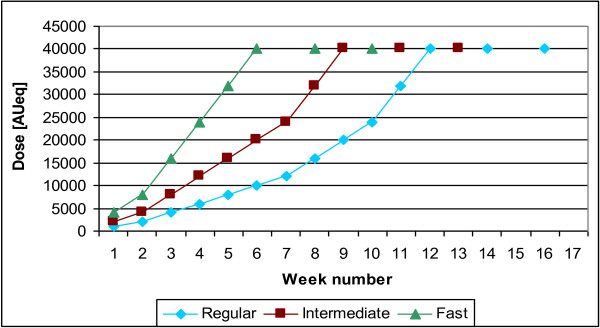
In total 48 patients with HDM-allergic rhinitis or rhinoconjunctivitis (29 M/19 F; 18-53 years) were included and enrolled into one of three up-dosing regimens (1:4:4): 1) a regular regimen with up-dosing to 40,000 AUeq followed by two maintenance doses (total duration 17 weeks), 2) an intermediate regimen (14 weeks) or 3) a fast regimen (11 weeks). Safety and tolerability were evaluated by monitoring of early and late local reactions and systemic reactions. In addition, short-term effects were assessed by conjunctival provocation test (CPT) and levels of serum allergen-specific IgE, IgG and IgG4.
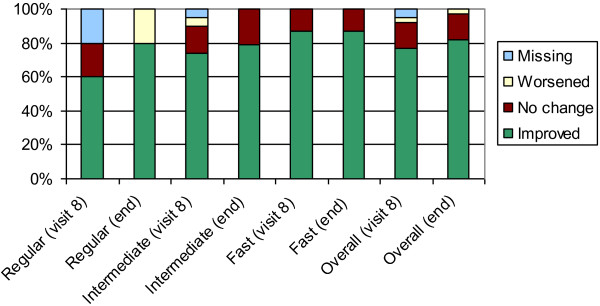
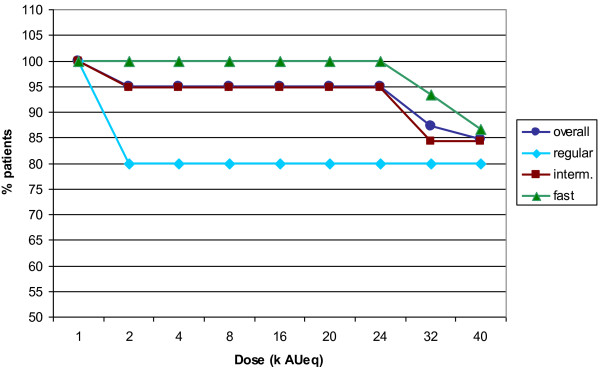
Thirty-nine patients completed the study according to protocol. No early local reactions occurred. Late local reactions (LLR) were observed in 12% of the injections. In total, 31 systemic reactions, all grade 1, were reported of which two needed oral antihistamine treatment. No grade 2 or higher systemic reactions were observed. Six patients (15%) did not reach the highest dose due to LLR and/or systemic reactions needing antihistamines (20% in the regular regimen, 16% in the intermediate regimen and 13% in the fast regimen). At the end of the study, an improvement in the CPT was observed in 82.1% of patients, indirectly indicating an early treatment effect at the current dose and higher doses. In addition, IgG4 immunoglobulin levels were significantly increased in all groups following treatment.
In this open-label study, allergoid HDM immunotherapy in doses up to 40,000 AUeq was generally well tolerated and no clinically relevant safety issues were identified. In the safety aspects of the three up-dosing regimens no clinically relevant differences were encountered. Therefore, these dose ranges and up-dosing regimens can be safely included in future dose-finding efficacy studies.
目前,皮下免疫原(10000AUeq/每月)用于屋尘螨(HDM)免疫治疗的维持剂量已在 HDM 诱导的过敏性鼻炎或鼻结膜炎患者中显示出显著的临床疗效。为了符合 2009 年 EMA 免疫治疗产品指南,进行了一项研究,以评估高剂量(高达 40000AUeq)免疫原 HDM 免疫治疗的递增方案的安全性、耐受性和短期治疗效果。
共纳入 48 例 HDM 过敏的鼻炎或鼻结膜炎患者(29 例男性/19 例女性;18-53 岁),并被纳入以下三种递增方案之一(1:4:4):1)常规方案,递增至 40000AUeq,然后进行两次维持剂量(总持续时间 17 周);2)中间方案(14 周)或 3)快速方案(11 周)。通过监测早期和晚期局部反应和全身反应来评估安全性和耐受性。此外,通过结膜激发试验(CPT)和血清过敏原特异性 IgE、IgG 和 IgG4 水平评估短期效果。
根据方案,39 例患者完成了研究。没有发生早期局部反应。12%的注射部位出现晚期局部反应(LLR)。共报告了 31 例全身反应,均为 1 级,其中 2 例需要口服抗组胺药治疗。未观察到 2 级或更高的全身反应。由于 LLR 和/或需要抗组胺药的全身反应(常规方案为 20%,中间方案为 16%,快速方案为 13%),有 6 例(15%)患者未达到最高剂量。研究结束时,82.1%的患者 CPT 得到改善,间接表明当前剂量和更高剂量的早期治疗效果。此外,所有组的 IgG4 免疫球蛋白水平在治疗后均显著升高。
在这项开放标签研究中,高达 40000AUeq 的免疫原 HDM 免疫治疗通常具有良好的耐受性,未发现有临床意义的安全性问题。在三种递增方案的安全性方面,未发现有临床意义的差异。因此,这些剂量范围和递增方案可以安全地纳入未来的剂量发现疗效研究。