Evolutionary Biology Center, Uppsala University, Uppsala, Sweden.
PLoS One. 2013 May 3;8(5):e62898. doi: 10.1371/journal.pone.0062898. Print 2013.
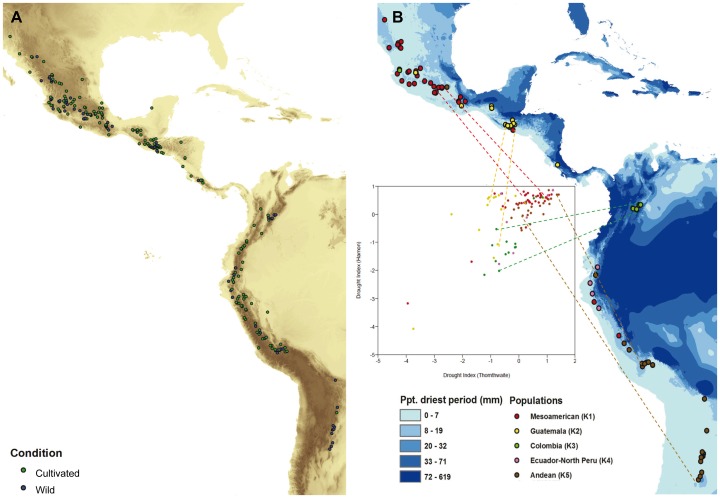
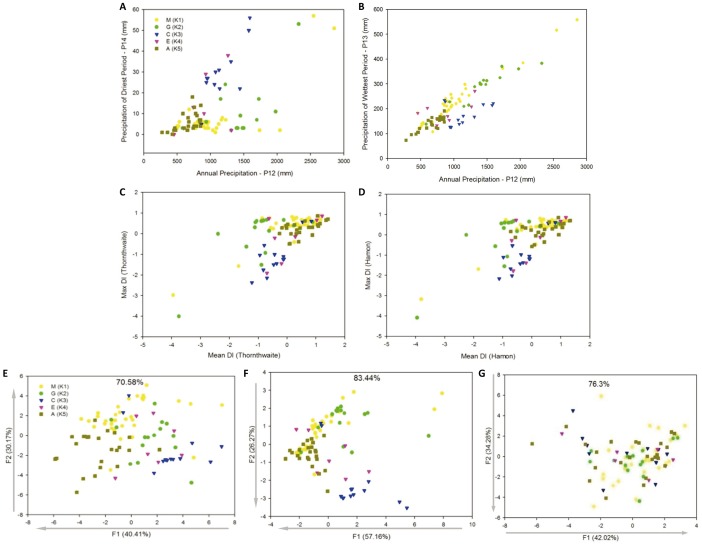
Reliable estimations of drought tolerance in wild plant populations have proved to be challenging and more accessible alternatives are desirable. With that in mind, an ecological diversity study was conducted based on the geographical origin of 104 wild common bean accessions to estimate drought tolerance in their natural habitats. Our wild population sample covered a range of mesic to very dry habitats from Mexico to Argentina. Two potential evapotranspiration models that considered the effects of temperature and radiation were coupled with the precipitation regimes of the last fifty years for each collection site based on geographical information system analysis. We found that wild accessions were distributed among different precipitation regimes following a latitudinal gradient and that habitat ecological diversity of the collection sites was associated with natural sub-populations. We also detected a broader geographic distribution of wild beans across ecologies compared to cultivated common beans in a reference collection of 297 cultivars. Habitat drought stress index based on the Thornthwaite potential evapotranspiration model was equivalent to the Hamon estimator. Both ecological drought stress indexes would be useful together with population structure for the genealogical analysis of gene families in common bean, for genome-wide genetic-environmental associations, and for postulating the evolutionary history and diversification processes that have occurred for the species. Finally, we propose that wild common bean should be taken into account to exploit variation for drought tolerance in cultivated common bean which is generally considered susceptible as a crop to drought stress.
在野生植物种群中可靠地估计耐旱性一直具有挑战性,因此需要更可行的替代方法。考虑到这一点,进行了一项生态多样性研究,该研究基于 104 个野生普通豆种的地理起源,以估计其在自然栖息地中的耐旱性。我们的野生种群样本涵盖了从墨西哥到阿根廷的一系列湿润到非常干燥的栖息地。根据地理信息系统分析,将考虑温度和辐射影响的两种潜在蒸散量模型与过去五十年的每个收集点的降水情况相结合。我们发现,野生品种根据纬度梯度分布在不同的降水区域,并且收集点的栖息地生态多样性与自然亚种群相关。与参考收集的 297 个品种的栽培普通豆相比,我们还发现野生豆在生态方面的地理分布更为广泛。基于 Thornthwaite 潜在蒸散量模型的生境干旱胁迫指数与 Hamon 估计值相当。这两个生态干旱胁迫指数将与种群结构一起用于普通豆基因家族的系统发生分析、全基因组遗传-环境关联以及推测物种发生的进化历史和多样化过程,非常有用。最后,我们建议考虑利用野生普通豆的变异性来提高栽培普通豆的耐旱性,因为一般认为栽培普通豆对干旱胁迫敏感。