Department of Neurobiology, Howard Hughes Medical Institute, Harvard Medical School, Boston, MA 02115, USA.
Neuron. 2013 May 8;78(3):510-22. doi: 10.1016/j.neuron.2013.03.017.
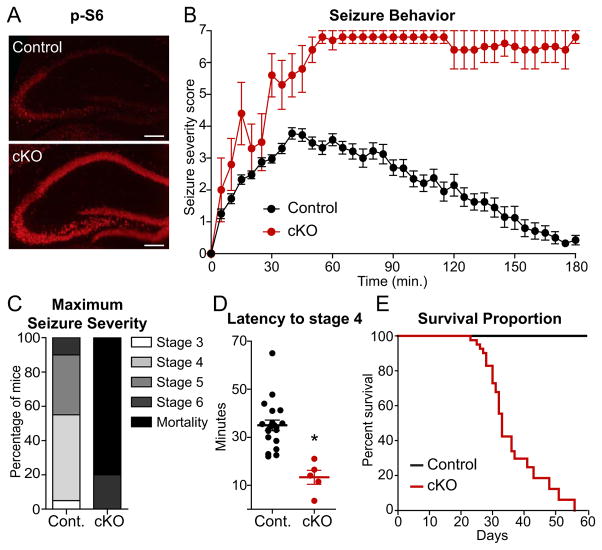
Neural circuits are regulated by activity-dependent feedback systems that tightly control network excitability and which are thought to be crucial for proper brain development. Defects in the ability to establish and maintain network homeostasis may be central to the pathogenesis of neurodevelopmental disorders. Here, we examine the function of the tuberous sclerosis complex (TSC)-mTOR signaling pathway, a common target of mutations associated with epilepsy and autism spectrum disorder, in regulating activity-dependent processes in the mouse hippocampus. We find that the TSC-mTOR pathway is a central component of a positive feedback loop that promotes network activity by repressing inhibitory synapses onto excitatory neurons. In Tsc1 KO neurons, weakened inhibition caused by deregulated mTOR alters the balance of excitatory and inhibitory synaptic transmission, leading to hippocampal hyperexcitability. These findings identify the TSC-mTOR pathway as a regulator of neural network activity and have implications for the neurological dysfunction in disorders exhibiting deregulated mTOR signaling.
神经回路受活动依赖性反馈系统调节,该系统可严格控制网络兴奋性,被认为对大脑正常发育至关重要。建立和维持网络内稳态的能力缺陷可能是神经发育障碍发病机制的核心。在这里,我们研究了结节性硬化复合物 (TSC)-mTOR 信号通路的功能,该通路是与癫痫和自闭症谱系障碍相关突变的常见靶点,其在调节小鼠海马体中活动依赖性过程中的作用。我们发现 TSC-mTOR 通路是一个正反馈回路的核心组成部分,通过抑制兴奋性神经元上的抑制性突触来促进网络活动。在 Tsc1 KO 神经元中,mTOR 失调导致的抑制作用减弱会改变兴奋性和抑制性突触传递之间的平衡,导致海马体过度兴奋。这些发现确定了 TSC-mTOR 通路是神经网络活动的调节剂,对表现出 mTOR 信号失调的神经紊乱的神经功能障碍具有重要意义。