UCL Institute of Ophthalmology, University College London, London EC1V 9EL, UK.
Curr Biol. 2013 May 20;23(10):890-4. doi: 10.1016/j.cub.2013.04.012. Epub 2013 May 9.
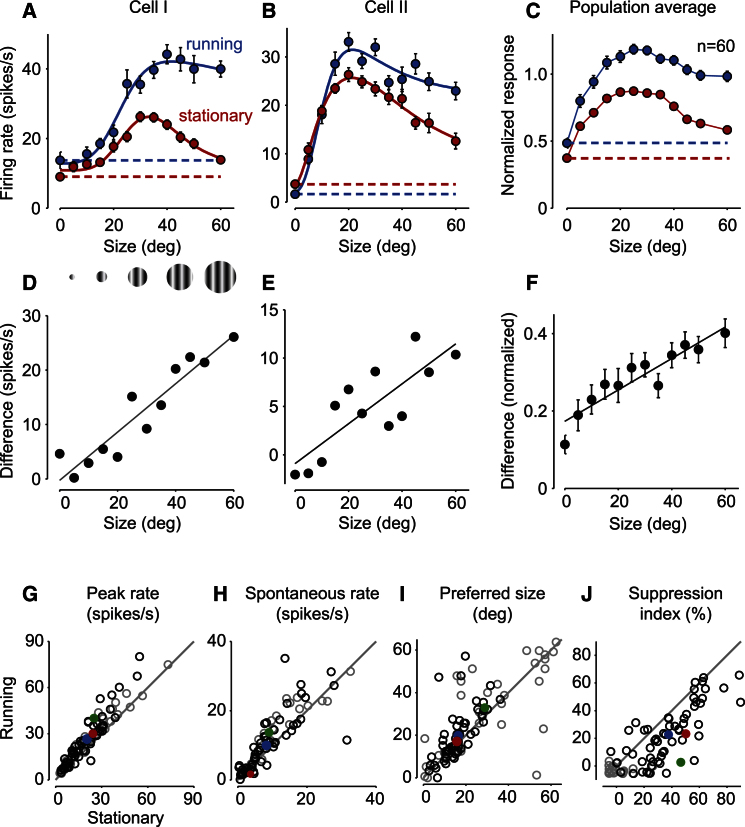
Growing evidence indicates that responses in sensory cortex are modulated by factors beyond direct sensory stimulation. In primary visual cortex (V1), for instance, responses increase with locomotion. Here we show that this increase is accompanied by a profound change in spatial integration. We recorded from V1 neurons in head-fixed mice placed on a spherical treadmill. We characterized spatial integration and found that the responses of most neurons were suppressed by large stimuli. As in primates, this surround suppression increased with stimulus contrast. These effects were captured by a divisive normalization model, where the numerator originates from a central region driving the neuron and the denominator originates from a larger suppressive field. We then studied the effects of locomotion and found that it markedly reduced surround suppression, allowing V1 neurons to integrate over larger regions of visual space. Locomotion had two main effects: it increased spontaneous activity, and it weakened the suppressive signals mediating normalization, relative to the driving signals. We conclude that a fundamental aspect of visual processing, spatial integration, is controlled by an apparently unrelated factor, locomotion. This control might operate through the mechanisms that are in place to deliver surround suppression.
越来越多的证据表明,感官皮层的反应不仅受到直接感官刺激的调节,还受到其他因素的影响。例如,在初级视觉皮层(V1)中,反应随着运动而增加。在这里,我们表明这种增加伴随着空间整合的深刻变化。我们在头部固定在球形跑步机上的小鼠的 V1 神经元上进行了记录。我们对空间整合进行了表征,发现大多数神经元的反应受到大刺激的抑制。与灵长类动物一样,这种周围抑制随着刺激对比度的增加而增加。这些影响被一个除法归一化模型所捕捉,其中分子来自驱动神经元的中央区域,分母来自更大的抑制区域。然后,我们研究了运动的影响,发现它显著降低了周围抑制,使 V1 神经元能够整合更大的视觉空间区域。运动有两个主要影响:它增加了自发活动,并且相对于驱动信号,它削弱了介导归一化的抑制信号。我们的结论是,视觉处理的一个基本方面,即空间整合,是由一个显然不相关的因素——运动来控制的。这种控制可能通过为提供周围抑制而建立的机制来进行。