
一种分层声学模型,用于水下声网络的相位偏移。
A stratified acoustic model accounting for phase shifts for underwater acoustic networks.
机构信息
Department of Electronic Engineering, Tsinghua University, Beijing 100084, China.
出版信息
Sensors (Basel). 2013 May 13;13(5):6183-203. doi: 10.3390/s130506183.
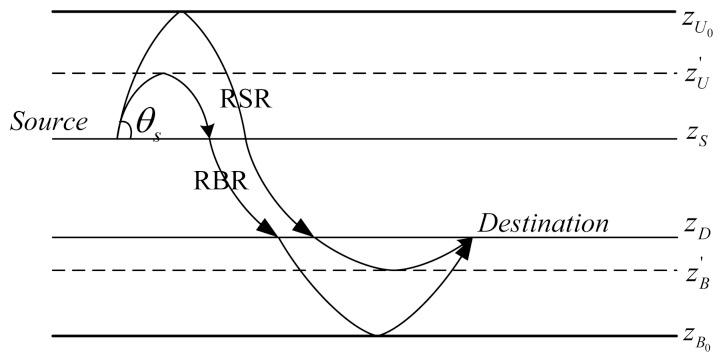
Accurate acoustic channel models are critical for the study of underwater acoustic networks. Existing models include physics-based models and empirical approximation models. The former enjoy good accuracy, but incur heavy computational load, rendering them impractical in large networks. On the other hand, the latter are computationally inexpensive but inaccurate since they do not account for the complex effects of boundary reflection losses, the multi-path phenomenon and ray bending in the stratified ocean medium. In this paper, we propose a Stratified Acoustic Model (SAM) based on frequency-independent geometrical ray tracing, accounting for each ray's phase shift during the propagation. It is a feasible channel model for large scale underwater acoustic network simulation, allowing us to predict the transmission loss with much lower computational complexity than the traditional physics-based models. The accuracy of the model is validated via comparisons with the experimental measurements in two different oceans. Satisfactory agreements with the measurements and with other computationally intensive classical physics-based models are demonstrated.
精确的声学信道模型对于水下声网络的研究至关重要。现有的模型包括基于物理的模型和经验近似模型。前者具有较高的准确性,但计算负荷较重,因此在大型网络中不实用。另一方面,后者计算成本较低,但不够准确,因为它们没有考虑边界反射损耗、多径现象和分层海洋介质中光线弯曲等复杂效应。在本文中,我们提出了一种基于频率无关几何光线跟踪的分层声模型(SAM),该模型考虑了传播过程中每条光线的相移。它是一种适用于大规模水下声网络模拟的信道模型,与传统的基于物理的模型相比,它可以以更低的计算复杂度来预测传输损耗。通过与两个不同海洋中的实验测量值进行比较,验证了该模型的准确性。结果表明,该模型与测量值以及其他计算密集型经典基于物理的模型具有较好的一致性。




 Zotero 插件