Internal Medicine, CHU Sétif, Sétif, Algeria.
Diabetes Ther. 2013 Jun;4(1):77-90. doi: 10.1007/s13300-013-0021-3. Epub 2013 May 14.
Diabetes therapy should balance glycemic control with risk of adverse events. This sub-analysis of the A1chieve study evaluated clinical safety and effectiveness of insulin detemir in different age-groups (≤40 years, >40-65 years, and >65 years) of insulin-experienced and insulin-naïve people with type 2 diabetes.
A1chieve was an international, open-label, non-interventional, 24-week study in 66,726 people with type 2 diabetes starting/switching to therapy with biphasic insulin aspart 30, insulin detemir or insulin aspart (alone/in combination) in routine clinical practice. This sub-analysis evaluated clinical safety and effectiveness in patients starting/switching to insulin detemir (±oral glucose-lowering drugs).
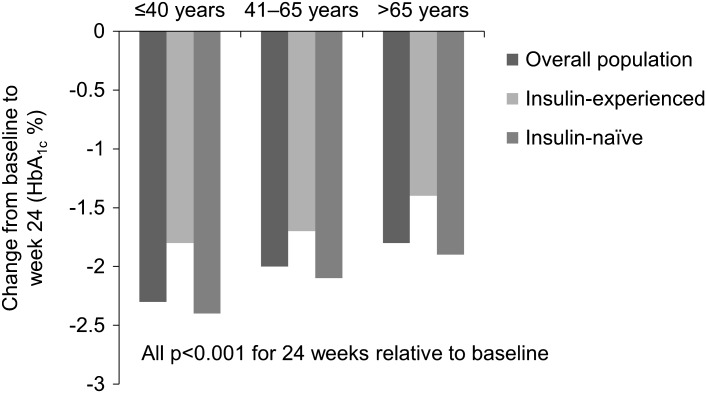
In total, 15,241 patients were included in the sub-analysis. In all age-groups, the proportion of participants experiencing any, major or nocturnal hypoglycemia was significantly (all p < 0.05) reduced relative to baseline, except in insulin-naïve patients for any and nocturnal hypoglycemia, where there was a significant increase or no significant change in patients aged >65 years and >40-65 years, respectively, and no significant change in major hypoglycemia in insulin-naïve patients aged ≤40 years. Seven serious adverse drug reactions were reported. Body weight was significantly reduced in patients aged ≤40 years and >40-65 years and significantly increased in insulin-naïve patients aged >65 years at 24 weeks. At 24 weeks, glycated hemoglobin was reduced by 2.3%, 2.0%, and 1.8%, in the ≤40 years, >40-65 years, and >65 years age-groups, respectively (all p < 0.001). Fasting and post-prandial plasma glucose were significantly reduced and health-related quality of life (HRQoL) significantly improved across all patient cohorts (all p < 0.001).
After 24-week treatment with insulin detemir, all age-groups of insulin-experienced and insulin-naïve patients had significantly improved glycemic control and HRQoL. The proportion of patients experiencing hypoglycemia was reduced in all age-groups but unchanged in insulin-naïve patients aged >40-65 years and increased in insulin-naïve patients aged >65 years. The safety and effectiveness of insulin detemir may benefit all age-groups.
糖尿病的治疗应在控制血糖和不良事件风险之间取得平衡。这项 A1chieve 研究的亚分析评估了在有经验和无经验使用胰岛素的 2 型糖尿病患者中不同年龄组(≤40 岁、>40-65 岁和>65 岁)中使用德谷胰岛素的临床安全性和有效性。
A1chieve 是一项国际性、开放性、非干预性、24 周的研究,共纳入了 66726 名开始/转换用双相门冬胰岛素 30、德谷胰岛素或门冬胰岛素(单独或联合)治疗的 2 型糖尿病患者,这些患者均处于常规临床实践中。这项亚分析评估了起始/转换用德谷胰岛素(±口服降糖药)的患者的临床安全性和有效性。
共有 15241 名患者纳入亚分析。在所有年龄组中,与基线相比,所有、主要或夜间低血糖的患者比例均显著(均 P<0.05)降低,除了无经验使用胰岛素的患者中,所有和夜间低血糖的患者比例在>65 岁和>40-65 岁患者中分别显著增加或无显著变化,≤40 岁无经验使用胰岛素的患者中主要低血糖无显著变化。报告了 7 例严重药物不良反应。体重在≤40 岁和>40-65 岁患者中显著降低,在>65 岁无经验使用胰岛素的患者中显著增加,在 24 周时。在 24 周时,≤40 岁、>40-65 岁和>65 岁年龄组的糖化血红蛋白分别降低了 2.3%、2.0%和 1.8%(均 P<0.001)。所有患者队列的空腹和餐后血糖均显著降低,健康相关生活质量(HRQoL)显著改善(均 P<0.001)。
在接受德谷胰岛素治疗 24 周后,有经验和无经验使用胰岛素的所有年龄组患者的血糖控制和 HRQoL 均显著改善。所有年龄组的低血糖患者比例均降低,但>40-65 岁无经验使用胰岛素的患者中无显著变化,而>65 岁无经验使用胰岛素的患者中增加。德谷胰岛素的安全性和有效性可能使所有年龄组受益。