Universidade Federal de São Paulo - UNIFESP, Federal University of São Paulo - Baixada Santista Campus, Santos, Brazil.
J Bras Pneumol. 2013 Mar-Apr;39(2):190-7. doi: 10.1590/s1806-37132013000200010.
To determine reference values for incremental shuttle walk distance (ISWD) and peak physiological responses during the incremental shuttle walk test (ISWT), as well as to develop a series of predictive equations for those variables in healthy adults.
We evaluated 103 healthy participants > 40 years of age (54 women and 49 men). We fitted each participant with a gas analysis system for use during the ISWT. Oxygen consumption (VO₂), carbon dioxide production, minute ventilation, heart rate (HR), ISWD, and maximal walking velocity (MWV) were obtained as primary outcomes. We also assessed hand grip strength (HGS) and lean body mass (LBM).
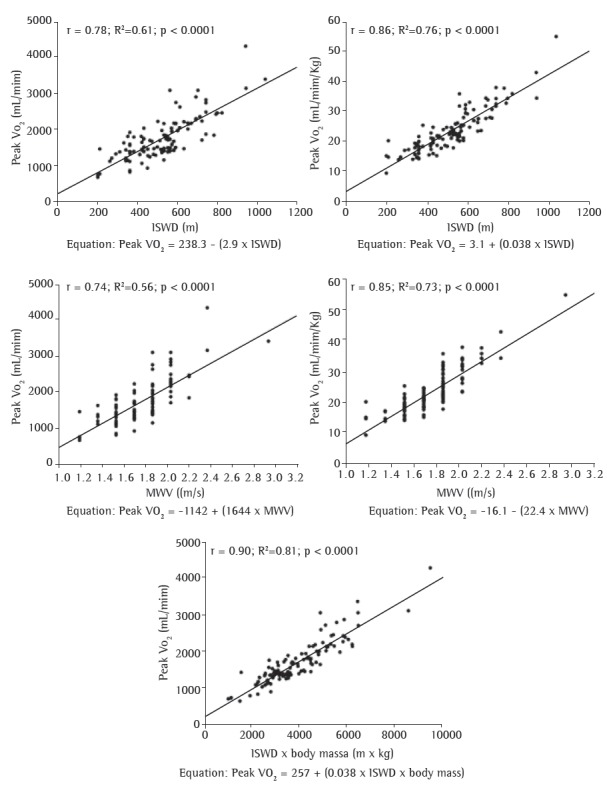
The regression analysis models, including physiological variables, ISWD, and MWV (adjusted for age, body mass, height, and sex), produced R² values ranging from 0.40 to 0.65 (for HR and peak VO₂, respectively). Using the models including LBM or HGS, we obtained no significant increase in the R² values for predicting peak VO₂, although the use of those models did result in slight increases in the R² values for ISWD and MWV (of 8% and 12%, respectively). The variables ISWD, MWV, and ISWD × body mass, respectively, explained 76.7%, 73.3%, and 81.2% of peak VO₂ variability.
Our results provide reference values for ISWD and physiological responses to the ISWT, which can be properly estimated by determining simple demographic and anthropometric characteristics in healthy adults > 40 years of age. The ISWT could be used in assessing physical fitness in the general adult population and in designing individualized walking programs.
确定递增式 shuttle 步行距离(ISWD)和递增式 shuttle 步行试验(ISWT)期间峰值生理反应的参考值,并为健康成年人开发一系列这些变量的预测方程。
我们评估了 103 名年龄超过 40 岁的健康参与者(54 名女性和 49 名男性)。我们为每位参与者配备了气体分析系统,用于 ISWT。主要结果是获得氧耗量(VO₂)、二氧化碳产生量、分钟通气量、心率(HR)、ISWD 和最大步行速度(MWV)。我们还评估了手握力(HGS)和瘦体重(LBM)。
包括生理变量、ISWD 和 MWV(按年龄、体重、身高和性别调整)的回归分析模型,产生的 R² 值范围从 0.40 到 0.65(分别为 HR 和峰值 VO₂)。使用包括 LBM 或 HGS 的模型,我们没有观察到预测峰值 VO₂的 R² 值显著增加,尽管使用这些模型确实导致 ISWD 和 MWV 的 R² 值略有增加(分别为 8%和 12%)。ISWD、MWV 和 ISWD×体重分别解释了峰值 VO₂变异性的 76.7%、73.3%和 81.2%。
我们的结果提供了 ISWD 和 ISWT 生理反应的参考值,这些值可以通过确定年龄超过 40 岁的健康成年人的简单人口统计学和人体测量特征来正确估计。ISWT 可用于评估一般成年人群的身体健康状况,并设计个性化的步行计划。