Department of Neuroscience, Temple University School of Medicine, Philadelphia, PA 19140, USA.
Virol J. 2013 May 14;10:147. doi: 10.1186/1743-422X-10-147.
Patients undergoing immune modulatory therapies for the treatment of autoimmune diseases such as multiple sclerosis, and individuals with an impaired-immune system, most notably AIDS patients, are in the high risk group of developing progressive multifocal leukoencephalopathy (PML), a fatal demyelinating disease of the white matter caused by human neurotropic polyomavirus, JC virus. It is now widely accepted that pathologic strains of JCV shows unique rearrangements consist of deletions and insertions within viral NCCR. While these kinds of rearrangements are related to viral tropism and pathology of the disease, their roles in molecular regulation of JCV gene expression and replication are unclear. We have previously identified SF2/ASF as a negative regulator of JCV gene expression in glial cells. This negative impact of SF2/ASF was dependent on its ability to bind a specific region mapped to the tandem repeat within viral promoter. In this report, functional role of SF2/ASF binding region in viral gene expression and replication was investigated by using deletion mutants of viral regulatory sequences.
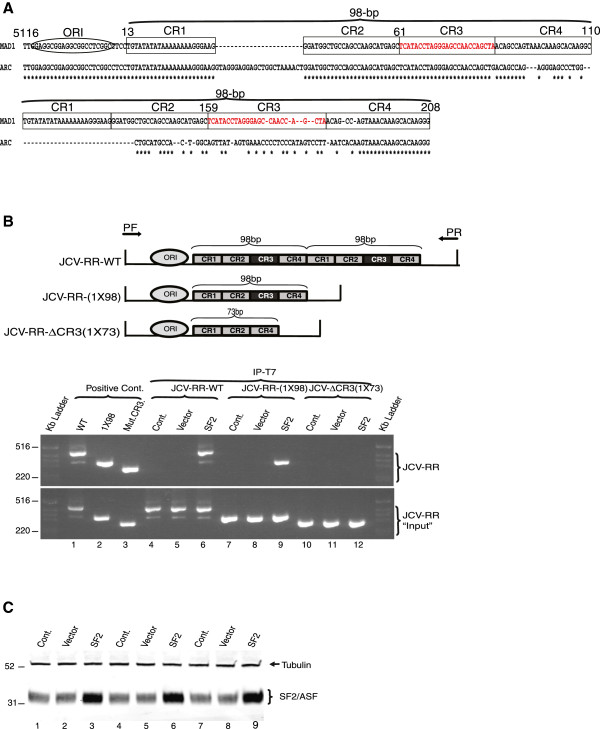
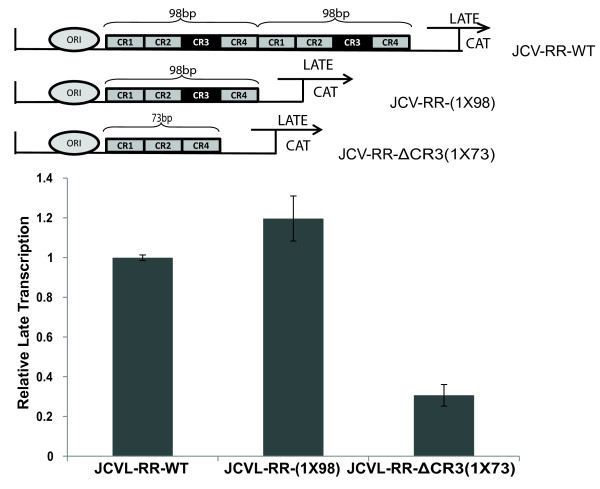
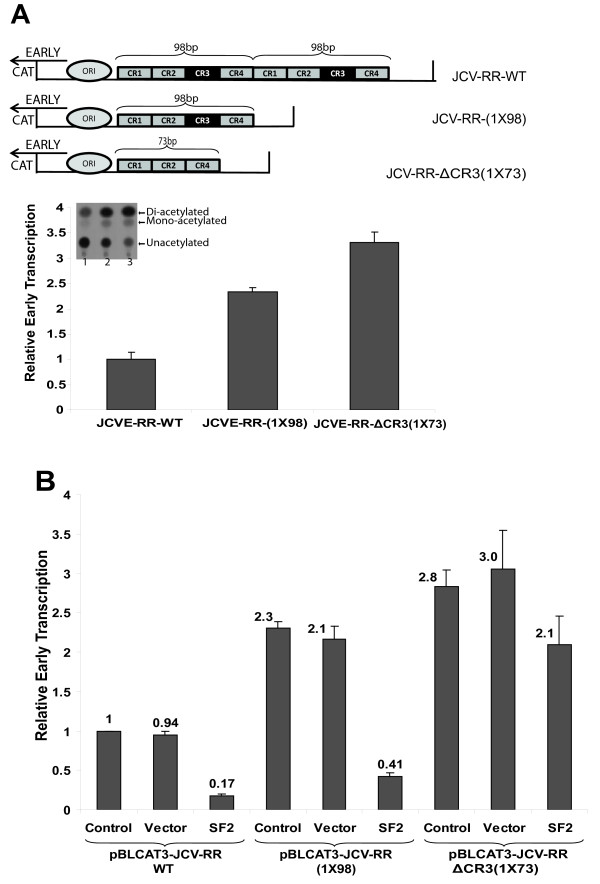
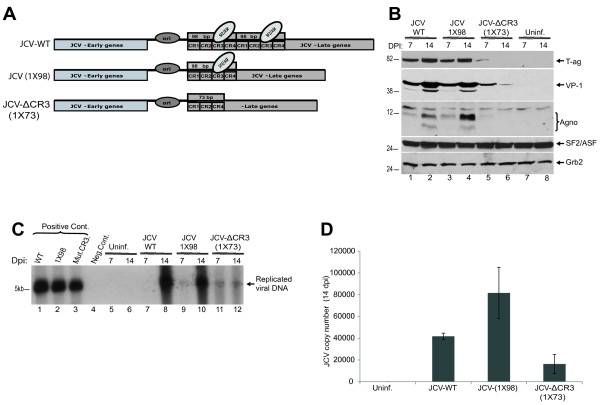
The second 98-base-pair tandem repeat on Mad1 strain was first mutated by deletion and named Mad1-(1X98). In addition to this mutant, the CR3 region which served the binding side for SF2/ASF was also mutated and named Mad1-ΔCR3 (1X73). Both mutations were tested for SF2/ASF binding by ChIP assay. While SF2/ASF was associated with Mad1-WT and Mad1-(1X98), its interaction was completely abolished on Mad1-ΔCR3 (1X73) construct as expected. Surprisingly, reporter gene analysis of Mad1-(1X98) and Mad1-ΔCR3 (1X73) early promoter sequences showed two and three fold increase in promoter activities, respectively. The impact of "CR3" region on JCV propagation was also tested on the viral background. While replication of Mad1-(1X98) strain in glial cells was similar to Mad1-WT strain, propagation of Mad1-ΔCR3 (1X73) was less productive. Further analysis of the transcription mediated by Mad1-ΔCR3 (1X73) NCCR revealed that late gene expression was significantly affected.
The results of this study reveal a differential role of CR3 region within JCV NCCR in expression of JCV early and late genes.
接受免疫调节疗法治疗多发性硬化等自身免疫性疾病的患者,以及免疫系统受损的个体,尤其是艾滋病患者,属于进展性多灶性白质脑病(PML)的高危人群,PML 是一种由人类亲神经多瘤病毒(JC 病毒)引起的致命性白质脱髓鞘疾病。目前人们普遍认为,病理株 JCV 显示出独特的重排,包括病毒 NCCR 内的缺失和插入。虽然这些重排与病毒嗜性和疾病病理学有关,但它们在 JCV 基因表达和复制的分子调控中的作用尚不清楚。我们之前已经确定 SF2/ASF 是神经胶质细胞中 JCV 基因表达的负调节剂。SF2/ASF 的这种负影响取决于其与映射到病毒启动子串联重复内特定区域结合的能力。在本报告中,通过使用病毒调节序列缺失突变体研究了 SF2/ASF 结合区在病毒基因表达和复制中的功能作用。
首先通过缺失突变 Mad1 株的第二个 98 个碱基对串联重复,命名为 Mad1-(1X98)。除了这种突变体,还突变了 CR3 区域,该区域是 SF2/ASF 的结合侧,命名为 Mad1-ΔCR3(1X73)。通过 ChIP 测定均测试了这两种突变体与 SF2/ASF 的结合。虽然 SF2/ASF 与 Mad1-WT 和 Mad1-(1X98)相关,但正如预期的那样,其与 Mad1-ΔCR3(1X73)构建体的相互作用完全被消除。令人惊讶的是,Mad1-(1X98)和 Mad1-ΔCR3(1X73)早期启动子序列的报告基因分析显示,启动子活性分别增加了两到三倍。还在病毒背景下测试了“CR3”区域对 JCV 传播的影响。Mad1-(1X98)株在神经胶质细胞中的复制与 Mad1-WT 株相似,而 Mad1-ΔCR3(1X73)株的复制效率较低。对 Mad1-ΔCR3(1X73)NCCR 介导的转录的进一步分析表明,晚期基因表达受到显著影响。
本研究结果揭示了 JCV NCCR 内 CR3 区域在 JCV 早期和晚期基因表达中的差异作用。