Craigie Michael, Regan Patrick, Otalora Yolanda-Lopez, Sariyer Ilker Kudret
Department of Neuroscience, Center for Neurovirology, Temple University Lewis Katz School of Medicine, 3500 North Broad Street, 7th Floor, Philadelphia, PA, 19140, USA.
Virol J. 2015 Nov 24;12:196. doi: 10.1186/s12985-015-0426-x.
Human polyomavirus JCV is the etiologic agent of progressive multifocal leukoencephalopathy (PML), a fatal demyelinating disease characterized by lytic infection of glial cells in the central nervous system. PML is seen primarily in immunosuppressed patients and is mainly classified as an AIDS-defining disease. In addition to structural capsid proteins, JCV encodes multiple regulatory proteins, including T-antigen and agnoprotein, which are required for functional lytic infection. Previous studies have suggested that molecular interaction between viral proteins and host factors play an important role in reactivation of JCV and progression of the viral life cycle in glial cells. Recently, serine/arginine rich splicing factor 1 (SRSF1), a cellular alternative splicing factor, was identified as a strong negative regulator of JCV in glial cells. SRSF1 inhibits JCV gene expression and viral replication by directly interacting with viral promoter sequences. Here, we have investigated possible impact of JCV regulatory proteins, T-antigen and agnoprotein, on SRSF1-mediated suppression of JCV gene expression in glial cells.
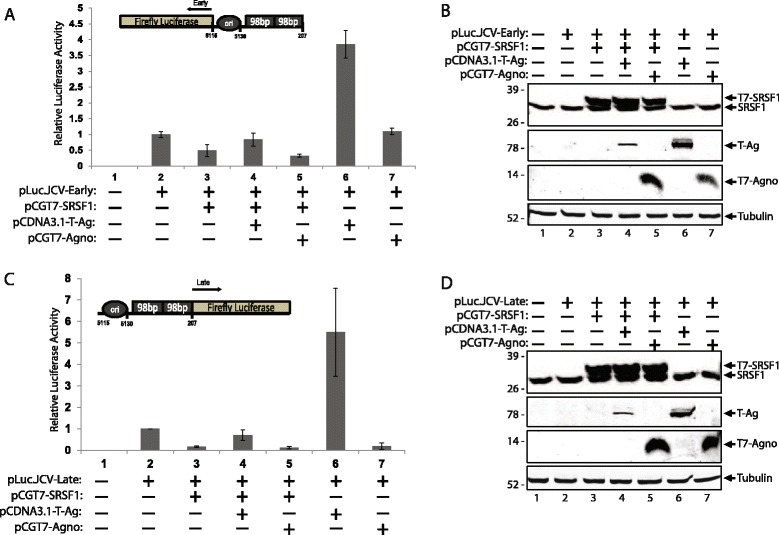
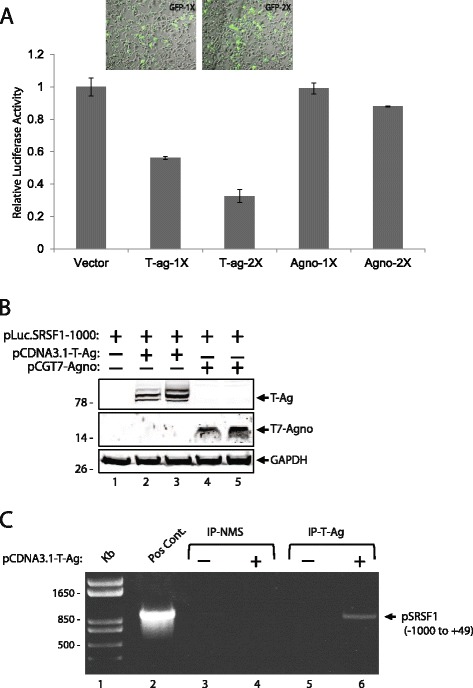
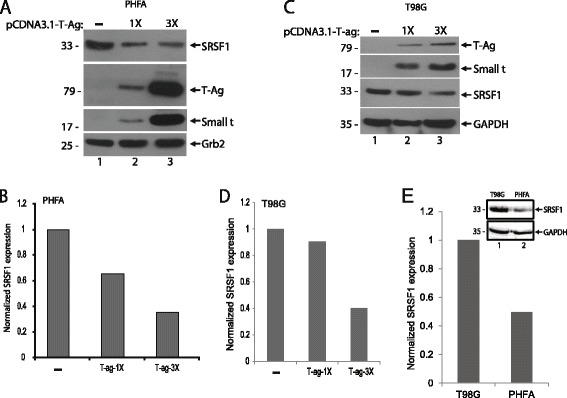
Reporter gene analysis has suggested that T-antigen rescues viral transcriptional suppression mediated by SRSF1. Further analyses have revealed that T-antigen promotes viral gene expression by suppressing SRSF1 gene transcription in glial cells. A subsequent ChIP analysis revealed that T-antigen associates with the promoter region of SRSF1 to induce the transcriptional suppression.
These findings have revealed a molecular interplay between cellular SRSF1 and viral T-antigen in controlling JCV gene expression, and may suggest a novel mechanism of JCV reactivation in patients who are at risk of developing PML.
人多瘤病毒JCV是进行性多灶性白质脑病(PML)的病原体,PML是一种致命的脱髓鞘疾病,其特征是中枢神经系统中的神经胶质细胞发生溶解性感染。PML主要见于免疫抑制患者,主要被归类为艾滋病定义疾病。除了结构衣壳蛋白外,JCV还编码多种调节蛋白,包括T抗原和agnoprotein,它们是功能性溶解性感染所必需的。先前的研究表明,病毒蛋白与宿主因子之间的分子相互作用在JCV的重新激活和神经胶质细胞中病毒生命周期的进展中起重要作用。最近,富含丝氨酸/精氨酸的剪接因子1(SRSF1),一种细胞可变剪接因子,被鉴定为神经胶质细胞中JCV的强负调节因子。SRSF1通过直接与病毒启动子序列相互作用来抑制JCV基因表达和病毒复制。在这里,我们研究了JCV调节蛋白T抗原和agnoprotein对神经胶质细胞中SRSF1介导的JCV基因表达抑制的可能影响。
报告基因分析表明,T抗原可挽救由SRSF1介导的病毒转录抑制。进一步分析表明,T抗原通过抑制神经胶质细胞中SRSF1基因转录来促进病毒基因表达。随后的染色质免疫沉淀分析表明,T抗原与SRSF1的启动子区域结合以诱导转录抑制。
这些发现揭示了细胞SRSF1与病毒T抗原在控制JCV基因表达方面的分子相互作用,并可能提示在有发生PML风险的患者中JCV重新激活的新机制。