Crescencio María Elena, Rodríguez Emma, Páez Araceli, Masso Felipe A, Montaño Luis F, López-Marure Rebeca
Departamento de Biología Celular, Instituto Nacional de Cardiología "Ignacio Chávez", México.
Int J Biomed Sci. 2009 Dec;5(4):411-20.
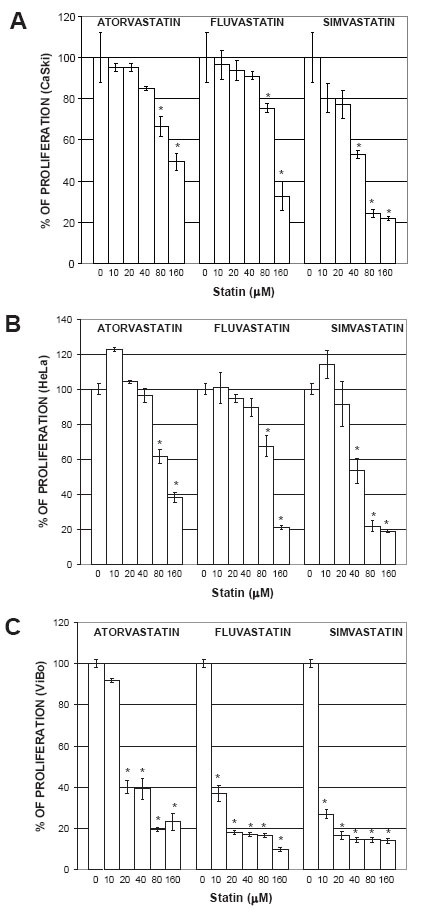
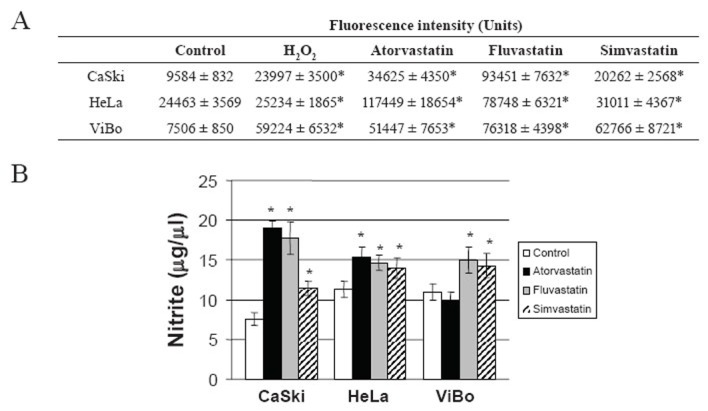
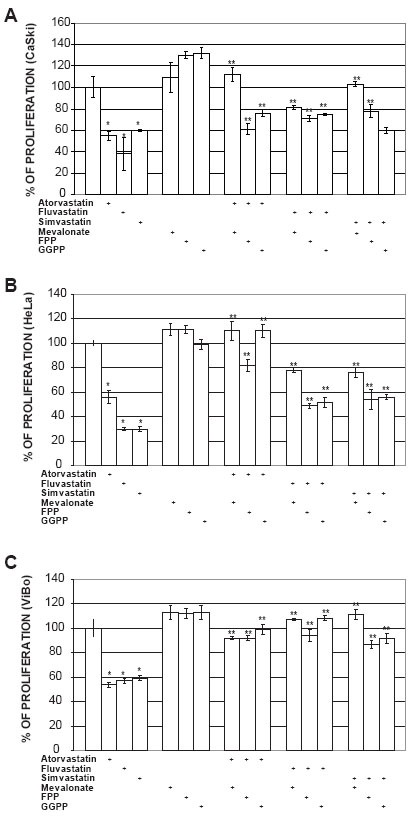
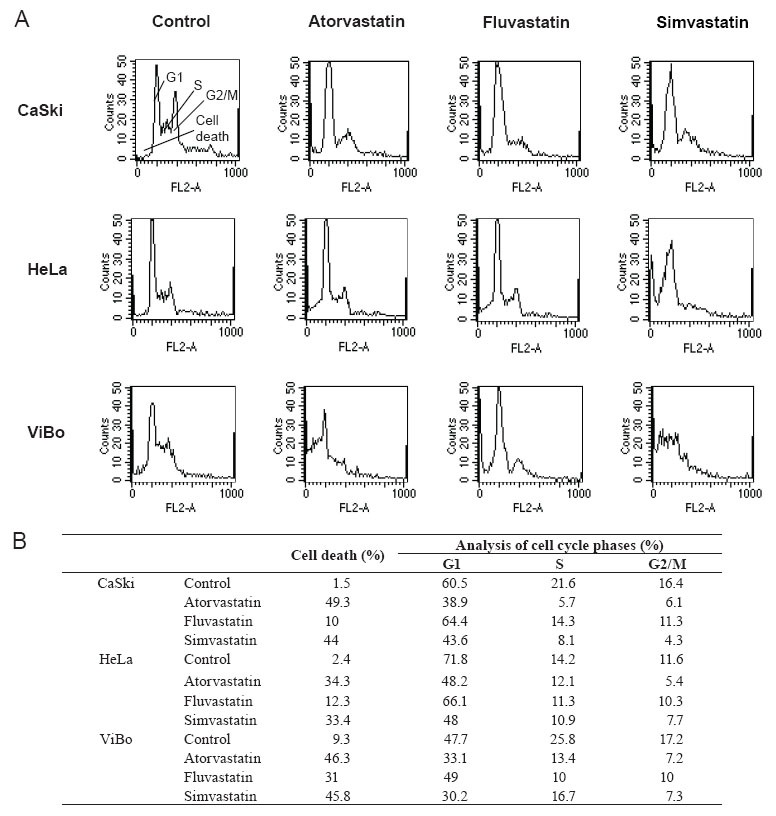
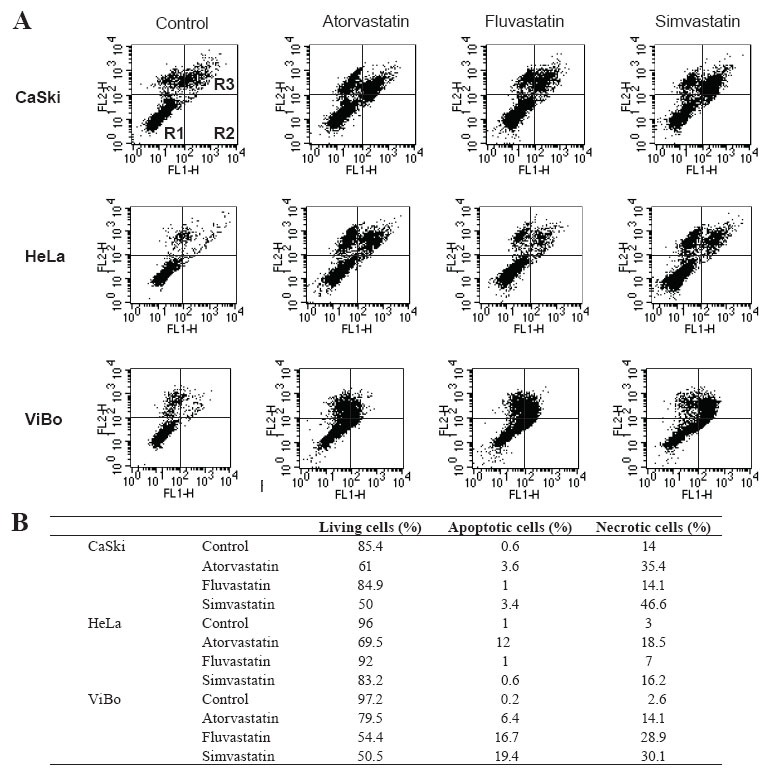
Statins, competitive inhibitors of 3-hydroxy-3-methylglutaryl-coenzyme A (HMG-CoA) reductase, have anti-tumoral effects on multiple cancer types; however, little is known about their effect on cervical cancer. We evaluated the effect on proliferation, cell cycle, oxidative stress and cell death of three statins on CaSki, HeLa (HPV(+)) and ViBo (HPV(-)) cervical cancer cell lines. Cell proliferation was assayed by crystal violet staining, cell cycle by flow cytometry and cell death by annexin-V staining. Reactive oxygen species (ROS) production was evaluated by the oxidation of 2,7-dichlorofluorescein diacetate and nitrite concentration (an indirect measure of nitric oxide (NO) production), by the Griess reaction. Inhibition of cell proliferation by atorvastatin, fluvastatin and simvastatin was dose-dependent. ViBo cells were the most responsive. Statins did not affect the cell cycle, instead they induced cell death. The antiproliferative effect in ViBo cells was completely inhibited with mevalonate, farnesyl pyrophosphate (FPP) and geranylgeranyl pyrophosphate (GGPP) treatments. In contrast, cell proliferation of CaSki and HeLa cells was partially (33%) rescued with these intermediates. The three statins increased ROS and nitrite production, mainly in the ViBo cell line. These results suggest that statins exert anti-tumoral effects on cervical cancer through inhibition of cell proliferation and induction of cell death and oxidative stress. Statins could be an aid in the treatment of cervical cancer, especially in HPV(-) tumors.
他汀类药物是3-羟基-3-甲基戊二酰辅酶A(HMG-CoA)还原酶的竞争性抑制剂,对多种癌症类型具有抗肿瘤作用;然而,关于它们对宫颈癌的影响知之甚少。我们评估了三种他汀类药物对CaSki、HeLa(HPV(+))和ViBo(HPV(-))宫颈癌细胞系的增殖、细胞周期、氧化应激和细胞死亡的影响。通过结晶紫染色测定细胞增殖,通过流式细胞术测定细胞周期,通过膜联蛋白V染色测定细胞死亡。通过二氯荧光素二乙酸酯的氧化评估活性氧(ROS)的产生,并通过Griess反应评估亚硝酸盐浓度(一氧化氮(NO)产生的间接测量)。阿托伐他汀、氟伐他汀和辛伐他汀对细胞增殖的抑制作用呈剂量依赖性。ViBo细胞反应最为敏感。他汀类药物不影响细胞周期,反而诱导细胞死亡。用甲羟戊酸、法尼基焦磷酸(FPP)和香叶基香叶基焦磷酸(GGPP)处理可完全抑制ViBo细胞的抗增殖作用。相比之下,这些中间体可部分(33%)挽救CaSki和HeLa细胞的增殖。三种他汀类药物主要在ViBo细胞系中增加ROS和亚硝酸盐的产生。这些结果表明,他汀类药物通过抑制细胞增殖、诱导细胞死亡和氧化应激对宫颈癌发挥抗肿瘤作用。他汀类药物可能有助于宫颈癌的治疗,尤其是在HPV(-)肿瘤中。