State Key Laboratory of Soil and Sustainable Agriculture, Institute of Soil Science, Chinese Academy of Sciences, Nanjing, Jiangsu, China.
PLoS One. 2013 May 13;8(5):e62955. doi: 10.1371/journal.pone.0062955. Print 2013.
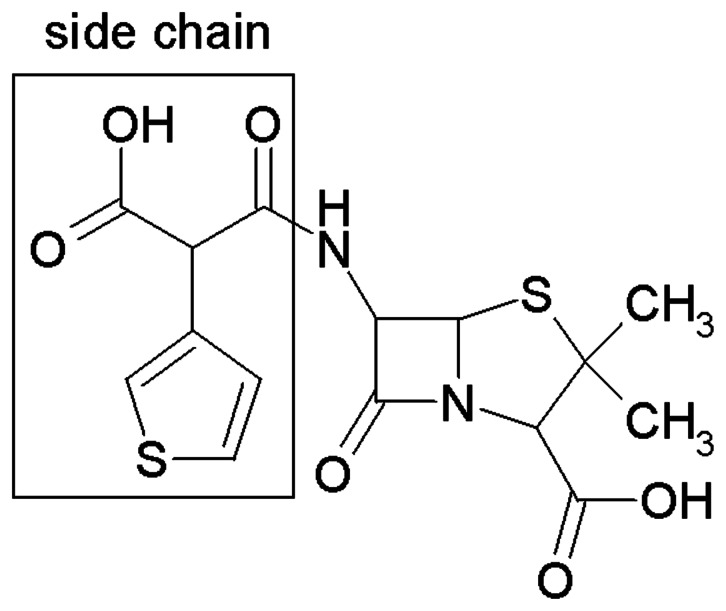
New Delhi metallo-β-lactmase-1 (NDM-1) has recently attracted extensive attention for its biological activities to catalyze the hydrolysis of almost all of β-lactam antibiotics. To study the catalytic property of NDM-1, the steady-kinetic parameters of NDM-1 toward several kinds of β-lactam antibiotics have been detected. It could effectively hydrolyze most β-lactams (k cat/K m ratios between 0.03 to 1.28 µmol⁻¹.s⁻¹), except aztreonam. We also found that thiophene-carboxylic acid derivatives could inhibit NDM-1 and have shown synergistic antibacterial activity in combination with meropenem. Flexible docking and quantum mechanics (QM) study revealed electrostatic interactions between the sulfur atom of thiophene-carboxylic acid derivatives and the zinc ion of NDM-1, along with hydrogen bond between inhibitor and His189 of NDM-1. The interaction models proposed here can be used in rational design of NDM-1 inhibitors.
新德里金属β-内酰胺酶-1(NDM-1)因其能够催化水解几乎所有β-内酰胺抗生素的生物学活性而受到广泛关注。为了研究 NDM-1 的催化特性,检测了 NDM-1 对几种β-内酰胺抗生素的稳态动力学参数。它可以有效水解大多数β-内酰胺类抗生素(k cat/K m 比值在 0.03 到 1.28 µmol⁻¹.s⁻¹ 之间),但不能水解氨曲南。我们还发现噻吩羧酸衍生物可以抑制 NDM-1,并与美罗培南联合显示出协同抗菌活性。柔性对接和量子力学(QM)研究揭示了噻吩羧酸衍生物的硫原子与 NDM-1 的锌离子之间的静电相互作用,以及抑制剂与 NDM-1 的 His189 之间的氢键。这里提出的相互作用模型可用于合理设计 NDM-1 抑制剂。