School of Science and Health, University of Western Sydney, Sydney, Australia.
BMC Public Health. 2013 May 15;13:477. doi: 10.1186/1471-2458-13-477.
Falls are one of the most common health problems among older people and pose a major economic burden on health care systems. Exercise is an accepted stand-alone fall prevention strategy particularly if it is balance training or regular participation in Tai chi. Dance shares the 'holistic' approach of practices such as Tai chi. It is a complex sensorimotor rhythmic activity integrating multiple physical, cognitive and social elements. Small-scale randomised controlled trials have indicated that diverse dance styles can improve measures of balance and mobility in older people, but none of these studies has examined the effect of dance on falls or cognition. This study aims to determine whether participation in social dancing: i) reduces the number of falls; and ii) improves cognitive functions associated with fall risk in older people.
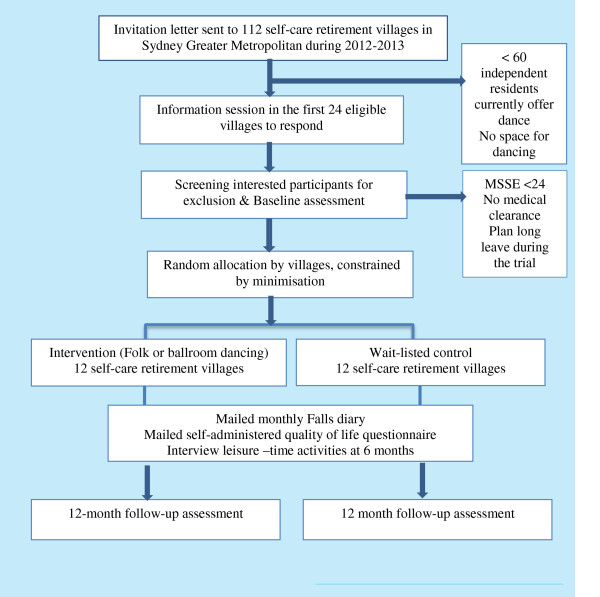
METHODS/DESIGN: A single-blind, cluster randomised controlled trial of 12 months duration will be conducted. Approximately 450 participants will be recruited from 24 self-care retirement villages that house at least 60 residents each in Sydney, Australia. Village residents without cognitive impairment and obtain medical clearance will be eligible. After comprehensive baseline measurements including physiological and cognitive tests and self-completed questionnaires, villages will be randomised to intervention sites (ballroom or folk dance) or to a wait-listed control using a computer randomisation method that minimises imbalances between villages based on two baseline fall risk measures. Main outcome measures are falls, prospectively measured, and the Trail Making cognitive function test. Cost-effectiveness and cost-utility analyses will be performed.
This study offers a novel approach to balance training for older people. As a community-based approach to fall prevention, dance offers older people an opportunity for greater social engagement, thereby making a major contribution to healthy ageing. Providing diversity in exercise programs targeting seniors recognises the heterogeneity of multicultural populations and may further increase the number of taking part in exercise.
Australian New Zealand Clinical Trials Registry ACTRN12612000889853The trial is now in progress with 12 villages already have been randomised.
跌倒 是老年人最常见的健康问题之一,给医疗保健系统带来了巨大的经济负担。锻炼是一种被广泛认可的独立跌倒预防策略,尤其是平衡训练或定期参加太极拳。舞蹈具有与太极拳等练习相同的“整体”方法。它是一种复杂的感知运动节奏活动,整合了多个身体、认知和社会元素。小规模随机对照试验表明,各种舞蹈风格可以改善老年人的平衡和活动能力,但这些研究都没有检测舞蹈对跌倒或认知的影响。本研究旨在确定参加社交舞:i)是否减少跌倒次数;ii)是否改善与老年人跌倒风险相关的认知功能。
方法/设计:这是一项为期 12 个月的单盲、群组随机对照试验。大约 450 名参与者将从澳大利亚悉尼的 24 个自理退休村招募,每个村至少有 60 名居民。没有认知障碍且获得医疗许可的村居民将有资格参加。在进行全面的基线测量,包括生理和认知测试以及自我完成的问卷后,将根据两个基线跌倒风险测量值,使用计算机随机化方法,将村庄随机分配到干预组(舞厅或民间舞蹈)或候补对照组。主要结果指标是跌倒,前瞻性测量,以及追踪认知功能测试。将进行成本效益和成本效用分析。
本研究为老年人的平衡训练提供了一种新方法。作为一种预防跌倒的社区方法,舞蹈为老年人提供了更多社交参与的机会,从而为健康老龄化做出了重大贡献。针对老年人的锻炼计划提供多样性,可识别出多元文化人群的异质性,并可能进一步增加参与锻炼的人数。
澳大利亚和新西兰临床试验注册中心 ACTRN12612000889853. 该试验目前正在进行中,已经有 12 个村已经被随机分配。