Prasad G Thiruvengita, Kumar T Suresh, Kumar R Krishna, Murthy Ganapathy K, Sundaram Nandkumar
Department of Orthopedics, Nova Specialty Surgery, Chennai, India.
Indian J Orthop. 2013 Mar;47(2):188-94. doi: 10.4103/0019-5413.108915.
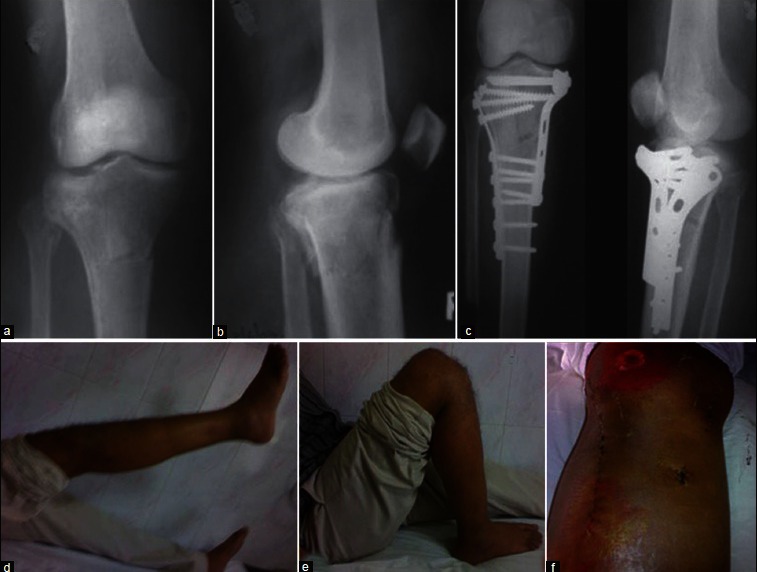
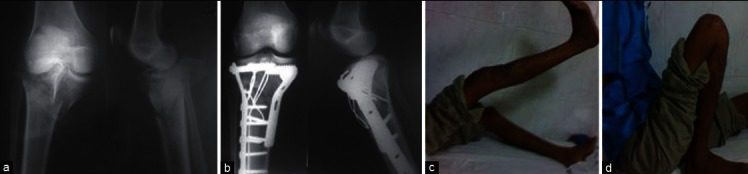
Dual plate fixation in comminuted bicondylar tibial plateau fractures remains controversial. Open reduction and internal fixation, specifically through compromised soft tissues, has historically been associated with major wound complications. Alternate methods of treatment have been described, each with its own merits and demerits. We performed a retrospective study to evaluate the functional outcome of lateral and medial plate fixation of Schatzker type V and VI fractures through an anterolateral approach, and a medial minimally invasive approach or a posteromedial approach.
We treated 46 tibial plateau fractures Schatzker type V and VI with lateral and medial plates through an anterolateral approach and a medial minimal invasive approach over an 8 years period. Six patients were lost to followup. Radiographs in two planes were taken in all cases. Immediate postoperative radiographs were assessed for quality of reduction and fixation. The functional outcome was evaluated according to the Oxford Knee Score criteria on followup.
Forty patients (33 men and 7 women) who completed the followup were included in the study. There were 20 Schatzker type V fractures and 20 Schatzker type VI fractures. The mean duration of followup was 4 years (range 1-8 years). All patients had a satisfactory articular reduction defined as ≤2 mm step-off or gap as assessed on followup. All patients had a good coronal and sagittal plane alignment, and articular width as assessed on supine X-rays of the knee in the anteroposterior (AP) and lateral views. The functional outcome, as assessed by the Oxford Knee Score, was excellent in 30 patients and good in 10 patients. All patients returned to their pre-injury level of activity and employment. There were no instances of deep infection.
Dual plate fixation of severe bicondylar tibial plateau fractures is an excellent treatment option as it provides rigid fixation and allows early knee mobilization. Careful soft tissue handling and employing minimal invasive techniques minimizes soft tissue complications.
双钢板固定治疗粉碎性双髁胫骨平台骨折仍存在争议。切开复位内固定,尤其是通过受损软组织进行的手术,历来与严重的伤口并发症相关。已描述了其他治疗方法,每种方法都有其自身的优缺点。我们进行了一项回顾性研究,以评估通过前外侧入路、内侧微创入路或后内侧入路对Schatzker V型和VI型骨折进行外侧和内侧钢板固定的功能结果。
我们在8年期间通过前外侧入路和内侧微创入路,用外侧和内侧钢板治疗了46例Schatzker V型和VI型胫骨平台骨折。6例患者失访。所有病例均拍摄了两个平面的X线片。对术后即刻X线片进行复位和固定质量评估。随访时根据牛津膝关节评分标准评估功能结果。
完成随访的40例患者(33例男性和7例女性)纳入研究。其中有20例Schatzker V型骨折和20例Schatzker VI型骨折。平均随访时间为4年(范围1 - 8年)。所有患者在随访时均获得了满意的关节复位,定义为台阶或间隙≤2 mm。所有患者在膝关节前后位(AP)和侧位仰卧位X线片上评估的冠状面和矢状面排列良好,关节宽度正常。根据牛津膝关节评分评估的功能结果,30例患者为优秀,10例患者为良好。所有患者均恢复到受伤前的活动和工作水平。无深部感染病例。
严重双髁胫骨平台骨折的双钢板固定是一种优秀的治疗选择,因为它提供了坚强的固定并允许早期膝关节活动。仔细处理软组织并采用微创技术可将软组织并发症降至最低。