Steele Leah S, Durbin Anna, Sibley Lyn M, Glazier Richard
Department of Family and Community Medicine, University of Toronto, Toronto, Ontario, Canada.
Open Med. 2013 Feb 12;7(1):e9-20. Print 2013.
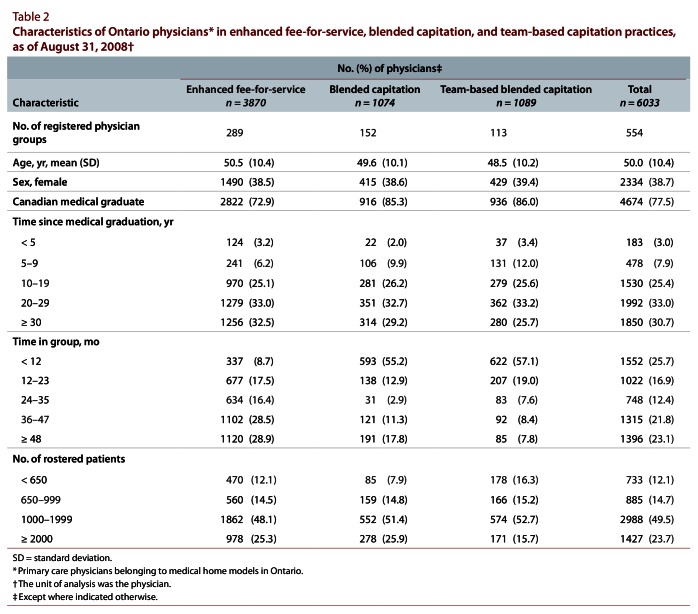
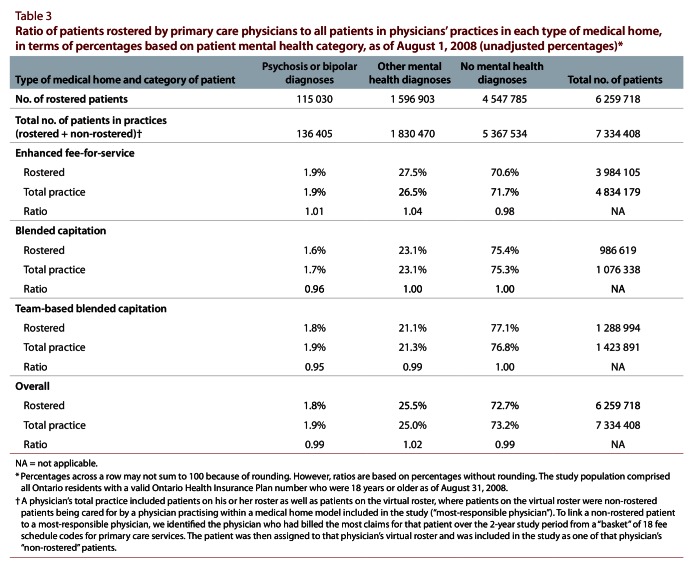
In Ontario, Canada, the patient-centred medical home is a model of primary care delivery that includes 3 model types of interest for this study: enhanced fee-for-service, blended capitation, and team-based blended capitation. All 3 models involve rostering of patients and have similar practice requirements but differ in method of physician reimbursement, with the blended capitation models incorporating adjustments for age and sex, but not case mix, of rostered patients. We evaluated the extent to which persons with mental illness were included in physicians' total practices (as rostered and non-rostered patients) and were included on physicians' rosters across types of medical homes in Ontario.
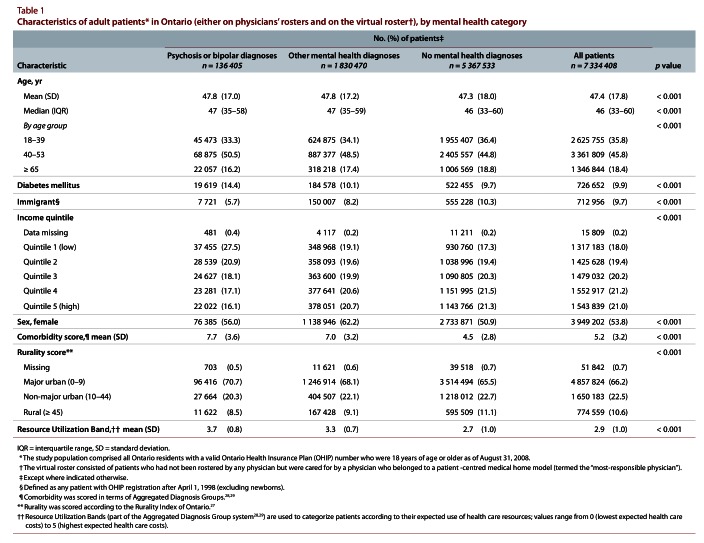
Using population-based administrative data, we considered 3 groups of patients: those with psychotic or bipolar diagnoses, those with other mental health diagnoses, and those with no mental health diagnoses. We modelled the prevalence of mental health diagnoses and the proportion of patients with such diagnoses who were rostered across the 3 medical home model types, controlling for demographic characteristics and case mix.
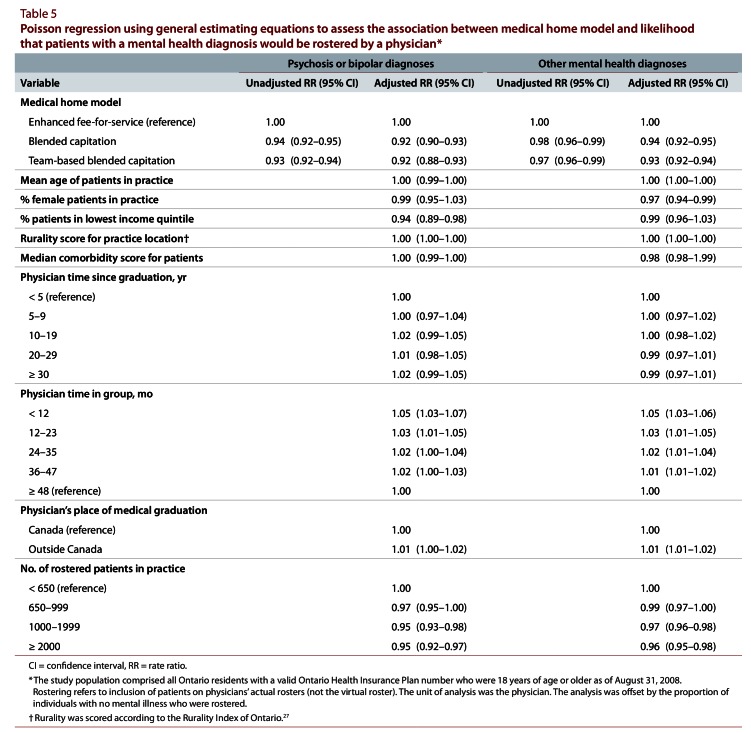
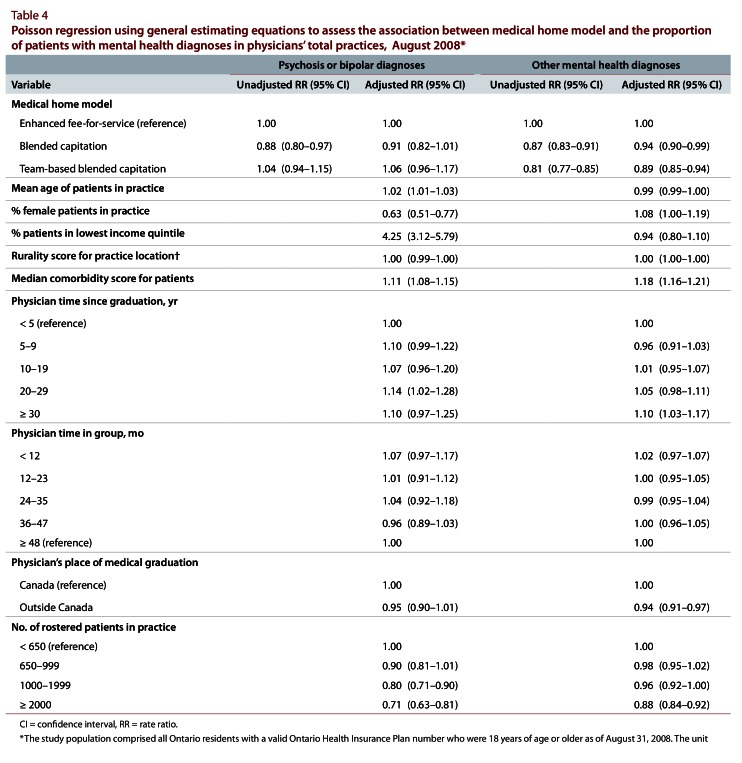
Compared with enhanced fee-for-service practices, and relative to patients without mental illness, the proportions of patients with psychosis or bipolar disorders were not different in blended capitation and team-based blended capitation practices (rate ratio [RR] 0.91, 95% confidence interval [CI] 0.82-1.01; RR 1.06, 95% CI 0.96-1.17, respectively). However, there were fewer patients with other mental illnesses (RR 0.94, 95% CI 0.90-0.99; RR 0.89, 95% CI 0.85-0.94, respectively). Compared with expected proportions, practices based on both capitation models were significantly less likely than enhanced fee-for-service practices to roster patients with psychosis or bipolar disorders (for blended capitation, RR 0.92, 95% CI 0.90-0.93; for team-based capitation, RR 0.92, 95% CI 0.88-0.93) and also patients with other mental illnesses (for blended capitation, RR 0.94, 95% CI 0.92-0.95; for team-based capitation, RR 0.93, 95% CI 0.92-0.94).
Persons with mental illness were under-represented in the rosters of Ontario's capitation-based medical homes. These findings suggest a need to direct attention to the incentive structure for including patients with mental illness.
在加拿大安大略省,以患者为中心的家庭医疗是一种初级医疗服务模式,本研究关注其中3种模式类型:强化按服务收费模式、混合人头付费模式和团队式混合人头付费模式。所有这3种模式都涉及患者登记,且有相似的执业要求,但医生报销方式不同,混合人头付费模式针对登记患者的年龄和性别进行调整,但不考虑病例组合。我们评估了患有精神疾病的人在医生的全部执业患者(包括登记患者和非登记患者)中的纳入程度,以及在安大略省不同类型家庭医疗模式中医生登记名单上的纳入情况。
利用基于人群的行政数据,我们考虑了3组患者:患有精神病或双相情感障碍诊断的患者、患有其他心理健康诊断的患者以及没有心理健康诊断的患者。我们对心理健康诊断的患病率以及在这3种家庭医疗模式类型中登记的此类诊断患者的比例进行建模,同时控制人口统计学特征和病例组合。
与强化按服务收费模式相比,相对于没有精神疾病的患者,在混合人头付费模式和团队式混合人头付费模式中,患有精神病或双相情感障碍的患者比例没有差异(率比[RR]分别为0.91,95%置信区间[CI]为0.82 - 1.01;RR为1.06,95%CI为0.96 - 1.17)。然而,患有其他精神疾病的患者较少(RR分别为0.94,95%CI为0.90 - 0.99;RR为0.89,95%CI为0.85 - 0.94)。与预期比例相比,基于两种人头付费模式的执业机构登记患有精神病或双相情感障碍患者的可能性显著低于强化按服务收费模式(混合人头付费模式,RR为0.92,95%CI为0.90 - 0.93;团队式人头付费模式,RR为0.92,95%CI为0.88 - 0.93),登记患有其他精神疾病患者的可能性也较低(混合人头付费模式,RR为0.94,95%CI为0.92 - 0.95;团队式人头付费模式,RR为0.93,95%CI为0.92 - 0.94)。
患有精神疾病的人在安大略省基于人头付费的家庭医疗登记名单中的代表性不足。这些发现表明需要关注纳入患有精神疾病患者的激励结构。