Department of Molecular and Clinical Pharmacology, Institute of Translational Medicine, The University of Liverpool, Liverpool L69 3BX, UK.
BMC Evol Biol. 2013 May 21;13:101. doi: 10.1186/1471-2148-13-101.
Retrotransposons are a major component of the human genome constituting as much as 45%. The hominid specific SINE-VNTR-Alus are the youngest of these elements constituting 0.13% of the genome; they are therefore a practical and amenable group for analysis of both their global integration, polymorphic variation and their potential contribution to modulation of genome regulation.
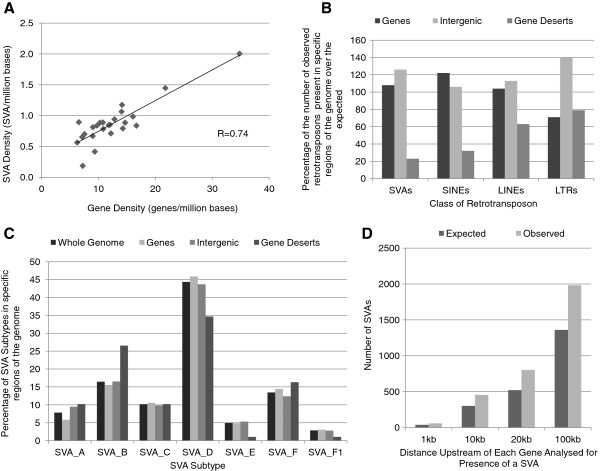
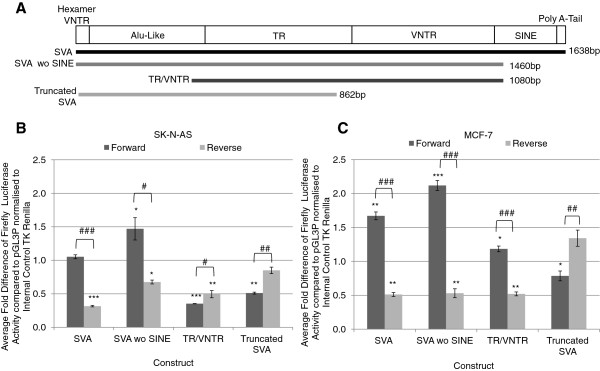
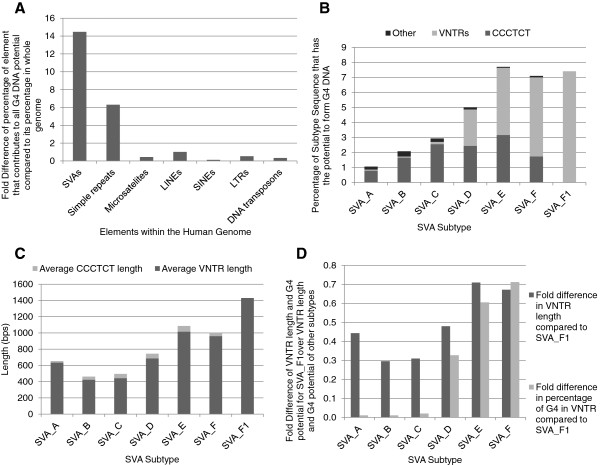
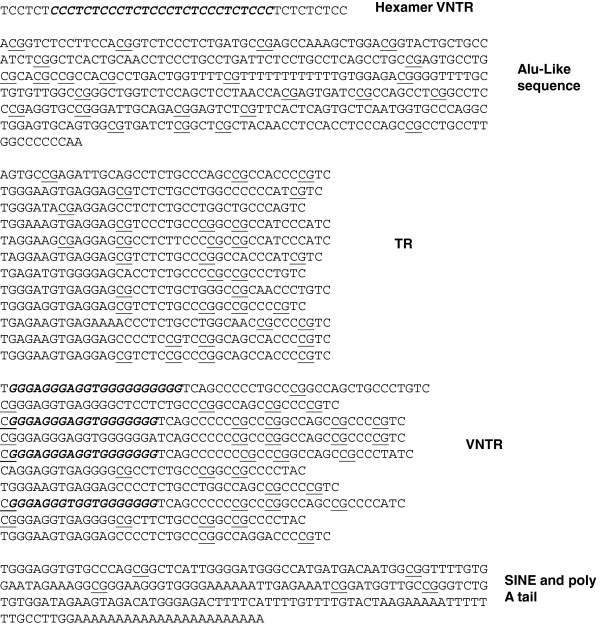
Consistent with insertion into active chromatin we have determined that SVAs are more prevalent in genic regions compared to gene deserts. The consequence of which, is that their integration has greater potential to have affects on gene regulation. The sequences of SVAs show potential for the formation of secondary structure including G-quadruplex DNA. We have shown that the human specific SVA subtypes (E-F1) show the greatest potential for forming G-quadruplexes within the central tandem repeat component in addition to the 5' 'CCCTCT' hexamer. We undertook a detailed analysis of the PARK7 SVA D, located in the promoter of the PARK7 gene (also termed DJ-1), in a HapMap cohort where we identified 2 variable number tandem repeat domains and 1 tandem repeat within this SVA with the 5' CCCTCT element being one of the variable regions. Functionally we were able to demonstrate that this SVA contains multiple regulatory elements that support reporter gene expression in vitro and further show these elements exhibit orientation dependency.
Our data supports the hypothesis that SVAs integrate preferentially in to open chromatin where they could modify the existing transcriptional regulatory domains or alter expression patterns by a variety of mechanisms.
逆转录转座子是人类基因组的主要组成部分,构成了多达 45%。人类特有的 SINE-VNTR-Alus 是这些元素中最年轻的,构成基因组的 0.13%;因此,它们是分析其整体整合、多态性变异及其对基因组调控调节潜在贡献的实用且可行的群体。
与插入活性染色质一致,我们确定 SVAs 在基因区域比基因荒漠中更为普遍。其结果是,它们的整合更有可能对基因调控产生影响。SVAs 的序列显示出形成二级结构的潜力,包括 G-四链体 DNA。我们已经表明,人类特异性 SVA 亚型 (E-F1) 在中央串联重复元件内形成 G-四链体的潜力最大,除了 5' 'CCCTCT' 六聚体外。我们在 HapMap 队列中对位于 PARK7 基因启动子中的 PARK7 SVA D(也称为 DJ-1)进行了详细分析,在该队列中我们鉴定出 2 个可变数串联重复域和 1 个串联重复,其中 5' CCCTCT 元件是可变区域之一。从功能上,我们能够证明这个 SVA 包含多个调节元件,支持体外报告基因的表达,并且进一步表明这些元件表现出定向依赖性。
我们的数据支持这样的假设,即 SVAs 优先整合到开放染色质中,在那里它们可以修饰现有的转录调控域,或者通过多种机制改变表达模式。