Royal National Orthopaedic Hospital, Stanmore, UK.
BMC Musculoskelet Disord. 2013 May 21;14:169. doi: 10.1186/1471-2474-14-169.
The purpose of this study was to examine the differences in gait profile between patients with knee osteoarthritis (OA) and healthy control and to create motion characteristics that will differentiate between them.
Twenty three patients diagnosed with knee OA and 21 healthy matched controls underwent a gait test using a sensor system (gaitWALK). Gait parameters evaluated were: stride duration, knee flexion range of motion (ROM) in swing and stance. T-Test was used to evaluate significant differences between groups (P < 0.05).
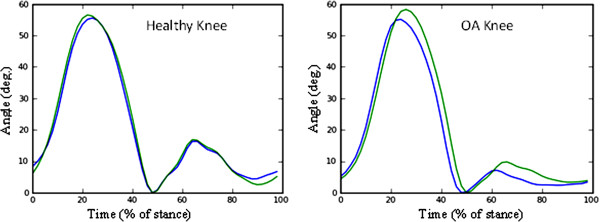
Patients with knee OA had significant lower knee flexion ROM (10.3° ± 4.0°) during stance than matched controls (18.0° ± 4.0°) (p < 0.001). Patients with knee OA had significant lower knee flexion ROM (54.8° ± 5.5°) during swing than matched controls (61.2° ± 6.1) (p = 0.003). Patients with knee OA also had longer stride duration (1.12 s ± 0.09 s) than matched controls (1.06 s ± 0.11 s), but this was not statistically significant (p = 0.073). Motion characteristics differentiate between a patient with knee OA and a healthy one with a sensitivity of 0.952 and a specificity of 0.783.
Significant differences were found in the gait profile of patients with knee OA compared to matched control and motion characteristics were identified. This test might help clinicians identify and evaluate a knee problem in a simple gait test.
本研究旨在探讨膝骨关节炎(OA)患者与健康对照者之间步态特征的差异,并创建可将两者区分开的运动特征。
23 例膝骨关节炎患者和 21 例健康匹配对照者使用传感器系统(gaitWALK)进行步态测试。评估的步态参数包括:步幅时间、摆动和支撑期的膝关节屈曲范围。使用 T 检验评估组间的显著差异(P < 0.05)。
膝骨关节炎患者在支撑期的膝关节屈曲ROM(10.3°±4.0°)明显低于匹配对照组(18.0°±4.0°)(p<0.001)。膝骨关节炎患者在摆动期的膝关节屈曲ROM(54.8°±5.5°)明显低于匹配对照组(61.2°±6.1°)(p=0.003)。膝骨关节炎患者的步幅时间也比匹配对照组长(1.12 s±0.09 s),但差异无统计学意义(p=0.073)。运动特征对膝骨关节炎患者和健康对照者具有较高的区分能力,敏感性为 0.952,特异性为 0.783。
与匹配对照组相比,膝骨关节炎患者的步态特征存在显著差异,并且确定了运动特征。该测试可能有助于临床医生在简单的步态测试中识别和评估膝关节问题。