Program in Personalized and Genomic Medicine, and the Division of Endocrinology, Diabetes and Nutrition, Department of Medicine, University of Maryland School of Medicine, Baltimore, MD, USA.
J Hum Genet. 2013 Jun;58(6):339-45. doi: 10.1038/jhg.2013.41. Epub 2013 May 23.
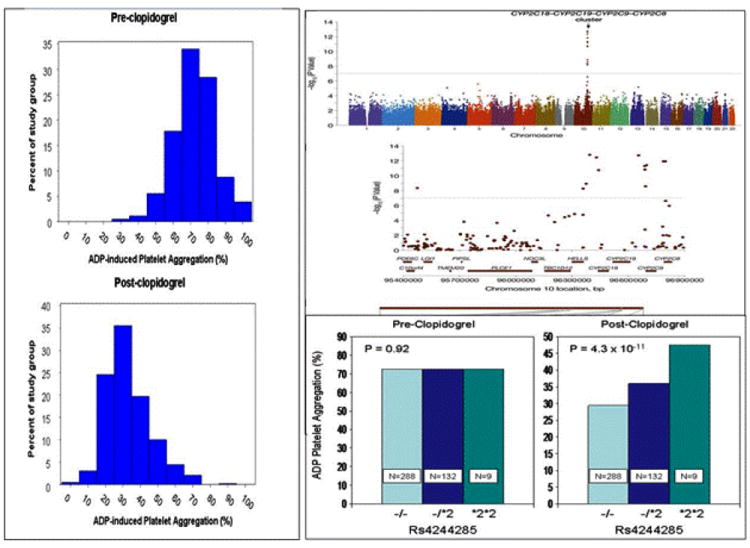
Pharmacogenomics, the study of the genomics of drug response and adverse effects, holds great promise for more effective individualized (personalized) medicine. Recent evidence supports a role of loss-of-function (LOF) variants in the cytochrome P450 enzyme CYP2C19 as a determinant of clopidogrel response. Patients given clopidogrel after percutaneous coronary intervention who carry LOF variants do not metabolize clopidogrel, a prodrug, into its active form resulting in decreased inhibition of platelet function and a higher likelihood of recurrent cardiovascular events. Despite a large body of evidence supporting clinical utility, adoption of anti-platelet pharmacogenetics into clinical practice has been slow. In this review, we summarize the pharmacokinetic, pharmacodynamic and clinical evidence, identify gaps in knowledge and other barriers that appear to be slowing adoption, and describe CYP2C19 pharmacogenetics implementation projects currently underway. Only when we surmount these barriers will clinicians be able to use pharmacogenetic information in conjunction with the history, physical examination and other medical tests and information to choose the most efficacious anti-platelet therapy for each individual patient.
药物基因组学,即药物反应和不良反应的基因组学研究,为更有效的个体化(个性化)医学提供了巨大的前景。最近的证据表明,细胞色素 P450 酶 CYP2C19 的失活(LOF)变体作为氯吡格雷反应的决定因素。接受经皮冠状动脉介入治疗后给予氯吡格雷的患者,如果携带 LOF 变体,就不能将氯吡格雷(一种前药)代谢为其活性形式,从而导致血小板功能抑制降低,复发性心血管事件的可能性增加。尽管有大量证据支持其临床实用性,但抗血小板药物基因组学在临床实践中的应用一直缓慢。在这篇综述中,我们总结了药物代谢动力学、药效学和临床证据,确定了知识空白和其他似乎阻碍其应用的障碍,并描述了目前正在进行的 CYP2C19 药物基因组学实施项目。只有克服这些障碍,临床医生才能将药物遗传学信息与病史、体检和其他医学检查和信息结合起来,为每个个体患者选择最有效的抗血小板治疗。