MMWR Morb Mortal Wkly Rep. 2013 May 24;62(20):405-8.
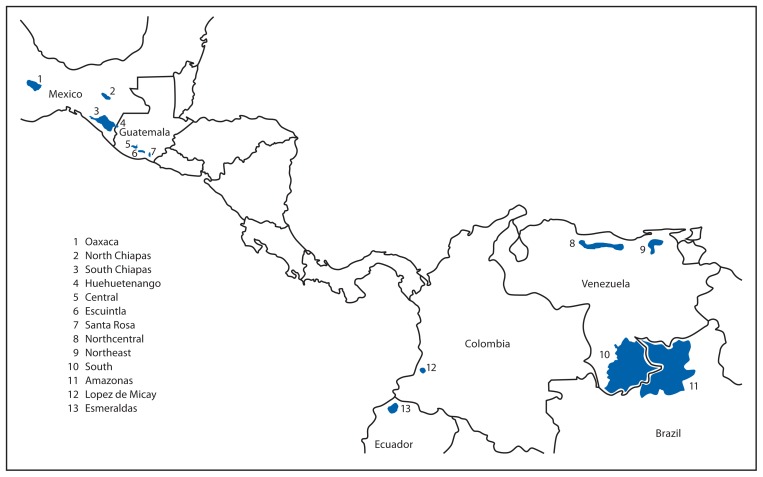
Onchocerciasis (river blindness) is caused by the parasitic worm Onchocerca volvulus, transmitted to humans by the bite of infected black flies of the genus Simulium, and is characterized by chronic skin disease, severe itching, and eye lesions that can progress to complete blindness. Currently, among approximately 123 million persons at risk for infection in 38 endemic countries, at least 25.7 million are infected, and 1 million are blinded or have severe visual impairment. Periodic, communitywide mass drug administration (MDA) with ivermectin (Mectizan, Merck) prevents eye and skin disease and might interrupt transmission of the infection, depending on the coverage, duration, and frequency of MDA. The Onchocerciasis Elimination Program for the Americas (OEPA) was launched in response to a 1991 resolution of the Pan American Health Organization (PAHO) calling for the elimination of onchocerciasis from the Americas. By the end of 2012, transmission of the infection, judged by surveys following World Health Organization (WHO) guidelines, had been interrupted or eliminated in four of the six endemic countries in the WHO Americas Region. Thus, in 2013, only 4% (23,378) of the 560,911 persons originally at risk in the Americas will be under ivermectin MDA. Active transmission currently is limited to two foci among Yanomami indigenes in adjacent border areas of Venezuela and Brazil.
盘尾丝虫病(河盲症)是由寄生虫盘尾丝虫引起的,通过受感染的黑蝇属(Simulium)的叮咬在人类间传播,其特征为慢性皮肤疾病、严重瘙痒和眼部病变,这些病变可能进展为完全失明。目前,在 38 个流行国家中约有 1.23 亿人面临感染风险,至少有 2570 万人受到感染,100 万人失明或存在严重视力损害。定期在社区范围内大规模使用伊维菌素(Mectizan,默克公司)进行药物治疗(MDA)可以预防眼部和皮肤疾病,并可能中断感染的传播,这取决于 MDA 的覆盖范围、持续时间和频率。美洲盘尾丝虫消除规划(OEPA)是对 1991 年泛美卫生组织(PAHO)决议的回应,该决议呼吁从美洲消除盘尾丝虫病。截至 2012 年底,根据世界卫生组织(WHO)指南进行的调查表明,在 WHO 美洲区域的六个流行国家中,有四个国家已经中断或消除了该感染的传播。因此,在 2013 年,美洲最初有 560911 人面临伊维菌素 MDA,只有 4%(23378 人)将接受药物治疗。目前,活跃的传播仅限于委内瑞拉和巴西接壤边境地区的两个雅诺马米印第安人聚居区。