Grupo de Parasitología, Instituto Nacional de Salud, Avenida Calle 26 No. 51-20, Bogotá, DC CP 111321, Colombia.
Laboratorio Departamental de Salud Pública, Secretaría Departamental de Salud del Cauca, Calle 5 No. 15-57, Popayán, Cauca, CP 190003, Colombia.
Parasit Vectors. 2018 Apr 11;11(1):237. doi: 10.1186/s13071-018-2821-9.
Onchocerciasis is a chronic parasitic infection originally endemic in 13 discrete regional foci distributed among six countries of Latin America (Brazil, Colombia, Ecuador, Guatemala, Mexico and Venezuela). In Colombia, this disease was discovered in 1965 in the Pacific Coast of the country. The National Onchocerciasis Elimination Program was established in 1993 with the aim of eliminating disease morbidity and infection transmission. In 2013, the World Health Organization (WHO) verified Colombia as free of onchocerciasis, becoming the first country in the world to reach such a goal. This report provides the empirical evidence of the elimination of Onchocerca volvulus transmission by Simulium exiguum (s.l.) after 12 years of 6-monthly mass drug administration of Mectizan® (ivermectin) to all the eligible residents living in this endemic area.
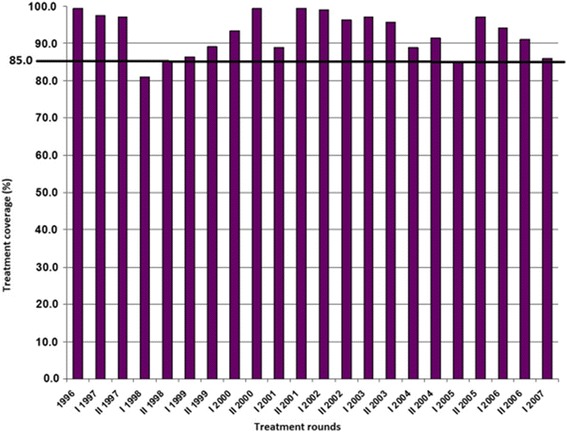
From 1996 onwards, a biannual community-based mass ivermectin administration programme was implemented, complemented by health education and community participation. In-depth parasitological, serological and entomological surveys were conducted periodically between 1998 and 2007 to evaluate the impact of ivermectin treatment according to the 2001 WHO guidelines. When the interruption of parasite transmission was demonstrated, the drug distribution ceased and a three-year post-treatment surveillance (PTS) period (2008-2010) was initiated.
After 23 rounds of treatment, parasitological and ophthalmological assessments showed absence of microfilariae in skin and anterior chamber of the eyes. Serological tests proved lack of antibodies against O. volvulus in children under 10 years-old. A total of 10,500 S. exiguum flies tested by PCR had no L3 infection (infectivity rate = 0.0095%; 95% CI: 0.0029-0.049) during 2004, indicating interruption of parasite transmission. However, biannual ivermectin treatments continued until 2007 followed by a 3-year PTS period at the end of which 13,481 flies were analyzed and no infective flies were found (infectivity rate = 0%; 95% CI: 0.0-0.014).
These results fulfilled the WHO criteria for onchocerciasis elimination. Consequently, in 2013 Colombia was verified as free of onchocerciasis, demonstrating that elimination of this neglected tropical disease is an achievable goal and paving the way for an elimination agenda to be followed by other endemic countries in Latin America and Africa.
盘尾丝虫病是一种慢性寄生虫感染病,最初流行于拉丁美洲的六个国家的 13 个离散区域性病灶中(巴西、哥伦比亚、厄瓜多尔、危地马拉、墨西哥和委内瑞拉)。在哥伦比亚,这种疾病于 1965 年在该国太平洋海岸发现。1993 年,成立了国家盘尾丝虫病消除规划,旨在消除疾病发病率和感染传播。2013 年,世界卫生组织(WHO)证实哥伦比亚已无盘尾丝虫病,成为全球首个达到这一目标的国家。本报告提供了通过对居住在该流行地区的所有符合条件的居民每六个月进行一次美代菌素(伊维菌素)大规模药物治疗,消灭 Simulium exiguum(s.l.)传播盘尾丝虫的经验证据。
自 1996 年以来,实施了一项每两年进行一次的社区为基础的大规模伊维菌素管理方案,并辅以健康教育和社区参与。1998 年至 2007 年期间,定期进行深入的寄生虫学、血清学和昆虫学调查,根据 2001 年世卫组织指南评估伊维菌素治疗的影响。当证明寄生虫传播中断时,停止药物分发,并开始为期三年的治疗后监测(PTS)期(2008-2010 年)。
经过 23 轮治疗,皮肤和眼前房的寄生虫学和眼科评估显示无微丝蚴。血清学检测证明 10 岁以下儿童体内无针对 O.volvulus 的抗体。2004 年,通过 PCR 共检测了 10500 只 S.exiguum 苍蝇,感染率为 0.0095%(95%置信区间:0.0029-0.049),表明寄生虫传播已中断。然而,直到 2007 年,每年仍进行两次伊维菌素治疗,然后进行为期三年的 PTS 期,在该期间共分析了 13481 只苍蝇,未发现感染性苍蝇(感染率=0%;95%置信区间:0.0-0.014)。
这些结果符合世卫组织消除盘尾丝虫病的标准。因此,2013 年哥伦比亚被证实无盘尾丝虫病,证明消除这种被忽视的热带病是可以实现的目标,并为拉丁美洲和非洲其他流行国家制定消除议程铺平了道路。