Institute of Biology - Applied Zoology/Animal Ecology, Freie Universität Berlin, Berlin, Germany.
PLoS One. 2013 May 20;8(5):e63392. doi: 10.1371/journal.pone.0063392. Print 2013.
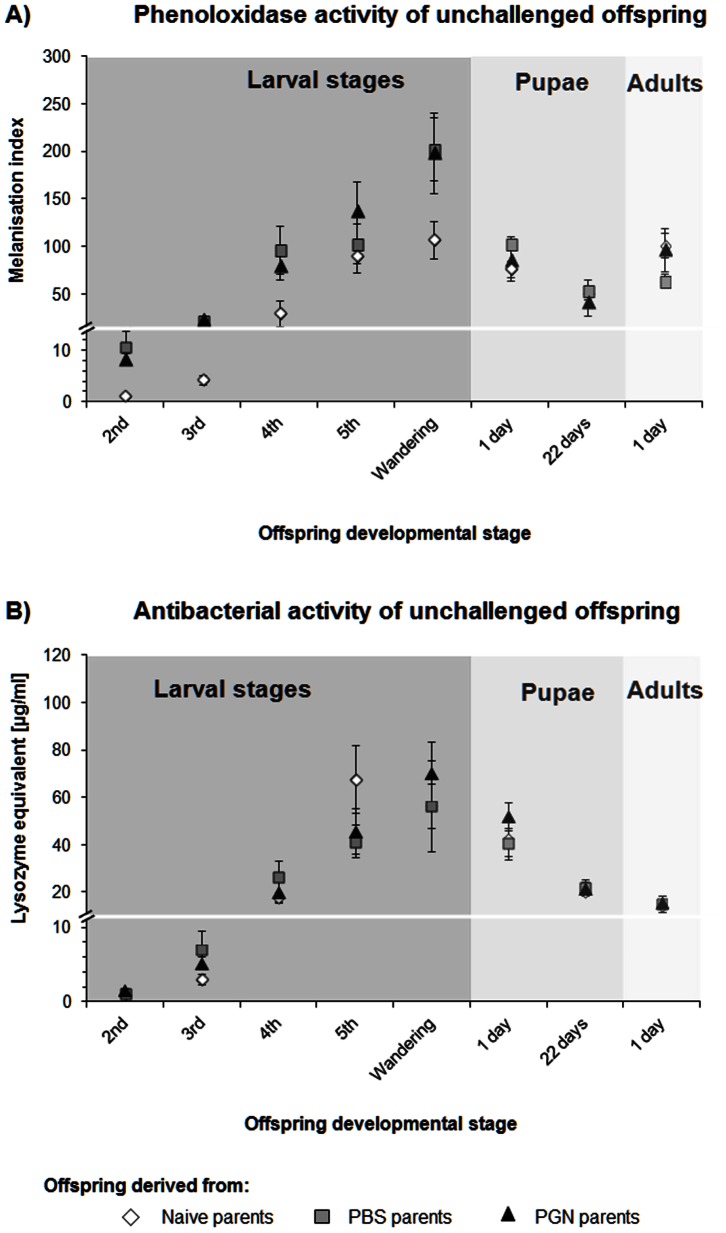
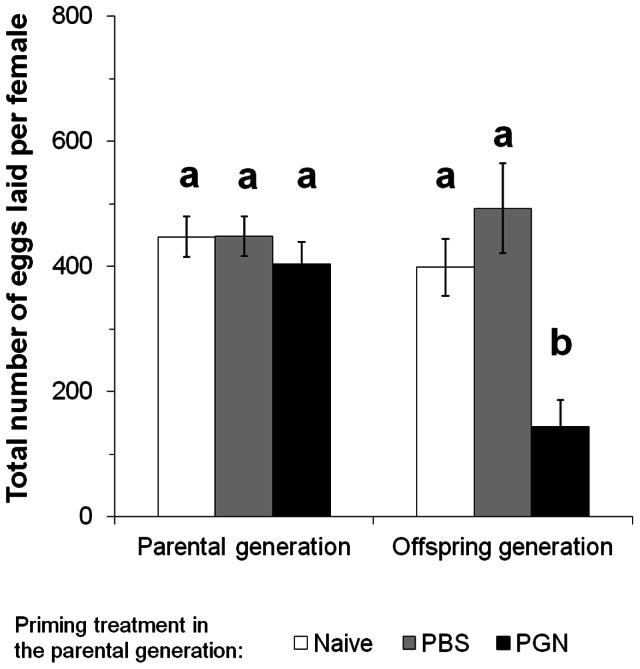
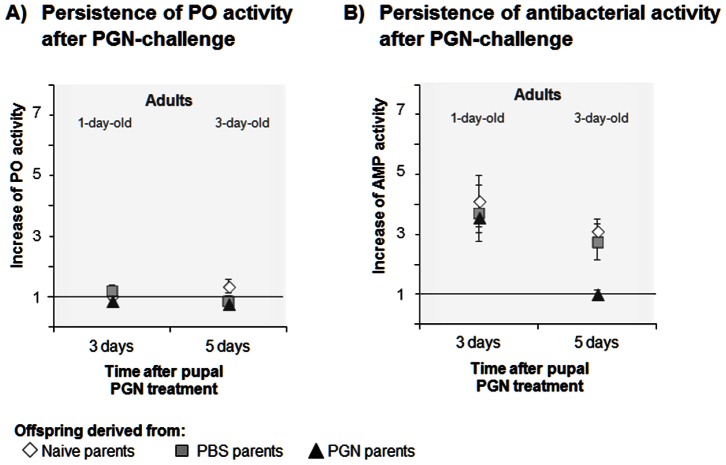
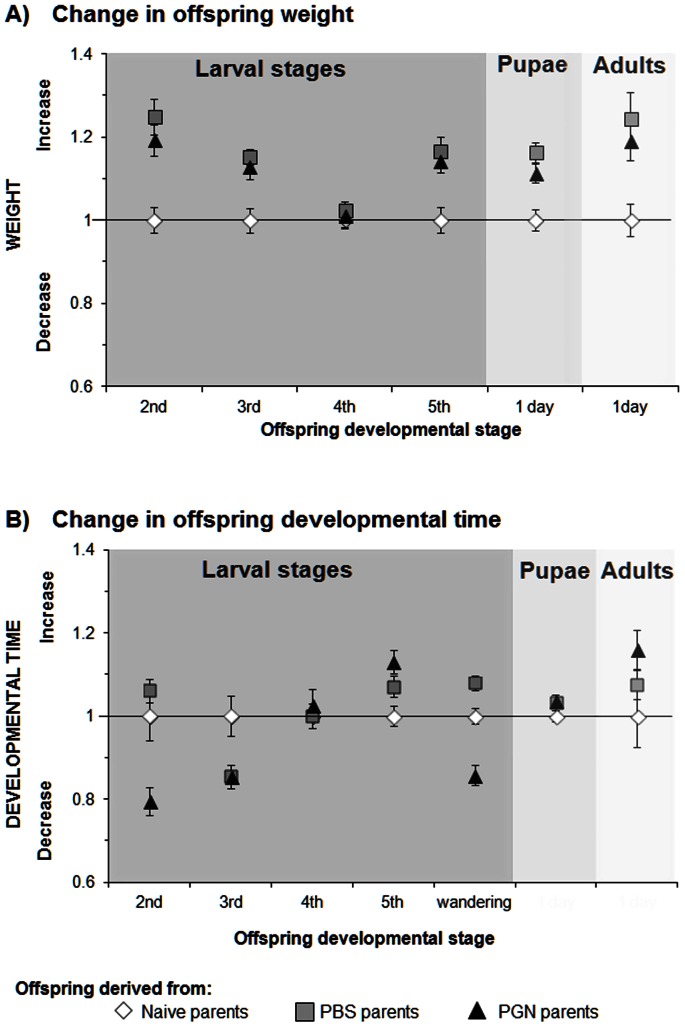
In insects, a parental immune challenge can prepare and enhance offspring immune activity. Previous studies of such transgenerational immune priming (TGIP) mainly focused on a single offspring life stage. However, different developmental stages may be exposed to different risks and show different susceptibility to parental immune priming. Here we addressed the question (i) whether TGIP effects on the immunity of Manduca sexta offspring vary among the different developmental offspring stages. We differentiated between unchallenged and immunochallenged offspring; for the latter type of offspring, we further investigated (ii) whether TGIP has an impact on the time that enhanced immune levels persist after offspring immune challenge. Finally, we determined (iii) whether TGIP effects on offspring performance depend on the offspring stage. Our results show that TGIP effects on phenoloxidase (PO) activity, but not on antibacterial activity, vary among unchallenged offspring stages. In contrast, TGIP effects on PO and antibacterial activity did not vary among immunochallenged offspring stages. The persistence of enhanced immune levels in immunochallenged offspring was dependent on the parental immune state. Antibacterial (but not PO) activity in offspring of immunochallenged parents decreased over five days after pupal immune challenge, whereas no significant change over time was detectable in offspring of control parents. Finally, TGIP effects on the developmental time of unchallenged offspring varied among stages; young larvae of immunochallenged parents developed faster and gained more weight than larvae of control parents. However, offspring females of immunochallenged parents laid fewer eggs than females derived from control parents. These findings suggest that the benefits which the offspring gains from TGIP during juvenile development are paid by the adults with reduced reproductive power. Our study shows that TGIP effects vary among offspring stages and depend on the type of immunity (PO or antibacterial activity) as well as the time past offspring immune challenge.
在昆虫中,父母的免疫挑战可以为后代的免疫活动做好准备并增强其活性。以前关于这种跨代免疫启动(TGIP)的研究主要集中在单一的后代生命阶段。然而,不同的发育阶段可能会面临不同的风险,并且对父母免疫启动的敏感性也不同。在这里,我们提出了以下问题:(i)TGIP 对烟青虫后代免疫力的影响是否因不同的后代发育阶段而异;(ii)对于后者类型的后代,我们进一步研究了 TGIP 是否会影响增强的免疫水平在后代免疫挑战后持续的时间;(iii)TGIP 对后代表现的影响是否取决于后代阶段。我们的研究结果表明,TGIP 对酚氧化酶(PO)活性的影响,但对抗菌活性的影响,在未受挑战的后代阶段之间存在差异。相比之下,TGIP 对 PO 和抗菌活性的影响在免疫挑战的后代阶段之间没有差异。免疫挑战的后代中增强的免疫水平的持续时间取决于亲代的免疫状态。免疫挑战的亲代后代的抗菌(但不是 PO)活性在蛹期免疫挑战后五天内下降,而在对照亲代的后代中没有检测到随时间的显著变化。最后,TGIP 对未受挑战的后代发育时间的影响因阶段而异;免疫挑战的亲代的幼幼虫比对照亲代的幼虫发育更快,体重增加更多。然而,免疫挑战的亲代后代的雌性产卵量比对照亲代的雌性产卵量少。这些发现表明,后代在幼年发育期间从 TGIP 中获得的益处是以成年的生殖能力降低为代价的。我们的研究表明,TGIP 对后代阶段的影响因阶段而异,并且取决于免疫类型(PO 或抗菌活性)以及后代免疫挑战过去的时间。