BMC Infect Dis. 2013 May 27;13:243. doi: 10.1186/1471-2334-13-243.
The distribution of and factors associated with intestinal parasitic infections are poorly defined in high risk vulnerable populations such as urban slums in tropical sub-Saharan Africa.
In a cross sectional study, children aged 5 years and below who presented with diarrhoea were recruited from selected outpatient clinics in Mukuru informal settlement, and from Mbagathi District hospital, Nairobi, over a period of two years (2010-2011). Stool samples were examined for the presence of parasites using direct, formal-ether concentration method and the Modified Ziehl Neelsen staining technique.
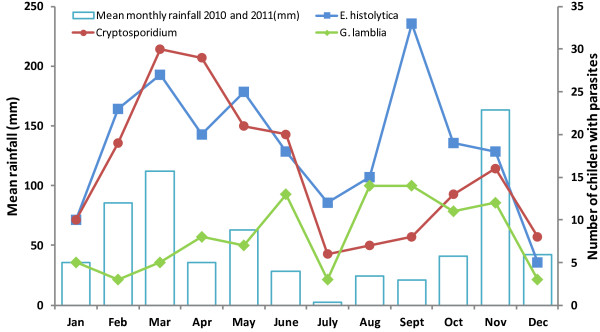
Overall, 541/2112 (25.6%) were positive for at least one intestinal parasite, with the common parasites being; Entamoeba histolytica, 225 (36.7%),Cryptosporidium spp. 187, (30.5%), Giardia lamblia, 98 (16%).The prevalence of intestinal parasites infection was higher among children from outpatient clinics 432/1577(27.4%) than among those admitted in hospital 109/535 (20.1%) p < 0.001. Infections with E. histolytica, and G. lamblia were higher among outpatients than inpatients (13.8% vs 1.3% p < 0.001 and 5.8% vs 1.3% p < 0.049) respectively, while infection with Cryptosporidium spp. was higher among inpatients than outpatients (15.3% vs 6.7%) respectively p < 0.001. Other parasites isolated among outpatients included Isospora belli, 19 (1.2%), Ascaris lumbricoides, 26 (1.6%), and Hymenolepis nana 12 (0.8%), with the remainder detected in less than ten samples each. HIV-infected participants were more likely to be infected with any parasite than uninfected participants, Adjusted Odds Ratio (AOR), 2.04, 95% CI, 1.55-2.67, p < 0.001), and with Cryptosporidium spp. (AOR, 2.96, 95% CI 2.07-4.21, p < 0.001).The inpatients were less likely to be infected with E. histolytica than outpatients (AOR, 0.11, 95% CI, 0.51-0.24, p < 0.001), but more likely for inpatients to be infected with Cryptosporidium spp. than outpatients (AOR, 1.91, 95% CI, 1.33-2.73, p < 0.001). Mixed parasitic infections were seen in 65 (12.0%) of the 541 infected stool samples.
Intestinal parasitic infections are common in urban informal settlements' environment. Routine examinations of stool samples and treatment could benefit both the HIV infected and uninfected children in outpatient and inpatient settings.
在热带撒哈拉以南非洲的城市贫民窟等高危弱势群体中,肠道寄生虫感染的分布和相关因素尚不清楚。
在一项横断面研究中,我们在两年(2010-2011 年)期间,从内罗毕 Mukuru 非正规住区的选定门诊诊所和 Mbagathi 区医院招募了 5 岁及以下患有腹泻的儿童。使用直接、乙醚浓缩法和改良齐尔-尼尔森染色技术检查粪便样本中寄生虫的存在。
总体而言,541/2112(25.6%)例至少有一种肠道寄生虫呈阳性,常见寄生虫为:溶组织内阿米巴,225 例(36.7%),隐孢子虫属,187 例(30.5%),蓝氏贾第鞭毛虫,98 例(16%)。门诊患儿肠道寄生虫感染率(432/1577,27.4%)高于住院患儿(109/535,20.1%),p<0.001。门诊患儿溶组织内阿米巴和蓝氏贾第鞭毛虫感染率高于住院患儿(13.8% vs 1.3%,p<0.001 和 5.8% vs 1.3%,p<0.049),而隐孢子虫属感染率在住院患儿中更高(15.3% vs 6.7%),p<0.001。门诊患儿还分离出其他寄生虫,包括等孢球虫,19 例(1.2%),蛔虫,26 例(1.6%)和微小膜壳绦虫,12 例(0.8%),其余每种寄生虫的检出例数均少于 10 例。与未感染的参与者相比,感染 HIV 的参与者更有可能感染任何寄生虫,调整后的优势比(AOR)为 2.04,95%置信区间(CI)为 1.55-2.67,p<0.001),并且更有可能感染隐孢子虫属(AOR,2.96,95%CI 2.07-4.21,p<0.001)。与门诊患儿相比,住院患儿感染溶组织内阿米巴的可能性较低(AOR,0.11,95%CI,0.51-0.24,p<0.001),但住院患儿感染隐孢子虫属的可能性更高(AOR,1.91,95%CI,1.33-2.73,p<0.001)。在 541 例受感染的粪便样本中,有 65 例(12.0%)存在混合寄生虫感染。
肠道寄生虫感染在城市非正规住区环境中很常见。对粪便样本进行常规检查和治疗可能使门诊和住院的 HIV 感染和未感染儿童受益。