Shimelis Techalew, Tassachew Yayehyirad, Lambiyo Tariku
Department of Medical Laboratory Science, Hawassa University, P. O. Box 1560, Hawassa, Ethiopia.
Parasit Vectors. 2016 May 10;9(1):270. doi: 10.1186/s13071-016-1554-x.
Intestinal parasitic infections are known to cause gastroenteritis, leading to higher morbidity and mortality, particularly in people living with HIV/AIDS. This study aimed to determine the prevalence of Cryptosporidium and other intestinal parasitic infections among HIV patients receiving care at a hospital in Ethiopia where previous available baseline data helps assess if improved HIV-related care has reduced infection rates.
A cross-sectional study was conducted at Hawassa University Hospital in southern Ethiopia from May, 2013 to March, 2014. A consecutive sample of 491 HIV- infected patients with diarrhea or a CD4 T cell count < 200 cells/μl were prospectively studied. A single stool sample was collected from each study participant and processed using direct, formol-ether concentration, and modified Ziehl-Neelsen techniques for the diagnosis of Cryptosporidium and other intestinal parasites. The study was approved by the Institutional Review Board of the College of Medicine and Health Sciences, Hawassa University. Physicians managed participants found to be infected with any pathogenic intestinal parasite.
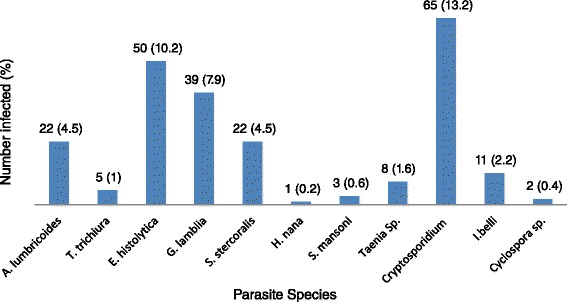
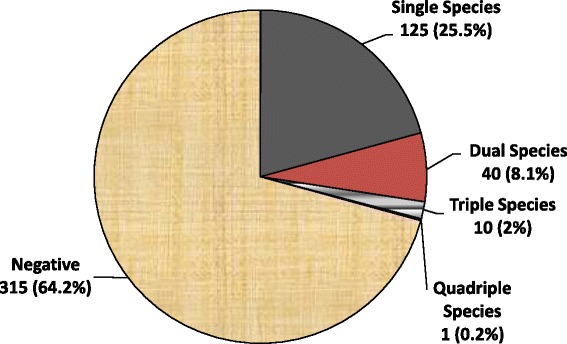
The overall prevalence of intestinal parasitic infections among the study population was 35.8 %. The most prevalent parasites were Cryptosporidium (13.2 %), followed by Entamoeba histolytica/dispar (10.2 %), and Giardia lamblia (7.9 %). The rate of single and multiple infections were 25.5 and 10.3 %, respectively. Patients with a CD4 T cell count < 200 cells/μl had a similar rate of any intestinal parasitic infection or cryptosporidiosis compared to those with counts ≥ 200 cells/μl, but with some type of diarrhea.
The study shows high prevalence of intestinal parasitic infections in the study population. However, the results in the current report are significantly lower compared to previous findings in the same hospital. The observed lower infection rate is encouraging and supports the need to strengthen and sustain the existing intervention measures in order to further reduce intestinal parasitic infections in people living with HIV/AIDS.
肠道寄生虫感染已知会导致肠胃炎,进而导致更高的发病率和死亡率,尤其是在艾滋病毒/艾滋病患者中。本研究旨在确定在埃塞俄比亚一家医院接受治疗的艾滋病毒患者中隐孢子虫及其他肠道寄生虫感染的患病率,此前可获得的基线数据有助于评估改善的艾滋病毒相关护理是否降低了感染率。
2013年5月至2014年3月在埃塞俄比亚南部的哈瓦萨大学医院进行了一项横断面研究。对491例腹泻或CD4 T细胞计数<200个细胞/微升的艾滋病毒感染患者进行了连续抽样前瞻性研究。从每个研究参与者收集一份粪便样本,并使用直接涂片法、甲醛乙醚浓缩法和改良齐-尼氏染色技术进行处理,以诊断隐孢子虫和其他肠道寄生虫。该研究获得了哈瓦萨大学医学与健康科学学院机构审查委员会的批准。医生对被发现感染任何致病性肠道寄生虫的参与者进行治疗。
研究人群中肠道寄生虫感染的总体患病率为35.8%。最常见的寄生虫是隐孢子虫(13.2%),其次是溶组织内阿米巴/迪氏内阿米巴(10.2%)和蓝氏贾第鞭毛虫(7.9%)。单一感染率和多重感染率分别为25.5%和10.3%。CD4 T细胞计数<200个细胞/微升的患者与计数≥200个细胞/微升但有某种腹泻的患者相比,任何肠道寄生虫感染或隐孢子虫病的发生率相似。
该研究表明研究人群中肠道寄生虫感染的患病率很高。然而,与同一家医院之前的研究结果相比,本报告中的结果显著更低。观察到的较低感染率令人鼓舞,并支持加强和维持现有干预措施以进一步降低艾滋病毒/艾滋病患者肠道寄生虫感染的必要性。