Peltonen Jussi, Cronin Neil J, Stenroth Lauri, Finni Taija, Avela Janne
Department of Biology of Physical Activity, Neuromuscular Research Center, University of Jyväskylä, Jyväskylä, Finland.
Springerplus. 2013 May 8;2(1):212. doi: 10.1186/2193-1801-2-212. Print 2013 Dec.
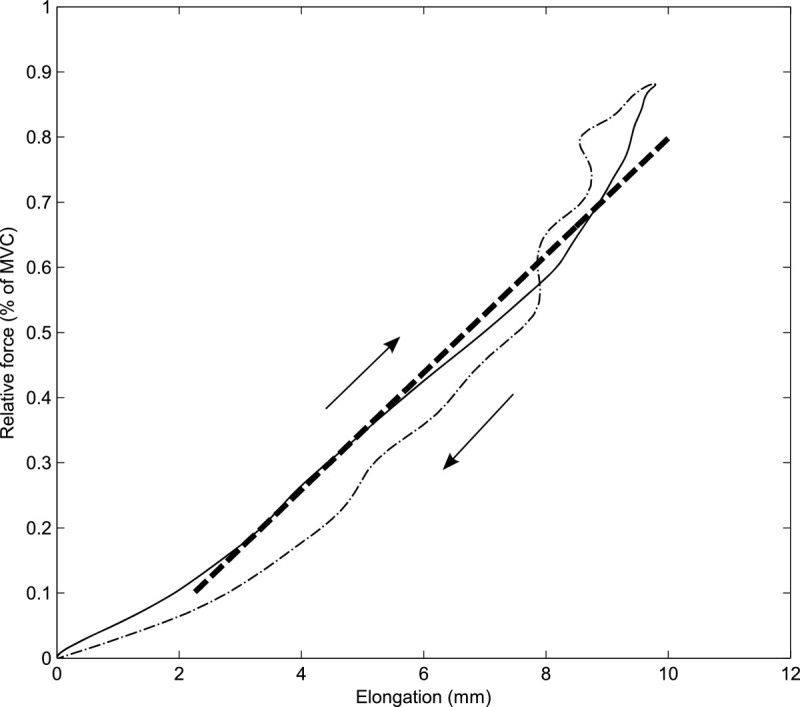
It has been postulated that human tendons are viscoelastic and their mechanical properties time-dependent. Although Achilles tendon (AT) mechanics are widely reported, there is no consensus about AT viscoelastic properties such as loading rate dependency or hysteresis, in vivo. AT force-elongation characteristics were determined from 14 subjects in an ankle dynamometer at different loading rates using motion capture assisted ultrasonography. AT stiffness and elongation were determined between 10 - 80% of maximum voluntary contraction (MVC) force at fast and slow loading rates. As subjects were unable to consistently match the target unloading rate in the slow condition, AT hysteresis was only calculated for the fast rate. There was a significant difference between the fast and the slow loading rates: 120 ± 6 vs. 21 ± 1% of MVC s(-1) (mean ± standard error), respectively. However, neither stiffness (193 ± 18 N mm(-1) vs. 207 ± 22 N mm(-1)) nor elongation at any force level (13.0 ± 1.2 mm vs. 14.3 ± 0.9 mm at 80% of MVC) were significantly different between the fast and slow loading rates. Tendon hysteresis at the fast rate was 5 ± 2%. As stiffness was not sensitive to loading rate and hysteresis was small, it was concluded that elastic properties prevail over viscous properties in the human AT. The current results support the idea that AT stiffness is independent of loading rate.
据推测,人类肌腱具有粘弹性,其力学性能随时间变化。尽管跟腱(AT)力学已有广泛报道,但对于AT的粘弹性特性,如加载速率依赖性或滞后现象,在体内尚无共识。利用运动捕捉辅助超声检查,在踝关节测力计中对14名受试者在不同加载速率下的AT力-伸长特性进行了测定。在快速和慢速加载速率下,在最大自主收缩(MVC)力的10%-80%之间测定AT的刚度和伸长。由于受试者在慢速条件下无法始终如一地匹配目标卸载速率,因此仅计算了快速速率下的AT滞后。快速和慢速加载速率之间存在显著差异:分别为120±6与21±1%的MVC s(-1)(平均值±标准误差)。然而,快速和慢速加载速率之间的刚度(193±18 N/mm与207±22 N/mm)以及任何力水平下的伸长(在MVC的80%时为13.0±1.2 mm与14.3±0.9 mm)均无显著差异。快速速率下的肌腱滞后为5±2%。由于刚度对加载速率不敏感且滞后较小,得出结论:在人类AT中,弹性特性优于粘性特性。目前的结果支持AT刚度与加载速率无关的观点。