Instituto de Biología Molecular y Celular de Plantas, Universidad Politécnica de Valencia-Consejo Superior de Investigaciones Científicas, Valencia 46022, Spain.
Virol J. 2013 May 28;10:164. doi: 10.1186/1743-422X-10-164.
Microarray profiling is a powerful technique to investigate expression changes of large amounts of genes in response to specific environmental conditions. The majority of the studies investigating gene expression changes in virus-infected plants are limited to interactions between a virus and a model host plant, which usually is Arabidopsis thaliana or Nicotiana benthamiana. In the present work, we performed microarray profiling to explore changes in the expression profile of field-grown Prunus persica (peach) originating from Chile upon single and double infection with Prunus necrotic ringspot virus (PNRSV) and Peach latent mosaic viroid (PLMVd), worldwide natural pathogens of peach trees.
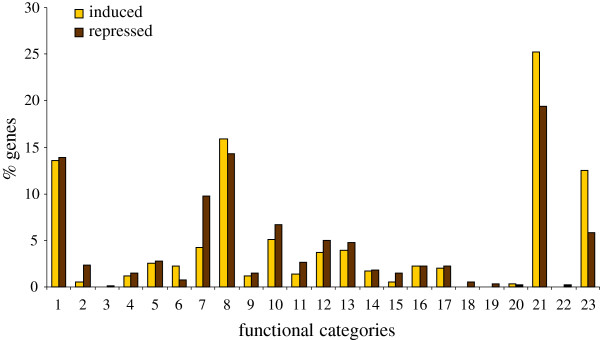
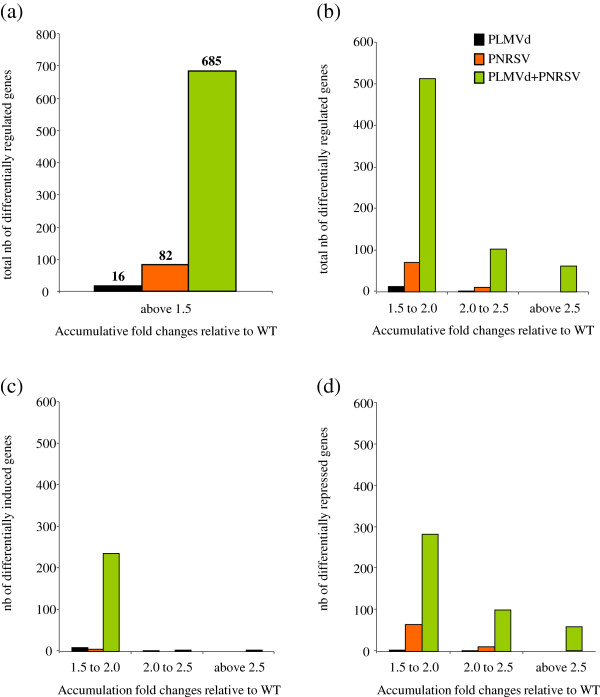
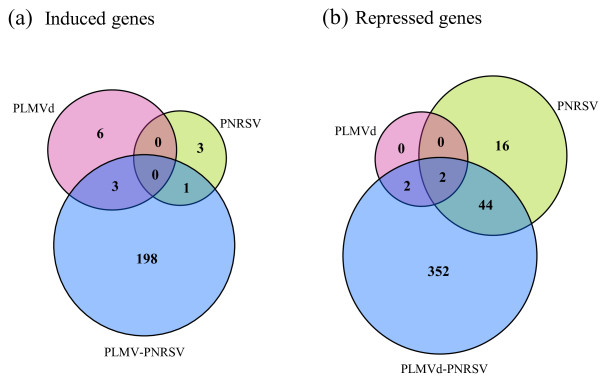
Upon single PLMVd or PNRSV infection, the number of statistically significant gene expression changes was relatively low. By contrast, doubly-infected fruits presented a high number of differentially regulated genes. Among these, down-regulated genes were prevalent. Functional categorization of the gene expression changes upon double PLMVd and PNRSV infection revealed protein modification and degradation as the functional category with the highest percentage of repressed genes whereas induced genes encoded mainly proteins related to phosphate, C-compound and carbohydrate metabolism and also protein modification. Overrepresentation analysis upon double infection with PLMVd and PNRSV revealed specific functional categories over- and underrepresented among the repressed genes indicating active counter-defense mechanisms of the pathogens during infection.
Our results identify a novel synergistic effect of PLMVd and PNRSV on the transcriptome of peach fruits. We demonstrate that mixed infections, which occur frequently in field conditions, result in a more complex transcriptional response than that observed in single infections. Thus, our data demonstrate for the first time that the simultaneous infection of a viroid and a plant virus synergistically affect the host transcriptome in infected peach fruits. These field studies can help to fully understand plant-pathogen interactions and to develop appropriate crop protection strategies.
微阵列分析是一种强大的技术,可以研究大量基因在特定环境条件下的表达变化。大多数研究病毒感染植物的基因表达变化都局限于病毒和模式宿主植物之间的相互作用,而这些宿主植物通常是拟南芥或本氏烟。在本工作中,我们进行了微阵列分析,以探索来自智利的田间生长的桃(桃)在单一和双重感染李坏死环斑病毒(PNRSV)和桃潜隐花叶病毒(PLMVd)后的表达谱变化,PLMVd 和 PNRSV 是桃树上的世界性天然病原体。
单独感染 PLMVd 或 PNRSV 时,统计上显著的基因表达变化数量相对较少。相比之下,双重感染的果实呈现出大量差异调节基因。其中,下调基因居多。对双重 PLMVd 和 PNRSV 感染后的基因表达变化进行功能分类,发现蛋白质修饰和降解是受抑制基因比例最高的功能类别,而诱导基因主要编码与磷酸盐、C 化合物和碳水化合物代谢以及蛋白质修饰相关的蛋白质。对双重感染 PLMVd 和 PNRSV 的过表达分析显示,受抑制基因中特定的功能类别存在过表达和低表达,表明病原体在感染过程中存在主动的反向防御机制。
我们的研究结果确定了 PLMVd 和 PNRSV 对桃果实转录组的协同作用。我们证明,在田间条件下经常发生的混合感染导致的转录反应比单一感染更复杂。因此,我们的数据首次表明,类病毒和植物病毒的同时感染协同影响感染桃果实中的宿主转录组。这些田间研究有助于全面了解植物-病原体相互作用,并制定适当的作物保护策略。