Institut des Sciences de l'Evolution, UMR 5554 CNRS, Universite Montpellier II, France.
Genome Biol Evol. 2013;5(7):1273-90. doi: 10.1093/gbe/evt083.
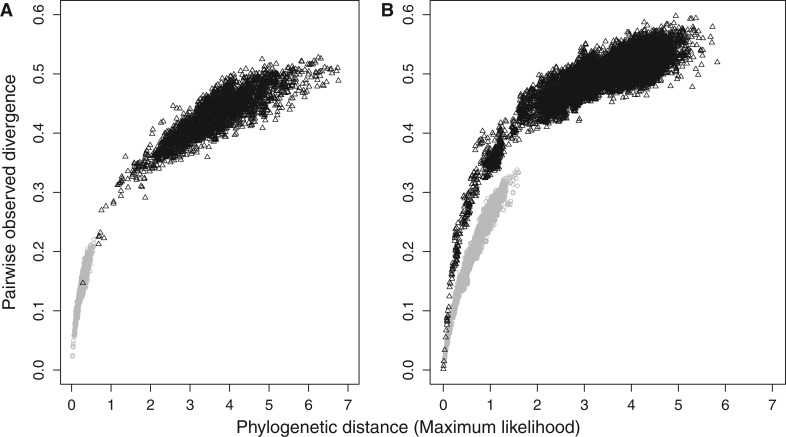
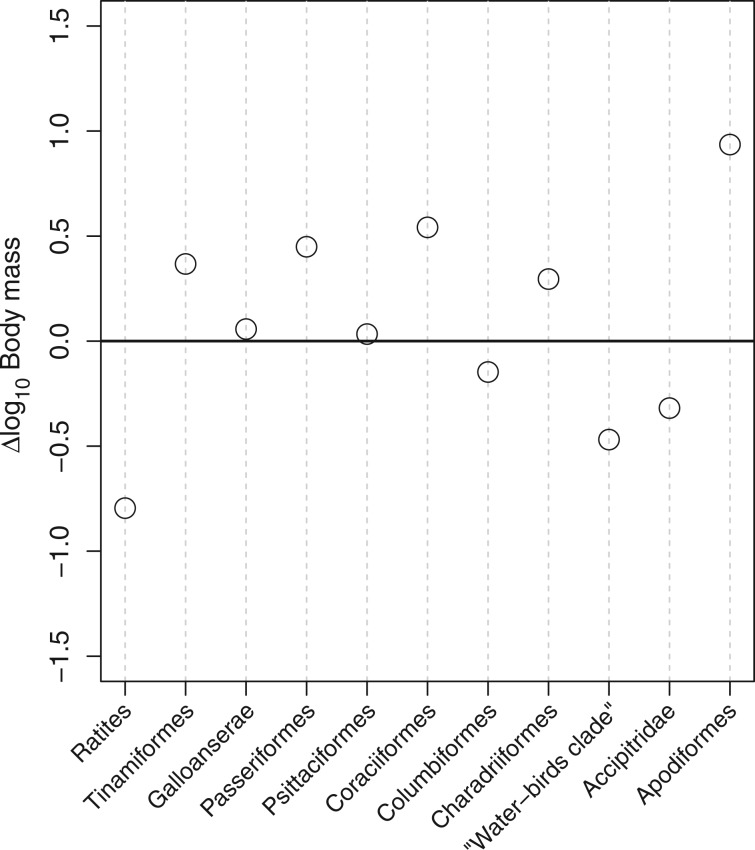
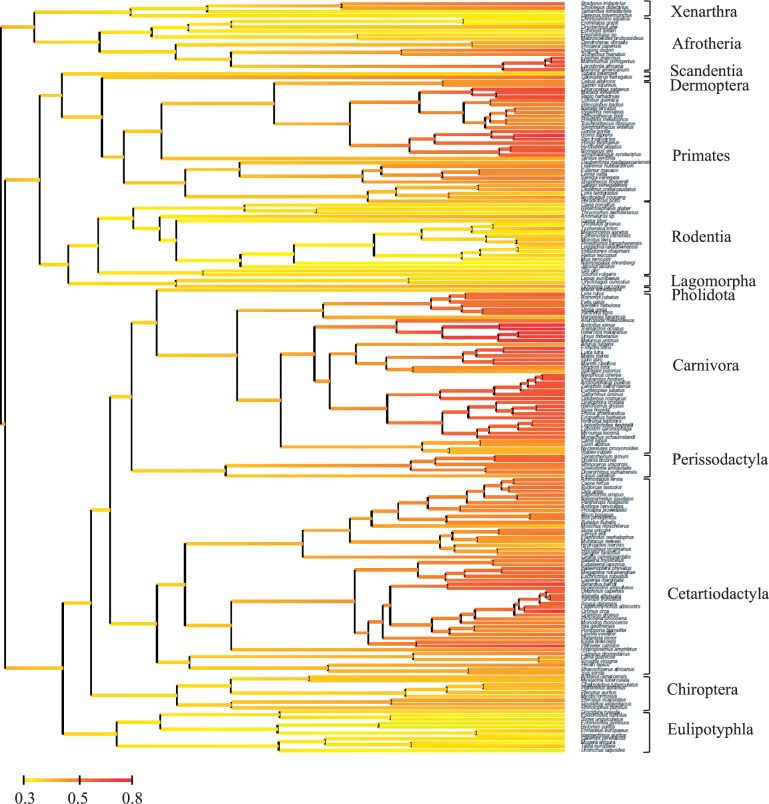
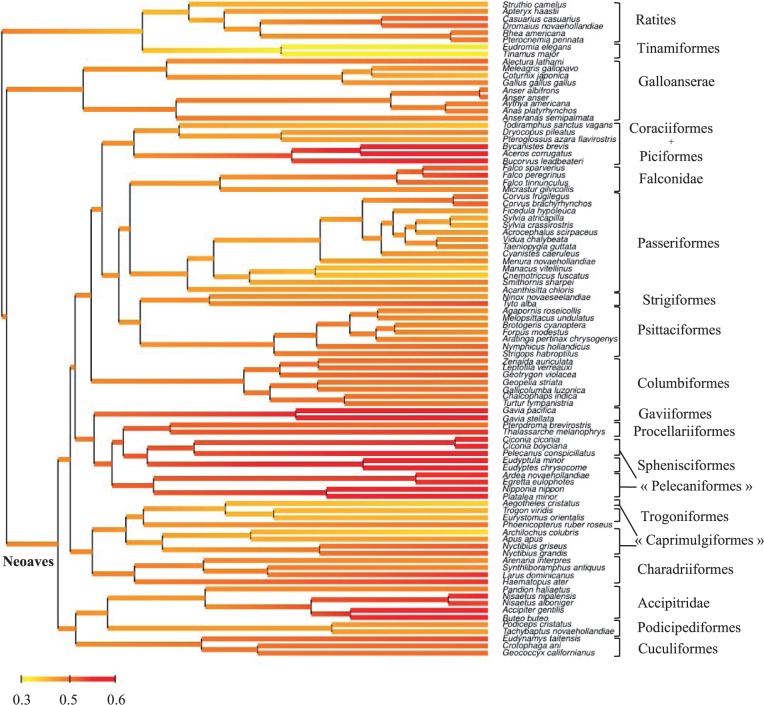
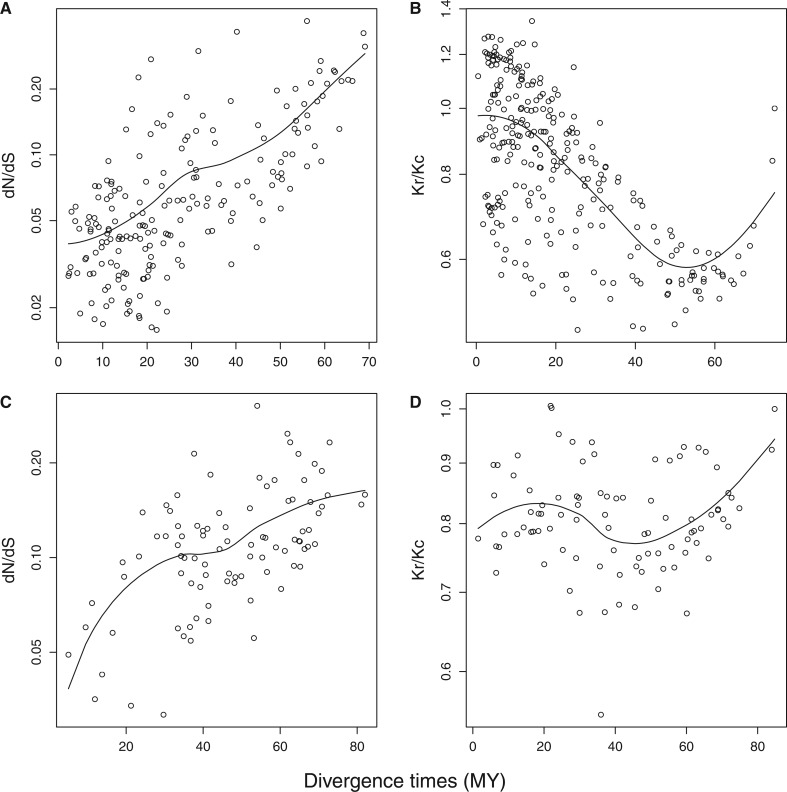
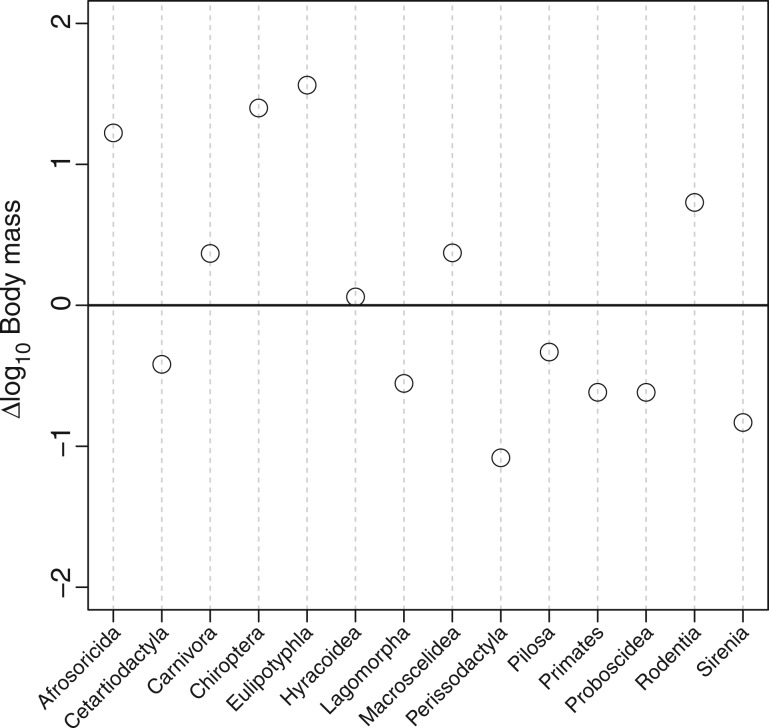
The nearly neutral theory, which proposes that most mutations are deleterious or close to neutral, predicts that the ratio of nonsynonymous over synonymous substitution rates (dN/dS), and potentially also the ratio of radical over conservative amino acid replacement rates (Kr/Kc), are negatively correlated with effective population size. Previous empirical tests, using life-history traits (LHT) such as body-size or generation-time as proxies for population size, have been consistent with these predictions. This suggests that large-scale phylogenetic reconstructions of dN/dS or Kr/Kc might reveal interesting macroevolutionary patterns in the variation in effective population size among lineages. In this work, we further develop an integrative probabilistic framework for phylogenetic covariance analysis introduced previously, so as to estimate the correlation patterns between dN/dS, Kr/Kc, and three LHT, in mitochondrial genomes of birds and mammals. Kr/Kc displays stronger and more stable correlations with LHT than does dN/dS, which we interpret as a greater robustness of Kr/Kc, compared with dN/dS, the latter being confounded by the high saturation of the synonymous substitution rate in mitochondrial genomes. The correlation of Kr/Kc with LHT was robust when controlling for the potentially confounding effects of nucleotide compositional variation between taxa. The positive correlation of the mitochondrial Kr/Kc with LHT is compatible with previous reports, and with a nearly neutral interpretation, although alternative explanations are also possible. The Kr/Kc model was finally used for reconstructing life-history evolution in birds and mammals. This analysis suggests a fairly large-bodied ancestor in both groups. In birds, life-history evolution seems to have occurred mainly through size reduction in Neoavian birds, whereas in placental mammals, body mass evolution shows disparate trends across subclades. Altogether, our work represents a further step toward a more comprehensive phylogenetic reconstruction of the evolution of life-history and of the population-genetics environment.
近中性理论提出,大多数突变是有害的或接近中性的,该理论预测非同义替换与同义替换的比率(dN/dS),以及潜在的激进与保守氨基酸替换的比率(Kr/Kc),与有效种群大小呈负相关。以前使用生命史特征(LHT),如体型或世代时间作为种群大小的替代物的经验测试,与这些预测一致。这表明,对 dN/dS 或 Kr/Kc 的大规模系统发育重建可能会揭示谱系间有效种群大小变化的有趣的宏观进化模式。在这项工作中,我们进一步开发了以前引入的系统发育协方差分析的综合概率框架,以便估计鸟类和哺乳动物线粒体基因组中 dN/dS、Kr/Kc 与三个 LHT 之间的相关模式。与 dN/dS 相比,Kr/Kc 与 LHT 的相关性更强且更稳定,我们将其解释为 Kr/Kc 比 dN/dS 更稳健,后者受到线粒体基因组中同义替换率高度饱和的影响。当控制分类群之间核苷酸组成变异的潜在混杂效应时,Kr/Kc 与 LHT 的相关性是稳健的。线粒体 Kr/Kc 与 LHT 的正相关与以前的报道以及近乎中性的解释是一致的,尽管也可能存在其他解释。最后,使用 Kr/Kc 模型重建鸟类和哺乳动物的生命史进化。这项分析表明,这两个群体的祖先体型相当大。在鸟类中,生命史进化似乎主要通过新鸟类的体型缩小来发生,而在胎盘哺乳动物中,身体质量的进化在亚群中呈现出不同的趋势。总的来说,我们的工作代表着朝着更全面的系统发育重建生命史和种群遗传学环境的方向迈出了进一步的一步。