Section of Neurobiology, The University of Texas at Austin, Austin, TX 78712, USA.
J Gen Physiol. 2013 Jun;141(6):737-46. doi: 10.1085/jgp.201310988.
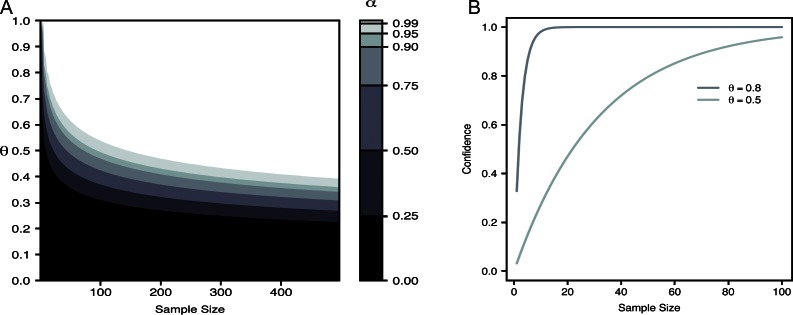
Single molecule photobleaching is a powerful tool for determining the stoichiometry of protein complexes. By attaching fluorophores to proteins of interest, the number of associated subunits in a complex can be deduced by imaging single molecules and counting fluorophore photobleaching steps. Because some bleaching steps might be unobserved, the ensemble of steps will be binomially distributed. In this work, it is shown that inferring the true composition of a complex from such data is nontrivial because binomially distributed observations present an ill-posed inference problem. That is, a unique and optimal estimate of the relevant parameters cannot be extracted from the observations. Because of this, a method has not been firmly established to quantify confidence when using this technique. This paper presents a general inference model for interpreting such data and provides methods for accurately estimating parameter confidence. The formalization and methods presented here provide a rigorous analytical basis for this pervasive experimental tool.
单分子光漂白是一种强大的工具,可用于确定蛋白质复合物的化学计量。通过将荧光团附着到感兴趣的蛋白质上,可以通过成像单个分子并计算荧光漂白步骤来推断复合物中相关亚基的数量。由于一些漂白步骤可能未被观察到,因此步骤的总和将呈二项式分布。在这项工作中,表明从这些数据中推断复合物的真实组成并非易事,因为二项式分布的观察结果提出了一个不适定的推断问题。也就是说,无法从观察结果中提取出相关参数的唯一和最优估计值。由于这个原因,在使用该技术时,尚未建立一种可靠的方法来量化置信度。本文提出了一种用于解释此类数据的通用推断模型,并提供了准确估计参数置信度的方法。这里提出的形式化和方法为这种普遍的实验工具提供了严格的分析基础。